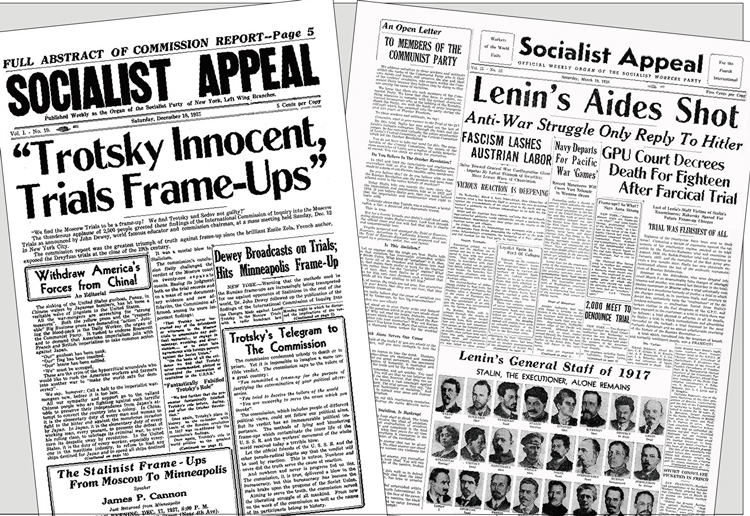
The Case of Leon Trotsky is one of Pathfinder’s Books of the Month for August. It contains Trotsky’s testimony before the 1937 Dewey Commission investigating frame-up charges made against him in the infamous Moscow Trials. Central leaders of the 1917 Russian Revolution were sentenced to death at these trials in the late 1930s, after the Joseph Stalin regime consolidated its counterrevolution in the Soviet Union. Trotsky, in exile and one of the chief defendants, explained how he led the fight to continue Lenin’s revolutionary internationalist course. John Dewey, a well-known Columbia philosophy professor, chaired the commission. The excerpts are from the second and ninth sessions. Copyright © 1965. Reprinted by permission of Pathfinder Press.
QUESTION: Were there in the Central Committee, or in the Communist International, differences over the question of the differentiation of bureaucracy and administration in the proletarian dictatorship? Was the danger of Bonapartism foreseen, and what position did you take on these questions?
LEON TROTSKY: These questions played the greatest role in the discussions in the Central Committee, and in personal discussions between Lenin and myself. Lenin had the finest sensitivity on this question, and he was the teacher of the future Left Opposition. He affirmed many times that the greatest danger for us was that we, as a backward country, isolated — that we could see our state, the proletarian state, degenerate into a bureaucratic, Bonapartist state.
He proposed certain organizational measures, as, for example, his Control Commission of genuine workers from the shops, in order to control the bureaucrats and show the bureaucrats that they are only transitory workers of the state. I want to say that the Control Commission itself degenerated and became a worse instrument in the proletarian dictatorship.
Lenin understood, however, that it was impossible to preserve the Soviet dictatorship only by organizational measures. It depended upon the world situation, the historic factors in the world arena. If the German proletariat, the most developed in Europe, if it had accomplished a victorious revolution — and we hope that it will do so yet — the combination of the Soviet state with the proletarian German state would have given us the possibility to avoid the degeneration of the Soviet state in Russia. Our isolation was the most important factor in our degeneration. …
[W]e did what we could to avoid the degeneration. During the Civil War the militarization of the Soviets and the Party was almost inevitable. But even during the Civil War I myself tried in the army — even in the army on the field — to give a full possibility to the Communists to discuss all the military measures. I discussed these measures even with the soldiers and, as I explained in my autobiography, even with the deserters. After the Civil War was finished, we hoped that the possibility for democracy would be greater. But two factors, two different but connected factors, hindered the development of Soviet democracy. The first general factor was the backwardness and misery of the country. From that basis emanated the bureaucracy, and the bureaucracy did not wish to be abolished, to be annihilated.
The bureaucracy became an independent factor. Then the fight became to a certain degree a struggle of classes. That was the beginning of the Opposition. For a certain time the question was an internal question in the Central Committee. We discussed by what means we should begin the fight on the degeneration and the bureaucratization of the state. Then it became not a question of discussions in the Central Committee, but a question of the fight, the struggle between the Opposition and the bureaucracy. …
In 1926, the struggle was very acute. … But then came the Chinese Revolution. The attitude of the Stalinists in the Chinese Revolution was as dangerous as now in Spain. It was in 1927, in October, when the Central Committee, behind our backs, sent a telegram … to the Chinese Central Committee to stop the agrarian movement because it was the time of an alliance between Stalin and Chiang Kai-Shek.
Trotsky’s attorney Albert Goldman: You mean the Central Committee of the Chinese Communist Party?
TROTSKY: The Central Committee of the Chinese Communist Party — to stop the agrarian movement because the Generals and officers of the National Armies were in their majority landlords and rich farmers. The agrarian movement of the poorer peasants, which was the genuine Chinese revolutionary movement, was dangerous to the higher stratum of the officers. Stalin was afraid to lose his alliance, as now with France. He sent a cable. He has assured the French bourgeoisie not to be afraid of a revolutionary policy in Spain. He reflects the French bourgeoisie. The same thing in China. Then the struggle became very acute for many months on the basis of our differences concerning the Chinese revolution. …
We considered the Soviet Union as a part of the world revolutionary movement of the working class. We considered it our duty to take every measure which could save and preserve the Soviet Union. We considered that the revolutionary movement in every country — that its success would best guarantee the stability of the Soviet Union. We never tried to submit the revolutionary movement in any country to the specific interests of the Soviet Union, because such a submission signifies the weakening of the workers’ movement in that country — in all countries. … [This] coincided totally with the independent revolutionary development of the proletariat across the world. …
We regarded ourselves, in spite of our expulsion, as part of the Party and part of the Communist International. …
GOLDMAN: I believe you told us before, your attitude on this matter changed after Hitler took power.
TROTSKY: Then we declared that the historical event was the defeat of the German proletariat. We said, “By the attitude of Stalin’s Politburo and the C.I., they are a hindrance to the understanding of the lessons of this defeat. We cannot wait for a long time for historical miracles. The Comintern as a revolutionary organization is dead. We must create a new organization.”