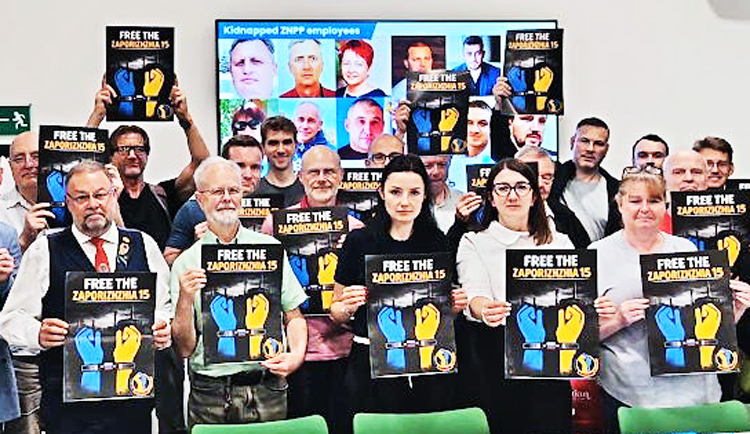
On Sept. 16, the Trades Union Congress in the United Kingdom voted overwhelmingly for a motion to build solidarity with Ukrainian workers and unions in their resistance to Moscow’s “murderous war against the Ukrainian people.” In particular, the motion condemned “the detention and abuse of workers at the Zaporizhzhia nuclear power plant in Ukraine by Russian occupation forces.”
Fifteen members of the Nuclear Energy and Industry Workers’ Union of Ukraine — Atomprofspilka — “have been abducted, subjected to show trials, and sentenced to prison terms of up to 25 years on fabricated charges. They’re held in inhuman conditions,” the Trades Union Congress motion said, demanding their release.
The resolution was moved by Chris Kitchen, general secretary of the National Union of Mineworkers. The Ukrainian labor movement — the Confederation of Free Trade Unions of Ukraine (KVPU) and the Federation of Trade Unions of Ukraine (FPU) — had directly appealed to the TUC, calling for trade union action to defend Ukrainian workers. The NUM has long-standing relations with the KVPU and the Independent Trade Union of Miners of Ukraine, which arose out of mass miners strikes in 1989 and 1990. This was part of the fight for Ukrainian independence from Russia, won in August 1991.
One of Moscow’s key goals in its Feb. 24, 2022, invasion was to seize control of both Europe’s largest nuclear power plant in Enerhodar, in the Zaporizhzhia Oblast, and the nuclear facility in Chernobyl, near the Belarus border. Residents in Enerhodar built barricades and thousands formed a human shield on the road leading into the facility to try to block the takeover. But Russian troops opened fire on them and stormed the plant.
To avoid a disaster, all six reactors at the plant were placed in cold shutdown by its Ukrainian operators, leaving it to generate only essential operations, especially its own power and cooling systems necessary for safe maintenance. Today, Russian artillery and drones strike the city of Zaporizhzhia just upriver, putting the nuclear power plant in the middle of a conflict zone and endangering not only its water and power, but also the radioactive waste stored there.
“Of the 11,000 workers who operated the plant before occupation, only 3,000 remain,” the TUC motion says. Occupation authorities have attempted to coerce operators into “accepting Russian citizenship,” noting “at least 1,000 workers have endured psychological abuse and torture.”
Ukraine unionists build support
Leading up to the TUC conference, Khrystyna Levchenko, a former Atomprofspilka union representative who lived under occupation in Enerhodar for 18 months, and Ivanna Khrapko from the FPU, spoke at an Aug. 27 public meeting in London organized by the Ukraine Solidarity Campaign. Kitchen, who chaired the meeting, explained that before the invasion Ukrainian workers faced the same labor problems from their bosses as workers in the U.K., but “now on top of that, they face the war.”
In June 2014, Militant reporters John Studer and Frank Forrestal were invited to visit the Zaporizhzhia nuclear power plant by the union, where they talked with Ivan Zdravchev, deputy chair of the local, describing their meetings with union leaders in Chernobyl.
Although Ukraine is a large country, Khrapko told the London meeting, the combat zone is a nightmare with small drones hunting people from Zaporizhzhia to Kherson. Workers don’t know if they will make it to their job and back.
Despite the Zaporizhzhia nuclear plant’s seizure, operators still went to work to ensure it was functioning safely, Levchenko said. But there can be “no safe operation of a nuclear power plant under the barrel of a gun.”
The persecution of the nuclear plant workers is part of Moscow’s “war against the Ukrainian people, which has targeted and killed thousands of civilians,” the TUC motion said, “including many trade unionists.” It notes, “Free trade unions in occupied areas have been suppressed.”
The TUC reaffirmed its “support for Ukraine’s fight for self-determination” and applauded “the resistance of the Ukrainian people.”