
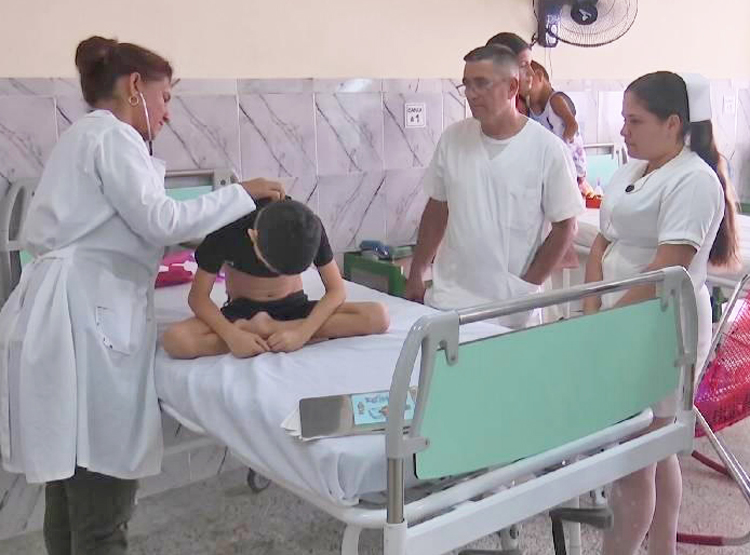
Over the last three decades, Global Health Partners has sent some $280 million in vitally needed medical aid and equipment to Cuba to alleviate the impact of Washington’s brutal economic, trade and financial embargo on the country’s health system. This year alone, they have provided more than $4 million in medical aid to Cuban hospitals, including syringes, sutures and pacemakers.
The Militant met with Bob Schwartz, its executive director, Sept. 17 to get an update on their current Neonatal and Maternal Healthcare Initiative.
Schwartz outlined the organization’s work to aid Cuba’s Ministry of Health to combat the infant mortality rate that doubled between 2018 and 2025 with the tightening of the U.S. blockade. Infant mortality serves as a barometer for any country’s overall health and access to healthcare services.
Before the 1959 revolution, Cuba’s infant mortality was over 70 deaths in the first year of life per 1,000 live births. By 1960, the rate dropped nearly in half, despite the flight of the majority of the doctors in Cuba after the revolution.
This was an “early commitment and crowning achievement of the Cuban Revolution, along with literacy, and is widely recognized as such around the world,” Schwartz said. By 2012 infant mortality had dropped to 4.8 per 1,000 live births.
But today the U.S. blockade is having a punishing effect on every aspect of life in Cuba, with an especially harsh toll on the public health system.
“The infant mortality rate is already over 10 per 1,000 live births this year and it will keep increasing. They have no equipment, no medications for treatments, and malnutrition is becoming a big issue,” Schwartz said. “There’s a big increase in low birth weight infants who need special care — largely related to the mother’s nutritional status. Anemia has become a significant issue in newborns as the public health system is unable to buy prenatal vitamins with iron and folic acid for pregnant women.”
“Walk into a pediatric intensive care unit. There is nothing there. No medications,” he said. “They may have taken the parts from three incubators to have one that works. If there is a ventilator, it could stop working anytime there’s a power outage.”
The direct connection between conditions in hospitals in Cuba and Washington’s blockade is deliberately never made in the capitalist media.
“When people hear babies are dying because of the U.S. government’s actions it has an impact,” said Schwartz, underlining the need to get out the truth about the effects of the U.S. blockade.
Schwartz pointed to the successful press conference organized by the National Nurses Union with Global Health Partners in Washington, D.C., June 30 calling on the U.S. government to end the blockade. It involved “people I couldn’t have reached. I’d like to get other unions involved in the initiative.
“We work with the Ministry of Health. They know the priorities and have the ability to distribute supplies across the island,” he said.
The group plans to put added emphasis on improving mothers’ health. Well-nourished women who receive proper vitamins and care during pregnancy tend to deliver healthier babies, decreasing the number of newborns with low birth weights, anemia or undiagnosed problems requiring resuscitation or special care at birth.
Schwartz noted that malnutrition especially affects Cubans who don’t get remittances from family or friends abroad or who cannot access U.S. dollars. This falls hardest on Afro Cubans and those in more rural areas.
The Cubans “wrote the book on infant and maternal health. They are the model for the world,” Schwartz said. But with U.S. government sanctions they have “no sources for obtaining what they need. They lack tools to function.”
Washington’s sanctions prohibit the sale to Cuba of any technology containing 10% or more of U.S.-origin components. This restriction encompasses the vast majority of modern medical equipment produced globally.
Cuba’s Ministry of Health has asked Global Health Partners for incubators, ventilators and blood pressure monitoring equipment. “It selected two maternity hospitals in Havana for our pilot project. If successful, the goal is to reach out across the country where there are even fewer resources than in Havana,” Schwartz said.
“The Ramón González Coro Maternity Hospital takes care of pregnant women from all 15 provinces with diabetes or heart disease, who have the highest risk of complications with pregnancy. The Diez de Octubre Maternity Hospital also takes high risk mothers and babies.”
Schwartz added, “We will also target nearby primary care clinics to provide specialized training and resources that have been diminished by the emigration of skilled medical personnel. This can lessen the need for emergency care in hospitals to save newborn lives.
“In two weeks we will have procured $60,000 to $80,000 of prenatal vitamins with folic acid. We will use the remainder of the $250,000 we are raising to buy equipment to ship to the two hospitals,” Schwartz said.
To donate money to send medical supplies to Cuba, go to the Global Health Partners website at https://ghpartners.org/cuba-2026.