Cuba workers act to develop their own energy sources
While the U.S. government steadily ratchets up sanctions to bar Cuba from receiving hard currency, oil and other resources, workers on the island are using their creativity and experience to maintain essential services for the population. Among them are thousands of members of the National Union of Energy and Mine Workers (SNTEM), who are waging a daily battle to keep the country’s electrical grid functioning.
Health, transportation, food and water supplies have been severely disrupted with life-threatening effects for millions since the oil blockade imposed by Washington in January had depleted the island’s fuel reserves.
Since last year President Donald Trump’s administration has imposed more than two dozen separate additional sanctions against Cuba. These include barring 40 entities — from foreign companies operating on the island to state-run port, construction and mining companies — further aggravating Cuba’s ability to acquire desperately needed revenue, resources and materials.
“Every time they create a new mechanism in which they try to get out of the noose, we just close it off,” Secretary of State Marco Rubio declared in August, reiterating Washington’s determination to strangle the Cuban economy and crush its people.
German-owned shipper Hapag-Lloyd had begun unloading containers of donated resuscitation kits, colostomy bags and intravenous tubes at the Mariel port June 4, before the latest sanctions took full effect. But they stopped and then took the load and dropped it in Panama.
Spare parts for Cuba’s Antonio Guiteras Thermoelectric Power Plant, Cuba’s largest, were stranded in a Caribbean port after French shipping company CMA CGM suspended delivery following the U.S. government’s executive orders.
Cuba’s power plants have been plagued by deteriorating infrastructure for decades with no major capital investment and vital maintenance deferred as a consequence of Washington’s six-decade-long economic and political war. The immediate cause of today’s blackouts and the recurrent system collapses, however, is the lack of parts and fuel due to the intensified sanctions.
To hide the brutal effects of its oil blockade and other sanctions, Washington tries to blame the outages on “the failure” of the country’s state-run economic system and its control by a “military-run kleptocracy” that it claims enriches itself at the expense of the Cuban people.
The fact is, that in addition to blocking the Cuban government’s access to fuel, the U.S. rulers have virtual control of gasoline and diesel imports to private businesses on the island. Some $96 million in fuel was exported by U.S. companies to Cuba in the first half of this year, a drop in the bucket compared to the country’s needs. Washington said none of it can go to state-owned facilities.
The U.S. rulers aim to force the Cuban government and people to surrender control of the island’s energy, industrial and other resources to U.S. business interests, and reimpose the dog-eat-dog rules of the market system.
In defense of Cuba’s sovereignty
“We Cubans, with our history regarding the United States, have been a beacon of sovereignty all these years doing something seemingly impossible to sustain,” Jesús Echevarría, told Cuban TV in May, after crews at the Guiteras plant where he works had just completed major repairs.
For the last nine months Cuba’s fuel supply has been limited to relatively small domestic crude and gas production, augmented by increasing solar energy during daylight.
Three milestones in these efforts to increase energy output have been highlighted by the Cuban press recently.
A group of technicians completed the installation of the El Algarrobo Solar Park in Guantánamo province in August. It was the first such project to be completed solely by Cuban technicians, after foreign advisers unexpectedly withdrew. After long days of trial and error, the Cuban crew figured out how to synchronize the park with the national grid.
“This is the first in the country to be done without Chinese assistance,” said Rusel Ramos, a 26-year-old engineer, who spearheaded the last stretch of the installation. “This is a victory,” he said proudly. “In addition to being part of something significant, we’re also motivated by knowing the population will have a little more electricity.”
A similar breakthrough was scored in May by workers of Unión Cuba-Petróleo (CUPET), the country’s state-owned oil and gas company. A Cuban crew replaced an electric submersible pump in an oil well in the offshore Varadero oil field in Matanzas, saving the country’s scarce hard currency.
“This had always been done with foreign technical assistance,” said Yodalis Hernández, a CUPET director. And acquiring and installing “the equipment to pump the oil is not easy for Cuba given that we are under siege.”
Last July, the State Department added CUPET’s research and development section to the list of sanctioned entities.
Through these measures, the U.S. government “has long tried to destroy our revolution, the morale of Cubans, our way of doing things,” Leonides Pelegrino, a CUPET technician, told the Cuban press in June. “They never expect the Cuban people’s resistance to be as great as it is.”
The battle to keep factory and farm production going is key for maintaining confidence and working-class participation in political and economic decision-making.
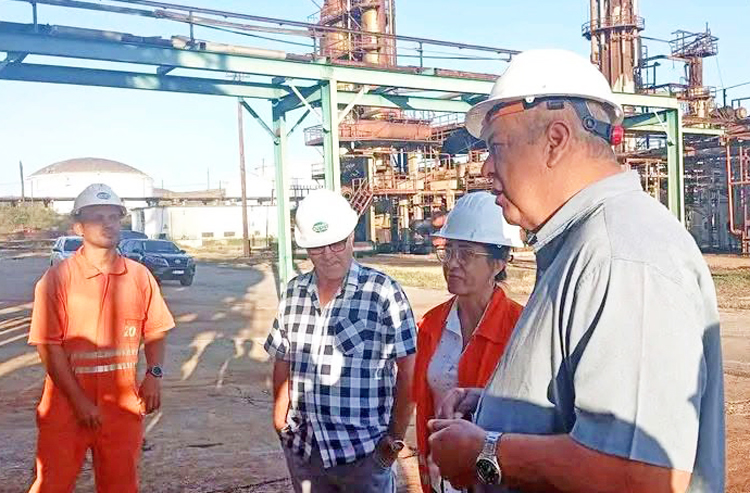
In August, workers at the Hermanos Díaz Oil Refinery in Santiago de Cuba succeeded in developing a process to refine the high-sulfur crude extracted on the island. This is not a small feat, since for decades Cuban crude has been considered unsuitable for conventional refining. While it does not come close to covering the country’s needs, workers at the refinery obtained significant batches of naphtha — a derivative used as a building block for other products and for oil well extraction — as well as fuel oil and diesel. And they are proud of it!