

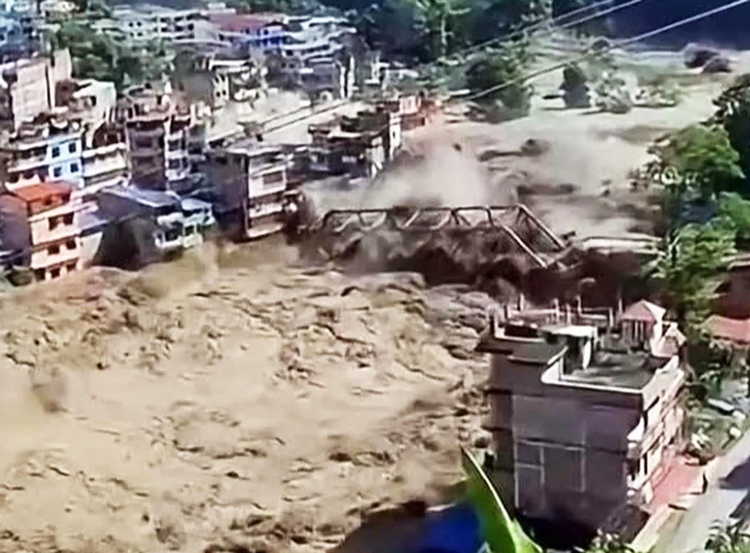
A huge glacial avalanche plummeting around a mile vertically down the Himalayas triggered a fast, towering flood that swept through a major river valley formed by the Lhenda Khola, Bhotekoshi and then the Trishuli rivers between Nepal and Tibet Aug. 26. It pulverized everything in its path, leaving thousands dead. News reports quickly blamed the catastrophe on “climate change,” as did both the Nepalese and Chinese governments.
This was indeed a man-made social catastrophe, but the reason it was so deadly wasn’t “climate change.” It was the destructive character of life under the lash of capitalist exploitation and competition.
In Nepal, more than 1,400 people have been confirmed dead and 6,000 are missing. Towns, farms and roads were washed away or buried under mud and rubble. This includes 900 workers entombed in tunnels when 12 hydropower plants were destroyed.
Up to 100,000 survivors lack food and shelter, including newly orphaned children. In one of the poorest and least developed regions in the world, this is devastating for working people. Many were still recovering from a destructive avalanche and earthquake in 2015.
Nepal’s finance minister estimates the cost of reconstruction could top $5 billion, a tenth of the country’s annual economic output.
In Tibet, the toll was reported as 43 dead and 519 missing. While the damage was less, the extent is unclear because of tight media control by the Chinese government.
As the glacier on Langtang Lirung mountain sheared off and fell into the valley below, it hit with the force of a large earthquake. At first it dammed up the valley, concentrating growing power, until it exploded in a torrent of water, ice, mud and rock that became an inland tsunami.
It obliterated Gyirong Port, a strategic border crossing between Nepal and Tibet, then surged down the narrow Trishuli River corridor.
While the scale of the flood was exceptional, its occurrence was not. Over the past century, dozens of floods have been recorded there, including a major glacier collapse during the 2015 earthquake. Last July a flood washed away the border bridge at Gyirong Port.
Capitalist development vs. nature
Langtang Lirung, like the rest of the Himalayan Mountains, has been slowly rising because of pressure from long-term tectonic movement, where one of the earth’s plates is pushing up against another. As the mountain rises, the glacier gets steeper, and parts fall off. This tectonic movement also triggers earthquakes that dislodge ice and rock. Scientists place the Himalayan Mountains in the highest-risk category for disasters, with seismic pressures capable of producing magnitude 8 earthquakes.
Farmers in the region have a saying, Outside magazine reported, that roughly translates as, “Live in the mountains and farm in the valley floor.” They put their homes and harvest on higher ground, away from the reach of most floods.
Nepalese authorities have failed to take this hazardous natural environment into account in their development of the region. “The people on these mountains understood it was dangerous to live by the river,” Kunda Dixit, editor of the Nepali Times, told the Sept. 9 Australian newspaper.
In recent decades, however, the government has authorized building highways and towns along river banks, And with development, more people have moved there.
One illustration of reckless capitalist development on both sides of the border is the accelerating construction of hydroelectric power plants and dams on area rivers.
The rulers of Nepal see this as central to economic growth. Hundreds of plants have been built or are under construction, and foreign investment has poured in. They are built to handle monsoon floods, but not the all-too-often high-velocity overflows like this one.
In Tibet, Beijing has also pursued an aggressive program of hydroelectric dam construction. This includes the $170 billion Medog project in the Himalayas that will become the world’s largest hydropower facility, generating electricity equal to the entire annual output of the United Kingdom.
These projects uproot populations with utter disregard for the environment. They also have consequences for millions of people downstream in Bangladesh and India who depend on these rivers.
Effect of profit-driven tourism
Another factor adding to destruction and ice melt in the Himalayas is highly profitable tourism. Each year, 100,000 people climb or trek Nepal’s mountains. According to a study published in July, the energy used to run facilities at the Mount Everest Base Camp alone each spring melts some 3,000 tons of ice on the mountain’s Khumbu Glacier.
The push to exploit the Himalayan region for capitalist development and profit leads to the settlement of growing populations, putting greater numbers at risk from its hazards. Protection from floods and other disasters requires developing advanced warning systems. Sensors and sirens are needed to alert people to escape from harm’s way. But no such systems are in place.
Instead, imperialist aid agencies raise cries about “climate change.” Climate “protection” funding provided by the U.S. Agency for International Development and the United Nations Green Climate Fund has flowed to projects like planting trees, developing ecosystems, climate “education” and “gender” action plans. Anything but practical lifesaving warnings that could have enabled people to escape to higher ground.
“Global flood deaths fell nearly 90% across the past century as nations built levees, dams, drainage and, most of all, early-warning systems,” Michael Shellenberger noted in the Sept. 5 Australian. Nepal’s rulers haven’t taken this course, instead prioritizing other schemes, “including ineffectual ‘nature-based solutions’ and woke programs around gender rather than the basics of sensors and sirens.”
Regional competition
Adding to the problem are frequent border disputes between rival governments. The Himalayan Mountains straddle five countries — Tibet, ruled by Beijing; Bhutan; Nepal; India; and Pakistan. The governments of India and China have fought battles over their border. Those of India and Pakistan have fought over occupied Kashmir, also in the region. When it comes to monitoring river flows, protective dam construction or emergency alarm systems, there is little collaboration or communication between the region’s rulers.
In both Nepal and Tibet, the impact of unbridled capitalist development on the environment and on the livelihoods and safety of workers and farmers will be a mounting factor adding fuel to coming class battles by working people on both sides of the border.