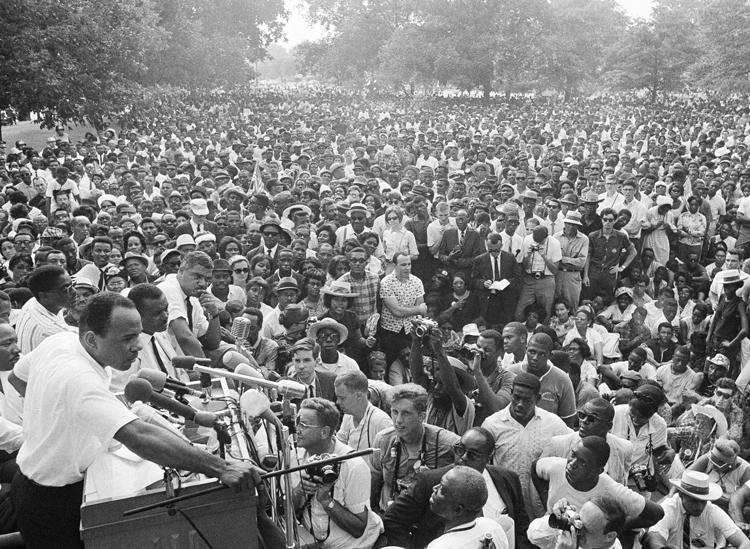
Crisscrossing Mississippi, the 1966 March Against Fear grew to the largest ever statewide action against Jim Crow segregation June 26 in Jackson, the capital. Stu Singer, a Student Nonviolent Coordinating Committee volunteer from Boston, who later became a leader of the Socialist Workers Party, took part in the march. Singer spent the last year of his life preparing a vivid, firsthand account of the action in 2012.
James Meredith single handedly started the march, but was shot after just one day. Singer and many like him did whatever was necessary to get to Mississippi to assure it continued. For Singer and thousands of others, participating in the mass struggle to topple Jim Crow was a school of disciplined revolutionary action.
During the three-week Mississippi march, SNCC led some 400 civil rights fighters into small towns and rural communities, worked with thousands of African Americans to register voters, pushed back assaults from white-supremacist thugs and drew workers and farmers into the fight that began to foreshadow the tumbling of decades of bloody segregation. The march took place in a state where Jim Crow forces were particularly entrenched, backed by the Ku Klux Klan on one side and Democratic Party politicians on the other. Courageous fighters against Jim Crow, including Medgar Evers in 1963, James Chaney, Andrew Goodman and Michael Schwerner in the 1964 Freedom Summer, and many others, had been slain in cold blood by racist forces.
Meredith came to national attention by leading the desegregation of the University of Mississippi in October 1962. This was accomplished with the intervention by federalized Mississippi National Guardsmen and U.S. troops.
Meredith’s march came on the heels of the landmark Selma to Montgomery march in Alabama in 1965, which drew national attention to the fight for Black rights. The action made clear to the capitalist rulers that there was expanding support for ending Jim Crow, and a growing number of fighters were determined to settle for nothing less.
A critical meeting
Alive, but unable to continue marching, Meredith met with leaders of SNCC and other groups to debate how to continue the march. NAACP leader Roy Wilkins walked out after failing to limit the politics of the march solely to a call for more civil rights laws. SNCC insisted the action focus on the failure of the Lyndon Johnson administration to enforce existing laws like the Voting Rights Act the president signed after the march to Montgomery.
Moreover SNCC, led by its new chair Stokely Carmichael, proposed changing the route of the march. Instead of getting to Jackson as quickly as possible, as Martin Luther King planned, SNCC wanted the march to stop early each day to allow volunteers to spread out into surrounding small communities and encourage voter registration.
“The only way to break the back of segregation,” Singer wrote for the Militant, was to “bring to bear the power of workers, farmers, sharecroppers and youth who were Black across the state. Disciplined self-defense had to be organized to protect neighborhoods and small towns where Blacks lived, as well as the lives of those engaged in the struggle.” And the movement had to resist the inevitable pressure from Democrats and Republicans to “wait” for a “better time.”
SNCC proposed and won agreement to accept the offer of the Deacons for Defense and Justice to provide marchers with armed protection. The Deacons had been formed by Black workers and Korean War veterans during hard-fought desegregation battles in Louisiana. They stood guard over the Meredith marchers’ encampments each night and escorted participants to and from the action.
“Since he knows we aren’t all non-violent, John Bigot isn’t so free to come in and start something,” Deacons’ leader Ernest Thomas told the Militant on the march.
“Black farmers and workers across the state were beginning to recognize and make use of the march as an instrument to beat back racist discrimination and terror,” Singer wrote.
Showdown in Greenwood
Chanting “We want Black power!” the marchers rallied in Greenwood. They demanded city officials appoint Black registrars to process the growing number of Blacks applying to vote. The City Council banned marchers from camping on public property. The June 27, 1966, Militant featured a front-page picture of cops in Greenwood beating Carmichael.
But with the eyes of the world’s press on them, the council backed off and let marchers camp in a city park. The following day 1,000 people demonstrated outside the Leflore County Courthouse there. Leflore County is where Emmett Till was lynched 11 years earlier.
“You can’t hold a meeting here,” the county sheriff told marchers, who refused to disperse, Singer said. After a short face-off, the sheriff backed down and marchers held their program before heading on, leaving behind a group of volunteers who registered thousands of Blacks to vote.
“When had there been popular mobilizations of this character in Mississippi since the defeat of Radical Reconstruction and the rise of Jim Crow?” Singer said. “Never. Including during the hard-fought and bloody struggles across the state the previous six years.”
The march prepared to step off again. Next week’s Militant will cover Singer’s description of how the March Against Fear concluded, electrifying Blacks in towns along the way, and the joyful welcome marchers received from several thousand when they reached Jackson.