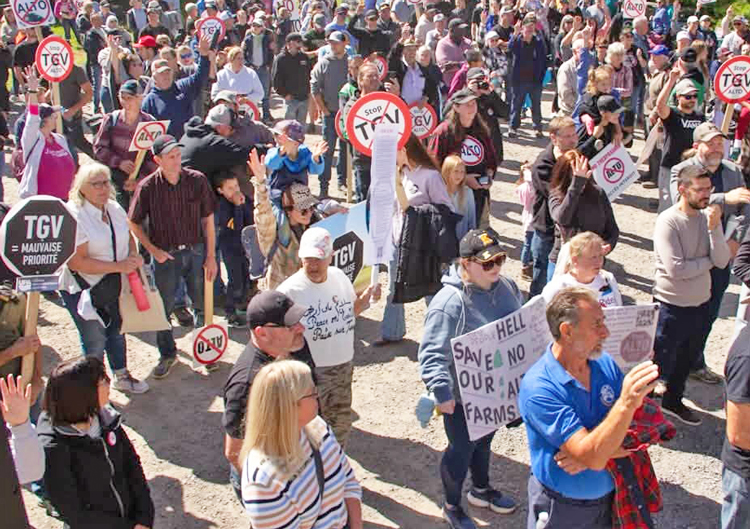
RIGAUD, Quebec — Some 500 farmers, their families and supporters from surrounding eastern Ontario and western Quebec rallied at a dairy farm here Sept. 19 to oppose a federal government plan to buy or expropriate farms to build a high-speed train corridor linking Toronto, Quebec City and Ottawa.
The protest, “Strong and United Against Alto High-Speed Rail,” was held in both French and English. It kicked off with a bagpipe-led tractorcade of hundreds of farmers with placards explaining the project threatens their livelihoods. The main organizer of the action was ALT-NO (United Against Alto), supported by major farm organizations like Quebec’s Union of Agricultural Producers (UPA) and the Ontario Farmers’ Association.
Alto is the name of the quasi-government company set up by Ottawa to build the project in conjunction with a consortium of profit-hungry private businesses.
Signs on tractors included: “Derail this train, save our farms”; “Our land is not for sale”; and “High-Speed Rail, wrong priority.”
Another on a 1970 model tractor said, “I fought against Mirabel.” In 1969 a hard-fought battle was waged by 3,000 farmers against Ottawa’s expropriation of 97,000 acres of their land to build the infamous Mirabel airport, 30 miles north of Montreal. It opened in 1975 at a cost of about 3 billion in today’s Canadian dollars ($2.1 billion). All told, some 10,000 people, mostly farmers, were displaced.
The airport proved to be a colossal failure, shutting down its passenger service in 2004. It’s used now only for air freight. Last February Parliament voted for the government to apologize to the Mirabel farmers.
Over the years since, 80,000 acres of expropriated land was sold back, much to the original owners, who now find themselves threatened once again by the Ottawa-Montreal leg of the Alto project.
One participant carried a sign saying, “Facing expropriation for a second time.” She told the Militant her dad had a dairy farm that was destroyed to make way for the ill-fated Mirabel airport.
The Montreal-Ottawa portion of the rail line got Ottawa’s approval late last year, with construction to begin in 2029. The final route is to be determined by the end of this year, with farmers reporting drone flights now scanning their properties. Most of the trackage will require a 60-meter-wide (197 foot) fenced-in corridor. Projected costs are CA$90 billion.
The impact will be huge, UPA President Martin Caron told the Montreal Gazette. “If they just take 60 meters, we would have to drive around the fence to get to the other side of our farm.”
Sharon Patton, a farmer from Rideau Lakes, Ontario, who farms maple and pine trees, came to the protest with 30 others from their area. “My family has farmed there since the 1700s,” she told the Militant. “I can’t see losing it.”
“It’s important to unite farmers in Ontario and Quebec,” said Mirabel City Councillor and coalition spokesperson Robert Charron, who chaired the rally. “We showed that with our last action in Ottawa” of almost 1,000 June 10.
“The laws on expropriation are unjust,” said Sharon Kellar from South Frontenac in Ontario. “We have to stand together to fight this.”
“I wasn’t planning on speaking today,” said Sandra Lavoratore, mayor of Pointe Fortune, a village of 640. “But when I saw so many people, I felt that the little community of Pointe Fortune is not at all alone.”
Annette Kouri and Steve Penner contributed to this article.