

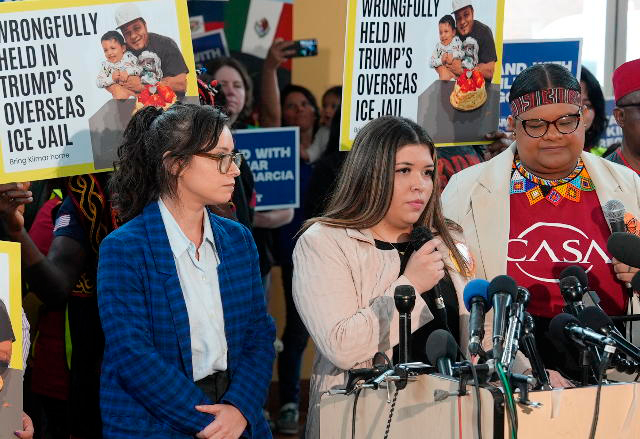
LOUISVILLE, Ky. — The labor movement in this area and around the country continues to organize to step forward to defend immigrant fellow workers from the threat of deportation.
In Maryland the SMART union has been a key part of the fight to bring home Kilmar Abrego Garcia, a sheet metal apprentice and member of the union who was deported and imprisoned in El Salvador, even though he was denied his right to a hearing and was protected by a court barring him from being deported.
U.S. District Judge Paula Xinis has issued a series of orders instructing the Justice Department, which had said the deportation was a “mistake,” to “facilitate” his return home. She also ruled they were acting in “bad faith” and ordered them to turn over daily detailed reports on what they are doing to implement her order.
On April 23 she ordered a seven-day “pause” in government compliance, with the agreement of Abrego Garcia’s lawyers, a sign of a possible hopeful shift in the case.
In Washington state, Alfredo “Lelo” Juarez Zeferino, a leader of the Familias Justicia farmworkers union, remains in the Northwest Detention Center in Tacoma after having been arrested and threatened with deportation.
His union and others, including the state AFL-CIO and the 50,000-member Local 3000 of the United Food and Commercial Workers, have organized protests and are fighting for his release. A hearing in his case is currently set for November.
Ongoing fight in Louisville area
On April 19 some 40 workers came out to the United Auto Workers Local 862 union hall here for a “Know Your Rights” training session. More sessions are planned, sponsored by several unions in the area.
Hundreds of workers in this area received letters from the government saying their “CHNV” humanitarian parole visas are being terminated and they will face deportation if they don’t “self-deport” by April 24. Many of these workers are union members at General Electric/Haier, Magna Seating and UFCW-organized plants in the area. CHNV stands for Cuba, Haiti, Nicaragua and Venezuela, governments that Washington opposes or considers oppressive.
If they get a sponsor in the U.S., people from these countries can get a two-year parole, legal status and work papers.
After the government letters went out, the Justice Action Center, Haitian Bridge Alliance and others filed a legal challenge. On April 14 U.S. District Court Judge Indira Talwani in Boston put the government’s move on hold, blocking deportation for now.
“Workers at GE/Haier are feeling good about the court ruling,” Erwin Ramirez, a member of International Union of Electrical Workers-CWA Local 83761, told the Militant. “But they still have a lot of questions about what happens next. Some want to know if they can travel out of the country or if they will be kept out when they try to return. We have more training sessions planned to try to answer people’s questions.” Ramirez and other unionists have been calling Spanish-speaking workers at GE/Haier to offer help and information. Another worker who speaks Creole has contacted Haitian workers there.
The Jefferson County Teachers Association is one of the unions speaking out against the threatened deportations.
“We do not ask students about their immigration status or their parents’ status,” Cassie Lyles, a high school teacher and member of the teachers association, told the Militant. “But we know that many are feeling the pressure because they or someone in their family could be deported. One told me, ‘I don’t know if I’m safer at home or at school. If they take my family away I want to be with them.’”
Lyles said a large number of her students are from Cuba. “Many teachers are scared about what will happen to our students,” she said. “But we are also ready to gear up and fight. We want our kids to be safe. They deserve to live in a world where they are not always looking over their shoulders. Many of us will be wearing red on May Day to show solidarity with immigrants.”
Similar actions will take place across the country on May 1.