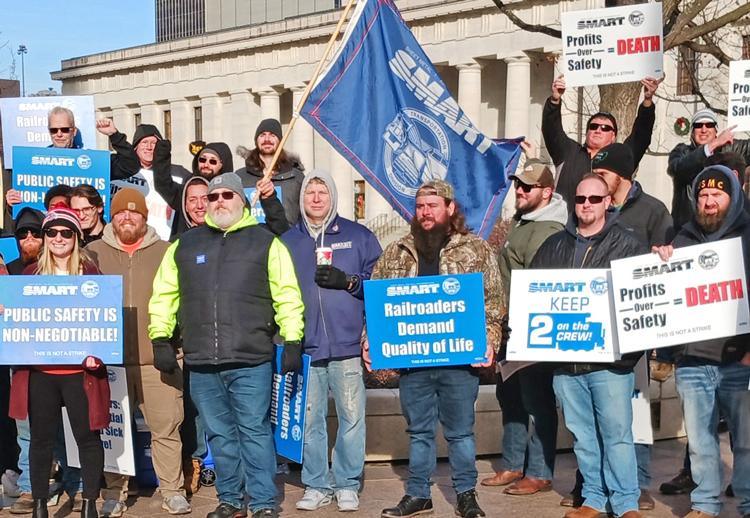
CHICAGO — An appalling report on the recent death of a rail worker on the job, released June 25 by the National Transportation Safety Board, confirms America’s rail bosses have no regard for safety. It underscores the need for the unions to organize to fight for workers’ control of job conditions.
On July 6, 2024, Justin Pender was killed when the rail car he was riding struck another train in Union Pacific’s Proviso yard near Chicago. According to the NTSB report, Pender, 27, had completed his conductor training just 12 days earlier. He had never led a shove move at that rail yard. It was at night. The engineer asked the yard boss for a utility conductor to help Pender, but was told he was busy and to “do what you can do.”
Two other rail conductors died on the job last month. Robert Gardner, 43, a Union Pacific worker with some two years’ experience, was killed in Nacogdoches, Texas, June 9. He too was told to lead a shove into a track in an area he wasn’t familiar with. He had spent the day being assessed by the yard manager until 16 minutes before he was killed. His union, SMART-TD Local 524, organized a fundraiser for his family.
A week later Michael Dewaine Townsend, 39, was struck and killed by a railcar while working for Transtar, servicing the U.S. Steel plant in Fairfield, Alabama.
Government regulators and the rail bosses file these deaths away as “accidents,” but they’re not. They’re the result of the bosses’ drive for profits, speedup and refusal to provide the much longer-term training needed to learn the job.
Bosses cut jobs, safety
Crew sizes have been drastically cut from four or more to two. In many yards today, one worker is left alone using a remote control box to switch rail cars. This year BNSF became the last of the major North American railroads to eliminate the third crew member — a helper or brakeman — on most yard and local jobs.
“It’s concerning. The company points to how other railroads are doing it, but is it safe?” Rick Leschina, an engineer in Chicago, told the Militant. “It’s all about them doing more with less.”
“When railroad crews were four or more, and at least three with years of experience, workers could safeguard each other in work moves,” said Lance Anton, a SMART-TD conductor with over 14 years’ experience in Lincoln, Nebraska.
The rail bosses are pushing for engineer-only operations, eliminating the conductor on long-haul freight trains.
Also on the rail bosses’ wish list is running trains without any workers at all. A company called Parallel Systems has begun testing self-propelled railcars in Georgia, and plans to launch commercial operations next year.
The Association of American Railroads is pressing the Federal Railway Association to let the bosses cut back on required visual track inspections along rails where automated track inspection systems have been deployed. This would eliminate more track workers, members of the Brotherhood of Maintenance of Way Employees, who inspect, repair and replace tracks. Rail workers are not against technology that can make work safer, but the bosses’ goal is using new technology to cut jobs and increase their profits at the expense of safety.
One key factor in Norfolk Southern’s disastrous derailment and fire that devastated East Palestine, Ohio, in 2023 was the failure of rail-side sensors to alert anyone to an overheating wheel bearing that gave way.
Need to rely on union power
None of these crucial questions are touched in the contracts currently being negotiated between a dozen rail unions and the major U.S. railroads. The majority of the unions have now ratified contracts containing a 17.5% wage increase over a five-year agreement. The two main operating crafts organizing conductors and engineers, SMART-TD and the Brotherhood of Locomotive Engineers and Trainmen, are still negotiating.
Rail negotiations in the U.S. are conducted under the boss-friendly Railway Labor Act, which wraps up talks in red tape, arbitration, “cooling off” periods and more, barring workers the right to strike for years. Unlike in the 2019-22 contract talks, this year all of the unions are negotiating separately.
In 2022, rail unions organized public rallies and marches to get broader support, and members of four unions, representing a majority of the workforce, set a strike deadline that all 12 rail unions pledged to support. Democratic President Joseph Biden then sponsored and signed bipartisan legislation banning a strike and imposed a contract rail workers had voted down.
“The Railway Labor Act gives railroad bosses and the government too much power and deals blows to the union’s collective bargaining process,” Jakob Forsgren, a track welder and vice general chair of BMWE working out of Lincoln, told the Militant. “We need to use our union power to rid the labor movement of such repressive laws.”
But all laws, like the Railway Labor Act, are just pieces of paper. It is the class struggle and relationship of class forces that decide if the workers and their allies or the bosses and their government will prevail.
Laura Anderson, a SMART-TD freight conductor in Florida, is the Socialist Workers Party candidate for mayor of Miami.
She is discussing with co-workers and others why “railroad unions need to use their power to fight for workers to have total control of their working conditions so no rail worker needs to die on the job. The life-and-death issue of safety is not a bargainable question.
“We need to use union power to force the bosses to hire thousands of workers, with control over their jobs, to run the trains and maintain and inspect equipment and trackage safely,” she told the Militant. “And there should be trains no longer than 50 cars, a crew of four on every train, two on the locomotive and two on the rear of the train.”
Naomi Craine is a member of SMART-TD in Chicago. Joe Swanson is a retired freight conductor.