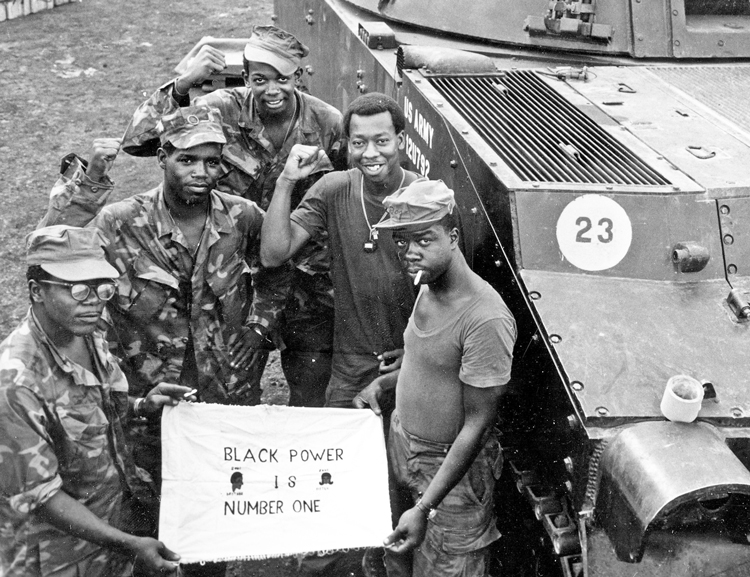
Blacks in America’s Wars by Robert W. Mullen is one of Pathfinder’s Books of the Month for September. It recounts the hidden history about Blacks participation in U.S. wars, from the First American Revolution to the Civil War to the war in Vietnam. This includes the fight against the segregationist policies that the U.S. military enforced, from the 1898 Spanish-American War through World War II. The excerpt below deals with the opposition by Blacks and other working people to Washington’s invasion of Vietnam in the 1960s, as Blacks returning from the war faced racist, derogatory treatment from the same U.S. government here at home. Copyright © 1973 by Robert W. Mullen. Reprinted by permission of Pathfinder Press.
The gap between the American ideal and the reality of Black people’s conditions in the United States is one of the Afro-American’s strongest grievances. Malcolm X frequently contrasted the “American dream” with the Black “American nightmare.” As a result of this country’s failure to deliver on its stated democratic ideals, Afro-Americans developed tremendous skepticism and cynicism regarding the government’s rhetoric about “defending democracy” and fighting for the self-determination of a small country.
Having experienced American-style “democracy” first hand, many Afro-Americans could deeply sympathize with the resistance of the Vietnamese to its imposition on them. As Malcolm X put it, “You and I haven’t benefited from America’s democracy, we’ve only suffered from America’s hypocrisy.”
There is no system in the world that has proven itself “more corrupt, more criminal” than the American system of democracy that “still enslaves twenty-two million Afro-Americans,” Malcolm told the Militant Labor Forum in New York in April 1964. He denounced the hypocrisy of a system that “can go all over this earth telling other people how to straighten out their house, when you have citizens of this country who have to use bullets if they want to cast a ballot.”
Malcolm X was one of the first Black leaders to speak out against American involvement in Vietnam. Speaking to a group of Black teenagers from McComb, Mississippi, on December 31, 1964, he blasted the United States as having “the most hypocritical government since the world began” because it was “supposed to be a democracy, supposed to be for freedom and all of that kind of stuff when they want to draft you and put you in the army and send you to Saigon to fight for them — and then you’ve got to turn around and all night long discuss how you’re going to just get a right to register and vote without being murdered.”
The Kennedy, Johnson, and Nixon administrations repeated time and again that America had an obligation to uphold the “rights” of its allies. Blacks were often quick to notice the contrast between this zeal and the fact that “twenty-two million people are living witnesses to the fact that America has failed to keep its constitutional commitment to its own Negro citizens at home.”
The government was willing to send more than half a million GIs to “defend democracy” in South Vietnam. But at the height of the voter registration drives in the South, after widespread intimidation and murders of Blacks trying to register, less than two hundred federal marshals and registrars could be found for assignment to Mississippi, Alabama, South Carolina, and elsewhere, although it was the president’s sworn duty to uphold the constitutional rights of citizens of this country.
As novelist John Oliver Killens put it: “We Black folk find it difficult to understand the nation’s hesitation about sending troops to Mississippi to guarantee free elections when we read of American boys dying thousands of miles from home to ensure freedom for the Vietnamese. The subtlety escapes us.”
During the height of the civil rights movement, when the government and political leaders continually admonished Blacks to remain nonviolent, to avoid striking back at those who beat and murdered them, Black youth were being drafted into the army to engage in violence against the Vietnamese people. The hypocrisy of the government’s stance was clear to many, but it was Malcolm X, again, who gave this realization its most biting expression:
Look right now what’s going on in and around Saigon and Hanoi and in the Congo and elsewhere. They are violent when their interests are at stake. But for all that violence they display at the international level, when you and I want just a little bit of freedom, we’re supposed to be nonviolent. They’re violent in Korea, they’re violent in Germany, they’re violent in the South Pacific, they’re violent in Cuba, they’re violent wherever they go. But when it comes time for you and me to protect ourselves against lynchings, they tell us to be nonviolent. …
Because of the obvious disparity between the stated goals of the United States in Vietnam and the commitment towards those same goals in the United States, it should not surprise anyone that the first organized civil rights group to protest the Vietnam war was a group in the deep South that had had firsthand experience with the lack of federal protection for Blacks trying to exercise basic democratic rights.
This first organized protest took the form of a leaflet circulated in McComb, Mississippi, and printed in the Mississippi Freedom Democratic Party newsletter of McComb on July 28, 1965. The statement said, in part: “It is very easy to understand why Negro citizens of McComb, themselves the victims of bombings, Klan-inspired terrorism, and harassment arrests, should resent the death of a citizen of McComb while fighting in Vietnam for ‘freedom’ not enjoyed by the Negro community of McComb.”
The leaflet had been circulated after the death of John D. Shaw, 23, of McComb, who had been a participant in civil rights demonstrations there in 1961.