
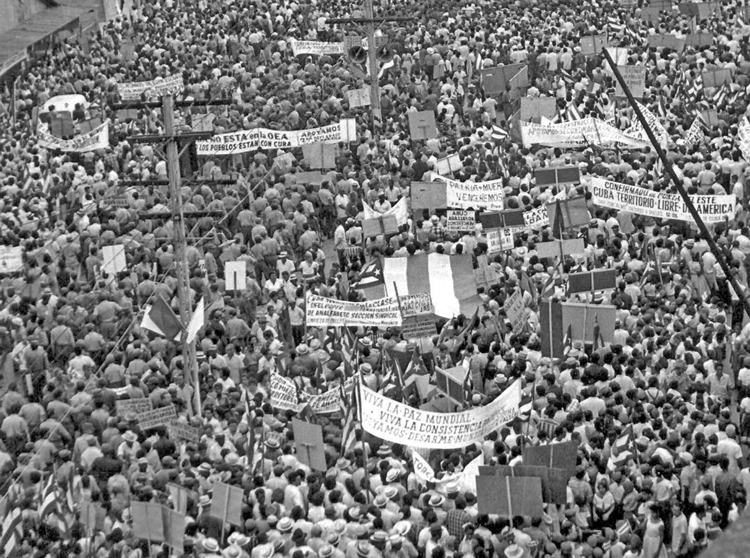
The First and Second Declarations of Havana: Manifestos of Revolutionary Struggle in the Americas adopted by the Cuban people is one of Pathfinder’s Books of the Month for May. Between the 1960 and 1962 declarations, both given by Fidel Castro and approved by millions in assemblies across Cuba, the mass struggle deepened into a socialist revolution. The excepts below are taken from “The Second Declaration of Havana.” Copyright © 2007 by Pathfinder Press. Reprinted by permission.
Cuba rose up. Cuba redeemed itself from the bastard tutelage. Cuba broke the chains that tied its fortunes to those of the imperial oppressor, reclaimed its wealth, reaffirmed its culture, and unfurled its sovereign banner of Free Territory and People of the Americas.
Now the United States will never again be able to use Cuba’s strength against the Americas. Conversely, the United States, dominating the majority of the other Latin American states, today attempts to use the strength of the Americas against Cuba.
What is the history of Cuba if not the history of Latin America? What is the history of Latin America if not the history of Asia, Africa, and the Pacific? And what is the history of all these peoples if not the history of imperialism’s pitiless and cruel exploitation throughout the world?
At the end of the last century and the beginning of the present one, a handful of economically developed nations had finished partitioning the world among themselves, subjecting to their economic and political domination two-thirds of humanity forced to work for the ruling classes of the economically advanced capitalist countries. …
Cuba affronts the imperialists in a special way. What is it that is hidden behind the Yankees’ hatred of the Cuban Revolution? …
What unifies them and incites them is fear. What explains it is fear. Not fear of the Cuban Revolution, but fear of the Latin American revolution. … [F]ear that the plundered people of the continent will seize the arms from their oppressors and, like Cuba, declare themselves free peoples of the Americas.
By crushing the Cuban Revolution they hope to dispel the fear that torments them, the specter of revolution that threatens them. By eliminating the Cuban Revolution, they hope to eliminate the revolutionary spirit of the people. They imagine in their delirium that Cuba is an exporter of revolutions. In their sleepless merchants’ and money lenders’ minds lives the idea that revolutions can be bought, sold, rented, loaned, exported and imported like a piece of merchandise. Ignorant of the objective laws that govern the development of human societies, they believe that their monopolistic, capitalistic, and semifeudal regimes are eternal. Educated in their own reactionary ideology — a mixture of superstition, ignorance, subjectivism, pragmatism, and other mental aberrations — they have an image of the world and of the march of history conforming to their interests as exploiting classes. …
[A] great ideological battle unfolded between the Cuban Revolution and Yankee imperialism. Who did each side represent, for whom did each one speak? Cuba represented the people; the United States represented the monopolies. Cuba spoke for the exploited masses of Latin America; the United States for the exploiting, oligarchic, and imperialist interests. Cuba for sovereignty; the United States for intervention.
Cuba for the nationalization of foreign enterprises; the United States for even greater investments by foreign capital. Cuba for culture; the United States for ignorance. Cuba for agrarian reform; the United States for great landed estates. Cuba for the industrialization of the Americas; the United States for underdevelopment. Cuba for creative work; the United States for sabotage and counterrevolutionary terror practiced by its agents — destruction of sugarcane fields and factories, bombing by their pirate planes of the work of a peaceful people. Cuba for the murdered literacy workers; the United States for the murderers. Cuba for bread; the United States for hunger. Cuba for equality; the United States for privilege and discrimination. Cuba for the truth; the United States for lies. Cuba for liberation; the United States for oppression. Cuba for the bright future of humanity; the United States for the past without hope. Cuba for the heroes who fell at Girón to save the country from foreign domination; the United States for the mercenaries and traitors who serve the foreigner against their own country. Cuba for peace among peoples; the United States for aggression and war. Cuba for socialism; the United States for capitalism. …
To the accusation that Cuba wants to export its revolution, we reply: Revolutions are not exported, they are made by the peoples.
What Cuba can give to the peoples, and has already given, is its example.
And what does the Cuban Revolution teach? That revolution is possible, that the peoples can make it, that in the contemporary world there are no forces capable of halting the liberation movement of the people.
Our triumph would never have been feasible if the revolution itself had not been inexorably destined to arise out of existing conditions in our socioeconomic reality, a reality that exists to an even greater degree in a good number of Latin American countries. …
The duty of every revolutionist is to make the revolution. It is true that the revolution will triumph in the Americas and throughout the world, but it is not for revolutionists to sit in the doorways of their houses waiting for the corpse of imperialism to pass by. The role of Job does not suit a revolutionist.
Each year that the liberation of Latin America is speeded up will mean the lives of millions of children saved, millions of intellects saved for culture, an infinite quantity of pain spared the people. Even if the Yankee imperialists prepare a bloody drama for Latin America, they will not succeed in crushing the peoples’ struggles; they will only arouse universal hatred against themselves. And such a drama will also mark the fall of their greedy and Stone Age system.