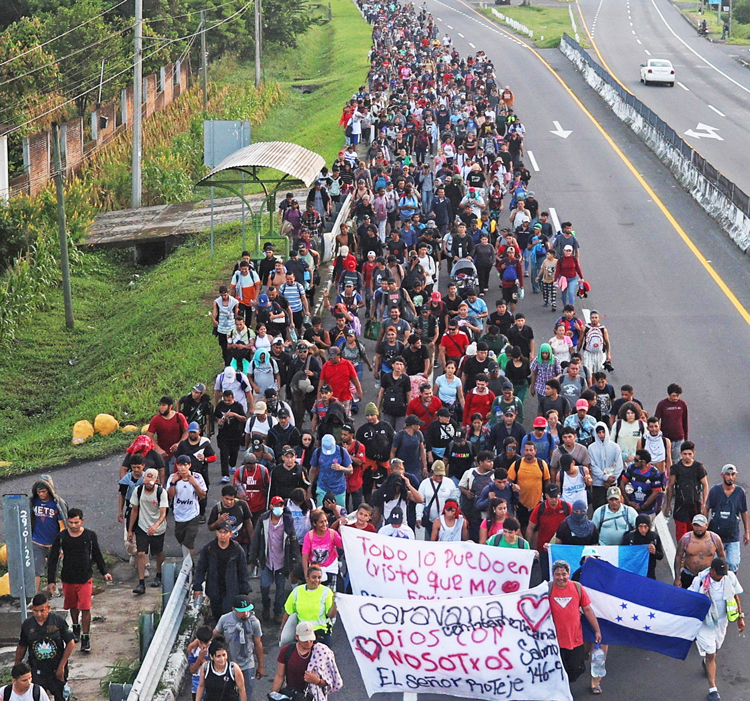
A group of some 1,500 working people, mostly from Central America, set out on foot from Tapachula in southern Mexico Nov. 10 hoping to get into the U.S. Many of them say that the Democrats’ win in the midterm elections would make it easier to get in.
“We believe the Democrats will help us,” Cesar Sandoval, a Nicaraguan who was on the caravan, told Reuters. Others were less convinced, but still determined to make it to the U.S. “Nothing has changed,” Aníbal from Guatemala told CNN. “Democrats and Republicans are the same, so if they capture us tomorrow, we’ll just head there again.
“Let’s see who gets tired first, them or us,” he said.
The group that set out from Tapachula was mostly made up of people from Honduras, but also included 100 Guatemalans, and several people from Cuba, Nicaragua and Venezuela. It was the largest caravan of immigrants headed to the U.S. border from Mexico this year, but paused shortly after starting the journey.
President Donald Trump threatened to impose higher tariffs on Mexico if the government there didn’t stop the group. In fact the administration of Mexican President Claudia Sheinbaum collaborates closely with Washington to crack down on undocumented immigrants trying to get to the U.S. Since September Mexican officials stopped and broke up two caravans before they left southern Mexico.
Sheinbaum’s government has also agreed to Washington’s request and accepted 21,000 people, originally from other countries, who were seized and deported by Immigration and Customs Enforcement agents in the U.S. That’s about 80% of all those deported not to their country of origin but to one chosen by the Trump administration, where they have no family or other connections.
After Trump took office unauthorized crossings at the Mexico-U.S. border dropped from 950 a day to 150 a day in July 2025. But they’ve gone back up to an average of 300 a day since March.
That’s hardly surprising. The conditions driving mass immigration haven’t gone away. Millions of workers and farmers across Latin America and beyond confront increasing hardship and uncertainty about the future as a result of the world capitalist crisis. Some 70,000 people joined more than 50 caravans from southern Mexico to try to get to the U.S. between 2019 and 2025.
“The truth is there’s work here, but it’s not enough to get by,” Mauricio, a farmer from El Salvador, told CNN. He joined one of the groups trying to get to the U.S. after the midterm elections.
Thousands of immigrants from across the continent are stranded at Tapachula and elsewhere in southern Mexico, with few jobs and a lack of healthcare or schools for their children.
U.S. rulers seek immigrant labor
At the same time that it’s tightened the border, the Trump administration is ensuring that U.S. bosses continue to have what they hope will be a steady stream of superexploitable immigrant labor. Bosses see this as key to creating divisions in the working class in the U.S., maximizing their profits and being better able to grab markets from their competitors abroad.
In January the administration doubled the number of H-2B visas it would grant to seasonal immigrant workers who are sponsored by employers to work in construction, hotels, landscaping and fish processing. These workers’ status in the U.S. is tied entirely to an employer hiring them for temporary work, which can be extended at the bosses’ request for up to three years.
The administration has also stepped up ICE raids and deportations across the country. Its aim isn’t to deport all undocumented workers, but to ensure that those who remain live and work in fear. The U.S. rulers believe that the second-class status these workers face will make them less willing to resist the bosses’ drive for low pay, backbreaking workloads and few or no benefits, and make them afraid to turn to unions to fight alongside U.S.-born workers for a better life.
For the labor movement, leading a fight to win amnesty for all workers without papers in the U.S. is key to unifying the working class to meet the growing attacks of the bosses.