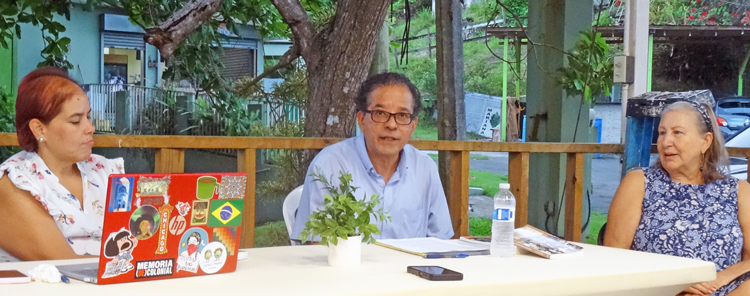
HUMACAO, Puerto Rico — Amid the chorus of hundreds of whistling coquí tree frogs on the Loma de la Niña Mariana hilltop, Rosalina Abreu welcomed participants to an Oct. 24 panel discussion about Cuba and the Independence War in Guinea-Bissau and Cape Verde: The Fall of the Last Colonial Empire in Africa by Cuban revolutionary Víctor Dreke.
Abreu is a longtime leader of Arecma — the Recreational and Educational Community Association of Mariana Neighborhood — which has organized working people here since 1982 to take initiatives to improve their lives in the face of government disdain and inaction.
In the wake of Hurricane Maria in 2017 — which ravaged the region — Arecma set up a community kitchen that fed hundreds of residents daily for six months. The group now maintains some 16 acres, including a breadfruit tree grove, a children’s playground, and the outdoor pavilion where the book presentation took place.
From the highest point of the hill are amazing views of nearby towns and the valleys where thousands of farmworkers went on strike in 1934 on now-vanished sugar plantations. You can see all the way to the island of Vieques, which was used by the U.S. Navy for live-fire bombing exercises until it was forced to close in 2003, after decades of protests.
“Members of the Socialist Workers Party and correspondents for the Militant newspaper have visited us several times over the last decade to learn about our political, social and economic situation,” Abreu said. “When they called us about having this conversation about the book, we liked the idea.”
Abreu introduced the two speakers, Marisaura Serrano, a graduate student at the University of Puerto Rico and member of Arecma’s executive board, and Róger Calero, a member of the Pathfinder Press editorial staff who took part in the interviews with Dreke, drawn together in this book.
In 1967-68 Dreke led Cuba’s internationalist mission in the West African countries of Guinea-Bissau and Guinea-Conakry that provided military training and medical help to combatants of the African Party for the Independence of Guinea and Cape Verde (PAIGC) led by Amílcar Cabral. The book is a firsthand account of that historic struggle that put an end to 500 years of Portuguese colonial domination.
The panelists highlighted the importance of Cabral’s leadership and the example of the Cuban Revolution for today’s struggles.
Cabral convinced people to unite
“Cabral’s determination to unite all the different ethnic groups, working people in city and countryside, men and women of all ages, blew my mind,” said Serrano. “He convinced everyone of why they must join together and fight.” That, and Cabral’s clear presentation of the PAIGC’s political program is what led Cuban leader Fidel Castro to have confidence their struggle would achieve victory, she noted.
It’s not just about “replacing a foreign authority with a national authority. The reasons that led these peoples to fight were basic needs like access to education, healthcare, the improvement of conditions and ending the empire’s exploitation,” she said. “They worked to develop political organization, and popular participation.”
Serrano noted Cabral’s firm stance in advancing women’s participation in society and politics. He didn’t see women “as spectators, companions or secondary figures,” she said. “But as necessary participants so that the revolution can achieve its objectives.”
“This book was published above all for working people and youth who are learning through their own struggles how to defend their working and living conditions and their rights, as the crisis of capitalism deepens and the rulers are marching humanity toward a third world war,” Calero said. And its publication is a contribution to telling the truth about Cuba’s socialist revolution.
“What motivated the Cubans to help struggles in other countries?” Calero asked. “The revolution that they themselves made in Cuba following Jan. 1, 1959. In overthrowing a hated dictatorship they discovered that to eradicate imperialist domination and all forms of exploitation, they had to defeat the capitalist class at home and take power into their own hands.”
“They understood that this was an international struggle of an international working class,” he added.
“The process of liberation” of Guinea-Bissau and Cape Verde “culminated a little more than 52 years ago” — not that long ago, Serrano said.
“This made me think about Puerto Rico,” she said. “How did other countries succeed in advancing to independence? What circumstances made this possible? Why are we, the Puerto Rican people, still debating our political future?” Puerto Rico has been a U.S. colony since 1898, when U.S. troops occupied the island after defeating Spain’s colonial forces.
“Every people have their own history, circumstances and traditions,” she added. “But learning about other experiences with decolonization allows us to broaden our perspective and ask what we can learn from it.”
“I also read the book,” Abreu said. “It’s an example of how we can transform our society. We are the ones who have to do it. No one can come and tell us how, it has to grow out of our own experience.”
Like in Guinea-Bissau and Cape Verde, “in Puerto Rico it is the working class that suffers the biggest impact of impoverishment today,” she said.
The discussion on the book “is invaluable to find a road forward,” she said. “We want to continue with these conversations.”