NEW YORK — “The world we are living in today is marked by increasingly cutthroat trade conflicts, social explosions and wars among rival capitalist ruling classes,” John Studer told participants at a Sept. 20 Militant Labor Forum here, called to discuss Moscow’s war to conquer Ukraine and working people’s defense of the country’s sovereignty. Studer is the Militant’s editor and a leader of the Socialist Workers Party.
“They’re fighting over the earth’s raw materials, markets, sources of superexploitable labor, profits and spheres of influence,” he said. “The capitalist rulers in the U.S. and worldwide are once again marching humanity toward social catastrophe, fascism, another Holocaust for the Jews and World War III.”
Studer pointed to two watershed events that have accelerated this course. First, the Oct. 7, 2023, Tehran-financed and -organized pogrom by Hamas in Israel that killed 1,200 people, most of them Jews, and wounded thousands, and the importance of Israel’s response — a defensive war that to be successful must lead to the destruction of Hamas in order to defend the existence of Israel as a refuge for Jews.
Second, the February 2022 invasion of Ukraine by Russian President Vladimir Putin’s regime.
“This war has marked the region and the world ever since,” Studer said. “Ruling classes worldwide, from Washington and rival imperialist powers to Moscow and Beijing, are upgrading their militaries and weaponry, and forming new blocs to advance their own interests.”
When Putin invaded Ukraine, the SWP responded immediately. The party campaigned and continues to do so today to get out the truth about Moscow’s murderous assault on Ukraine’s right to exist as a nation.
The SWP calls for getting Washington’s nuclear weapons and troops out of Europe. They’re not there to aid the Ukrainian people’s fight for national sovereignty but to pursue Washington’s own imperialist interests, Studer explained.
Putin’s war targets Ukrainian people
“Putin’s war targets the people of Ukraine. It’s not aimed at military targets,” Studer said. “Just last night Moscow launched 40 missiles and 580 drones against cities and villages throughout the country. In Dnipro, a Russian missile directly hit a multistory residential building, killing one and injuring 26.”
Moscow uses its deadly assaults to try to demoralize Ukrainians, he said. In the areas of eastern Ukraine occupied by Russian forces, Putin issued a decree that any Ukrainians living there that have not become Russian citizens are “foreigners” and subject to deportation beginning Sept. 10. They are also denied basic medical care, and cannot receive pensions or other social benefits.
On Sept. 10 Russia’s Supreme Court approved a 10-and-a-half-year sentence for Ukrainian IT worker Iryna Horobtsova. She was abducted by Russian forces from her home in Kherson, in eastern Ukraine, in May 2022 after speaking out against Moscow’s invasion and participating in protests there. The charge against her was “spying” over a period of almost 11 months. But during that time she was held incommunicado in Russian captivity, Studer pointed out.
There is increasing anti-war sentiment among working people in Russia. When Moscow’s invasion first began there were big protests, which were repressed by the Putin regime. “In fact, it’s a crime to admit it’s a war, rather than a ‘special military operation,’” Studer said. But individuals continue to find ways to express public opposition to Moscow’s assaults, despite the threat of imprisonment.
Large numbers of Russian soldiers are being killed or injured. They’re thrown into “meat grinder” frontal attacks to gain control of small amounts of territory. “Close to a million Russian troops are dead or maimed,” Studer said. Nearly one in three Russians say they know someone killed fighting in Ukraine, a recent poll says.
“Russia’s working class, including those in uniform, are the most important potential ally of Ukrainian workers in their fight to defend their national sovereignty,” he said. “This is why we oppose Washington’s sanctions against Russia, as they hit working people the hardest.”
Ukraine and fight against Jew-hatred
Studer pointed out that the struggle to defend Ukraine’s sovereignty is deeply connected to the fight against Jew-hatred. After the 1939 Stalin-Hitler pact divided Poland between Berlin and Moscow, Ukraine, which was then part of the Soviet Union, had the second-largest Jewish population in the world after the U.S., about 2.7 million.
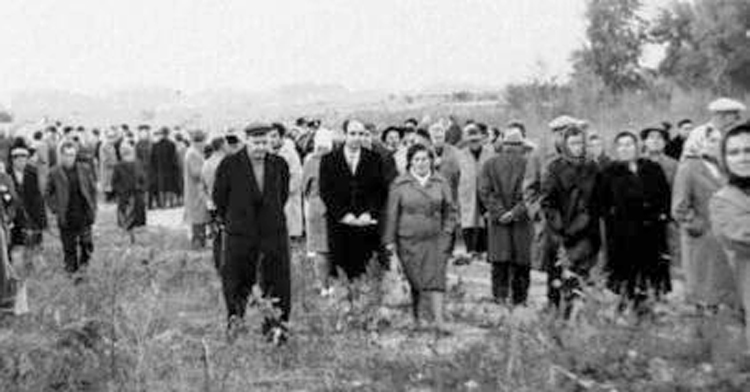
“The march of Hitler’s forces across Ukraine was accompanied by a ferocious effort to kill Jews. It was one of the centers of the Holocaust,” said Studer. Over two days, Sept. 28 and 29, 1941, more than 33,000 Jews were murdered at Babyn Yar, on the outskirts of Kyiv. Over the next few years another 70,000 to 80,000 were killed and dumped in the ravine there.
“And this was repeated as the Nazis marched all across Ukraine,” said Studer. Two weeks later in Dnipropetrovsk, the Nazis lined up and executed 11,000 Jews at the ravine there over two days. After the defeat of the fascist forces by Soviet troops, the regime of Soviet Premier Joseph Stalin refused to acknowledge these atrocities. It tried to build over the sites of the pogroms and refused to erect monuments to the Jews who were slaughtered there, Studer said.
A small monument was erected after a yearslong fight that included Ukrainian Marxist Ivan Dzyuba, poet Yevgeny Yevtushenko and composer Dmitri Shostakovich.
Studer described the three reporting trips he and other leaders of the SWP made to Ukraine in 2014 and 2015, and what they learned about the massive struggle by working people who joined the popular Maidan uprising, toppling pro-Moscow Ukrainian President Viktor Yanukovych in February 2014.
“We met with workers across the country — steel, rail, nuclear power, coal and iron ore miners, at chemical plants and more, immediately after the victory on the Maidan,” Studer said. “They told us how they viewed that struggle and how proud they were of what they accomplished.
“They said the bosses and the capitalist government did everything they could to take advantage of the fight with Moscow to attack workers and their unions. And they explained they could see another Maidan in the future.
“All political questions are class questions,” Studer said. “They can only be resolved by the actions of great social classes, classes with leadership that chart a road forward. It is only with the working class taking political power that we will be able to end the threat of new wars and all the other horrors of capitalist rule once and for all. That’s the example set by the two great revolutions of our epoch, the Bolshevik Revolution in Russia led by V.I. Lenin and Cuban Revolution led by Fidel Castro. ”