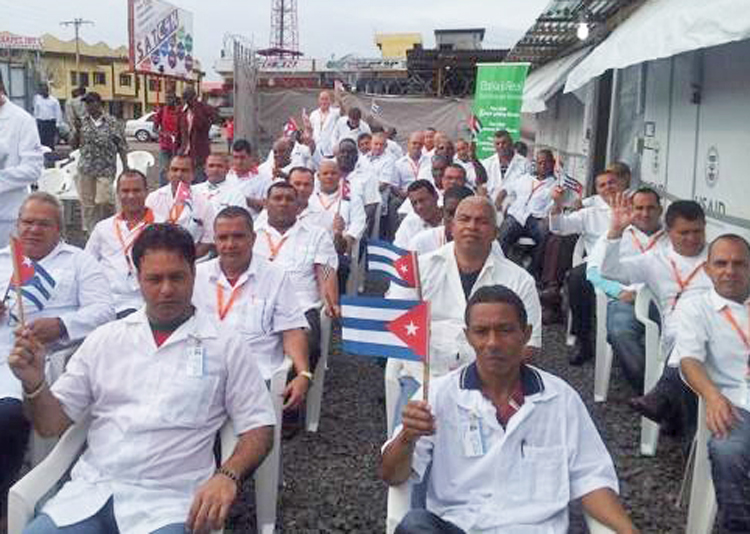
One of Pathfinder’s Books of the Month for November is Red Zone: Cuba and the Battle Against Ebola in West Africa by Enrique Ubieta Gómez. He explains the book is “about the solidarity and internationalism that are at the heart of the Cuban Revolution.” It recounts the work of Cuba’s volunteer doctors and nurses in West Africa during the 2014-2015 Ebola epidemic, when Cuba continued its decades-long tradition of solidarity by sending volunteers, including 256 doctors and nurses out of 12,000 who stepped forward, in response to the call for help from governments in Liberia, Sierra Leone and Guinea. Over eight months, the Cuban volunteers were crucial in helping stamp out Ebola in those countries.
The book is especially timely now, as the latest and fastest-growing Ebola outbreak Africa has faced, centered in the Democratic Republic of Congo, is wreaking havoc. In its first six months, over 11,200 have been infected with the virus, and over 5,500 have died. It continues to spread. Unlike the 2014-2015 eruption, Cuba is prevented from sending medical brigades to help bring the epidemic under control. The U.S. government has pressured foreign governments to abandon all efforts to use Cuban healthcare workers to combat the epidemic under threat of sanctions and loss of U.S. financial “aid.”
In Cuba, healthcare is treated as a right guaranteed to all, not a commodity to be bought and sold for profit. Cuba serves as an example to the world of the difference a socialist revolution can make. It’s this example Washington is driving to eliminate. The excerpt is from the preface. Copyright © 2019 by Pathfinder Press. Reprinted by permission.
* * *
The small island nation of Cuba provided what was most needed and what no other country even tried to deliver: hundreds of doctors, nurses, technicians, and public health specialists on the ground, caring for thousands of desperately ill human beings and their families and communities traumatized by the killer disease.
For the Cuban people and their communist leadership, such a response was nothing new. It was simply one more example of the political course that began with the January 1959 triumph of a revolution that brought to power a government representing working people. A government of, by, and for the humble, as they often describe it. That course — at home and abroad — is one of solidarity, not charity. …
[In] the words of Fidel Castro, historic leader of the Cuban Revolution, at the opening of the Ebola mission in October 2014: “The medical personnel who will go anywhere to save lives, even at risk of losing their own, are the greatest example of solidarity a human being can offer, above all because they aren’t motivated by material interest.”
The discipline, courage, sense of humor, and joy of these Cuban volunteers comes through time and again in these pages. The political course and moral values their actions embody are an expression of the social relations only a truly socialist revolution can produce. They register the economic, social, and political conquests working people in Cuba have made since they freed their country from US imperialist domination and took power out of the hands of domestic and foreign capitalists and plantation landowners.
Many have asked, “Why did no other country in the world respond to the Ebola epidemic the way Cuba did? Can’t Cuba’s medical system and internationalist missions be emulated by other countries?” The answer is no secret. Cuba’s proletarian internationalism is the product of a socialist revolution. It cannot be grafted onto other nations, nor reproduced by men and women who have not been transformed by a similar revolutionary class struggle. …
The record the Cuban internationalists recount here helps us understand what a socialist revolution is. Eradicating exploitation changes not only the circumstances in which we live and work. It begins to change what capitalism teaches us is “immutable” human nature. Cuba’s example points us to the only class forces that can and will make it possible for working people to fundamentally transform ourselves as we transform social conditions.
Red Zone also provides a compelling refutation of the US government’s slanders against Cuba’s internationalist medical cooperation.
Precisely because the example of this cooperation is so powerful and so welcomed by working people around the world, Washington has intensified efforts to peddle the lie that Cuban doctors, nurses, and medical technicians who volunteer for these missions are victims of “exploitative and coercive labor practices,” “human trafficking,” even “modern slavery!” …
Washington’s slanderous campaign is simply another front in the six-decade-long economic war by US Democratic and Republican administrations alike aimed at isolating and economically strangling the Cuban people. These measures, once again tightened since 2017, have the objective of ultimately restoring control of Cuba’s land, labor, factories, and natural resources to capitalist hands, from which they were ripped by working people in the opening years of the revolution. …
In Red Zone, Ubieta said at the 2016 launching, “I write about the seeds we are sowing inside and outside of ourselves. Every time a Cuban doctor takes part in a mission abroad, they renew themselves as revolutionaries.”
Some people contend “that the epic moments of the Cuban Revolution are a thing of the past,” Ubieta noted, and “that Cubans should concern themselves only with their own individual, everyday problems, which can sometimes be overwhelming.
“And then suddenly you hear the battle cry, like the request we received for aid. And thousands turn out, volunteering to go. Solidarity is very much alive in the Cuban people.”