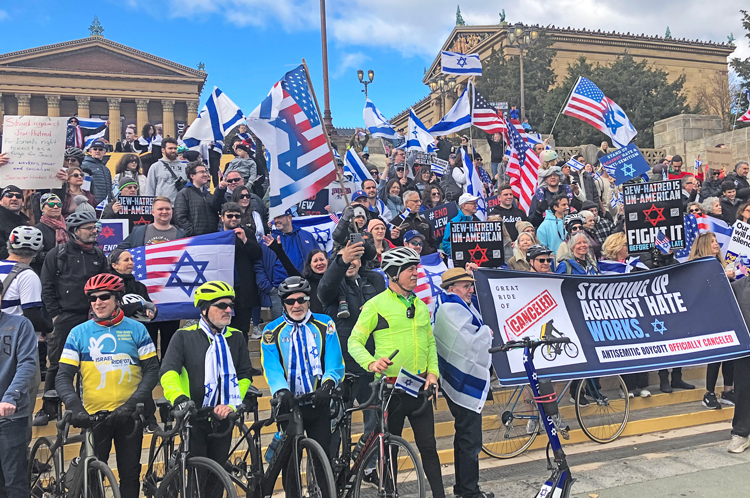
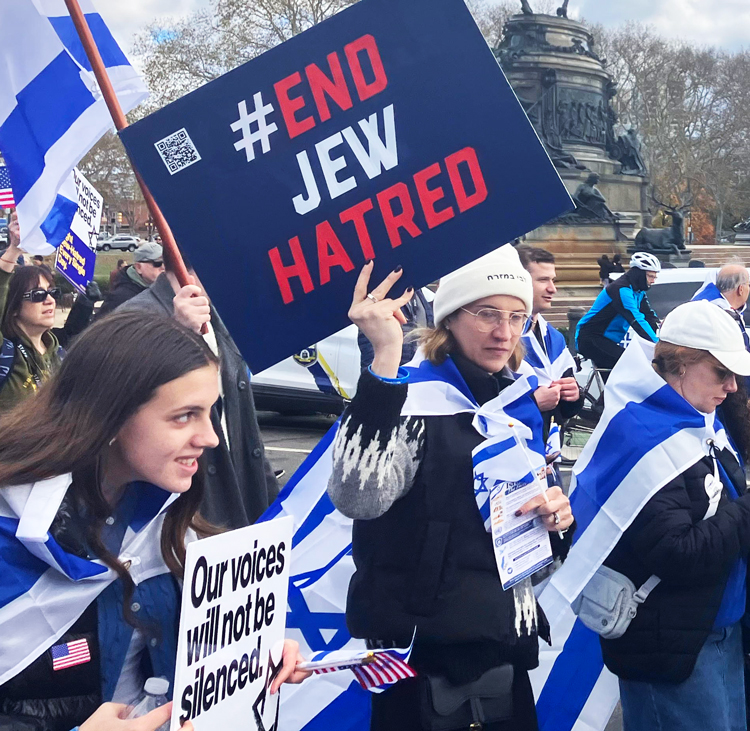
PHILADELPHIA — Some 250 Jews and fellow opponents of Jew-hatred rallied near the Rocky Balboa statue at the top of the stairs to the Philadelphia Museum of Art and joined a “Bike Ride for Israel” here Nov. 15. They mobilized to counter an announced second attempt to hold a bike ride demanding several Jewish-owned restaurants in the city be shut down, but that action was called off.
That’s why the main banner on the museum steps said, “Standing up against hate works: Antisemitic boycott officially canceled.”
They also were celebrating the success of their much larger counterdemonstration the week before, when they outnumbered and blocked out a reactionary, Jew-hating action against Jewish-owned businesses here.
After the rally, bikers and marchers made their way downtown to the Liberty Bell. Then they gathered at the Congregation Mikveh Israel, the oldest synagogue in the city — founded in 1740 — to celebrate and share a Kosher meal.
The ride was organized by the Philly-Israel Alliance, a coalition that includes the Jewish Federation of Greater Philadelphia, the American Jewish Committee, End Jew Hatred, Hadassah, and the historic synagogue.
A tiny group of pro-Hamas supporters waving Palestinian flags stood at the top of the museum’s steps yelling Jew-hating abuse. They said they will continue to try to organize a “boycott” of the restaurants.
“Ours is not a counterprotest,” Rachel Alaiev, co-chair of Jewish organization Chevra Sisterhood, told the rally. “We are not here to make someone else’s message louder by arguing with it. We are here to share our own.”
The Jerusalem Post quoted Aryeh Shalom, who posted the flyer for the Ride for Israel, saying that following the Oct. 7, 2023, massacre in Israel, Jewish residents in Philadelphia “have increasingly faced verbal harassment and accusations of genocide while simply walking into neighborhood coffee shops or convenience stores.” He said he organized the ride to push back against this “climate of intimidation,” calling on “both Jewish community members and non-Jewish allies to march together.”
Shalom added, “I don’t want my children to have to hide their Jewish identity.”
Some of the protesters at the Philadelphia rallies had been part of an earlier movement fighting for the freedom of the 250 hostages seized by Hamas during their Oct. 7 pogrom in Israel. The Hamas thugs murdered over 1,200 people, including Arabs and Bedouins who lived and worked with Jews; wounded thousands more; and raped and mutilated women.
Roots of Jew-hatred
“My grandfather was a Bolshevik!” a woman at the rally said to Roy Landersen, a member of the Socialist Workers Party from Union City, New Jersey, after he had told her about the continuity of the SWP going back to the Russian Bolsheviks led by V.I. Lenin and how the victory of the 1917 October Revolution had put an end to the reign of terror of the pogroms organized by the czarist regime there. Her grandfather, she said, “used to hide revolutionary literature in hollow table legs to avoid being discovered by the secret police.”
“There were a lot of Jews in the Bolsheviks,” she added. Her grandfather escaped from Ukraine to the U.S. in 1913. She got the Pathfinder book The Fight Against Jew-Hatred and Pogroms in the Imperialist Epoch: Stakes for the International Working Class.
Jenni Paul, a former school guidance counselor, initially told Landersen, “I don’t talk to socialists,” expressing her anger at the growing normalization of Jew-hatred being led by New York Mayor Zohran Mamdani and the Democratic Socialists of America. But when she realized he was part of the demonstration and not with the antisemitic handful there, she apologized and welcomed him.
David Alper, who held the main banner, told Landersen that the rise of Jew-hatred meant it was “time to unite in solidarity.”
“It is wonderful to see the turnout today, with more young people compared to last week,” he said. “I hope the attacks on Jews won’t happen again, but I know it will.”
SWP member Mary Martin spoke with Elvis Faruku who lives in Italy, but is originally from Albania. While visiting the museum, he saw the rally and decided to join. “I am not Jewish,” he told Martin, “but I think for me and all these people, being here today is important.”