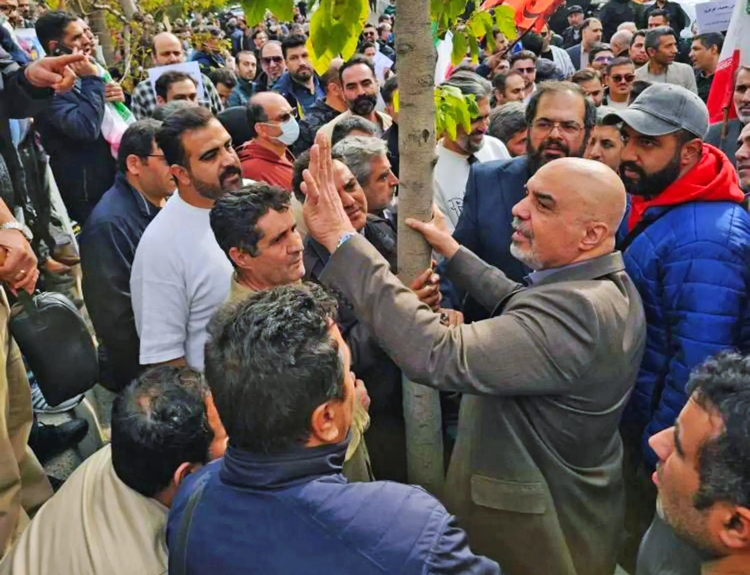
Every day brings new strikes, labor actions and social protests in Iran as the reactionary capitalist regime makes workers and farmers pay for the deepening capitalist economic crisis and for Tehran’s bloated military and provocative foreign adventures.
Those taking to the streets include bakers; youth looking for jobs; steel, electrical, municipal, health care and oil workers demanding a living wage and job safety; truck drivers; students; and opponents of the death penalty and violence against women.
Bakers protested outside the Khuzestan province governor’s office in Ahvaz Nov. 21 after the regime cut their flour allocations.
“Our flour has been gone for six days now,” the bakers said. “If we close the bakery, people will be dissatisfied. If we obtain flour from somewhere else the government accuses us of smuggling.”
The flour shortage comes on top of a government cap on how much subsidized bread households can buy in Khuzestan and at least two other provinces. Once their monthly bread quota runs out, customers pay more than five times the subsidized price.
Prices of meat and other staples have skyrocketed under the impact of the worldwide capitalist crisis, the devastation from the U.S. military attacks and sanctions on Iran, and the regime’s decision to prioritize producing weapons. As a result, growing numbers of working people rely on subsidized bread to survive.
Striking workers at the Khorasan Steel Complex in Neyshabur, in northeastern Iran, were joined by their wives and children sitting down in the road leading to the plant Nov. 22. They’re demanding higher wages, protesting poor work conditions and the threat of layoffs.
“For several years we have been asking company officials to eliminate discrimination and improve our conditions and benefits, but there has been no change,” one striker told the government-funded Iranian Labour News Agency.
Truck strike in face of tripling costs
Owner-operator truck drivers went on strike in as many as a dozen cities Nov. 22, saying the government’s 22% rate increase for carrying freight was far too little. It “does nothing to solve our problems,” the Association of Truckers and Drivers Unions of Iran, which called the strike, said Nov. 23.
“The prices of tires, spare parts, engine oil, and repairs in many cases increased by up to 300%,” two trucker associations in Aligudarz, Lorestan province, said in a letter to the government. “How can a driver whose truck maintenance costs have increased several times over be expected to continue operating with only a small increase in rates?”
One trucker wrote on the association’s internet site Nov. 23 that “the authorities attempt to use war and sanctions as an excuse to evade responsibility for their own negligence and incompetence.
“In order to cover the government’s expense, they have placed the entire burden of rising prices and hardship on our shoulders and those of the people.”
Retirees: ‘We don’t want war’
Weekly protests by retirees across the country for higher pensions and medical benefits are taking on broader demands.
“I don’t want war or killing. I want lasting prosperity,” some 75 retirees chanted outside the Labor Department in Kermanshah Nov. 24. “Imprisoned workers must be freed,” they demanded, a reference to the hundreds, if not thousands, of teachers, workers and others who have been detained by the regime on bogus charges.
The deepening resistance is impacting the government-funded Workers House. It supports workplace committees that include representatives of the workers, the government and the bosses to try to keep workers tied to the regime and prevent them from going on strike.
But at a Nov. 20 meeting attended by over 500 people, the Workers House read out a resolution calling on the regime to raise wages and benefits and to guarantee workers the right to organize unions without government or boss “interference.”
It also demanded the government take “appropriate decisions as soon as possible to bring an end to unjust and inhumane sanctions against the people of Iran” — while also pledging “unwavering” support for Supreme Leader Mojtaba Khamenei.
That can only be understood as a call on the regime to agree to the demands of the U.S. rulers for Tehran to cease attacking ships using the Strait of Hormuz, restrict its nuclear program and stop its stepped-up military attacks against neighboring states.
But the regime boasts it is ready for a new war. It’s promoting a video showing a massive underground facility full of missiles. This gives Washington a pretext for blockading Iranian ports and imposing sanctions, which adds further to the burden the working people in Iran face.