Moscow on July 4 launched the largest drone and missile barrage so far since its 2022 invasion, targeting civilians in the capital Kyiv and other Ukrainian cities. The day before, Russian President Vladimir Putin talked on the phone with President Donald Trump, insisting in no uncertain terms that “Russia will continue to pursue all its goals.” That is, to conquer and subjugate Ukraine and its people.
Trump told reporters he was “very unhappy” about the call. His goal has been to convince Putin to agree to a ceasefire and join with Washington to offset Beijing’s challenge to the U.S.-dominated world capitalist pecking order. “It just seems like he wants to go all the way and just keep killing people.”
But the immense cost of the war — over a million Russian workers and farmers in uniform have been killed or maimed — is deepening disaffection on the front lines. Despite the Kremlin’s repression, opposition to Putin’s bloody war on Ukraine and his increasingly repressive regime at home continues to mount.
Moscow is ramping up drone production and missile attacks on apartment buildings, factories, schools, medical facilities and other civilian targets. But Ukrainian working people remain as determined as ever to resist.
In a phone call later in the day July 4, Trump spoke to Ukrainian President Volodymyr Zelensky about renewing supplies of Patriot missiles to strengthen Ukraine’s capacity to protect its people. “They’re going to need something because they’re being hit pretty hard. We’re going to have to send more weapons,” Trump told the press.
The same day, German Chancellor Friedrich Merz called Trump and then told the media Berlin would try to fill the air defense gap by buying Patriots from the U.S. to ship to Ukraine.
Putin keeps trying to claw more territory from Ukraine using Russia’s weighty advantage in manpower and armaments. Moscow’s military thrust into Ukraine’s Donbas region over the past two years has come at a huge cost. The Kremlin high command cynically treats Russian troops as cannon fodder, accepting immense casualties in hopes of making slow grinding progress.
Pro-Kremlin military commentators, who are given wide play in Russia, describe Moscow’s military brass as rife with corruption. Generals make false claims about conquering villages they haven’t taken and demand bribes from soldiers seeking to escape being sent on Putin’s deadly “meat assaults.” Supplies are increasingly transported to the front lines by 80-year-old trucks, civilian cars, golf carts or even donkeys.
Maimed troops thrown into battle
Videos circulate showing wounded soldiers, including some who have lost an arm or a leg, being forced back into battle. The result, these “milbloggers” say, is widespread drunkenness and drug use coupled with low morale and growing desertions by Russian troops.
Soldiers are forced to rely on online fundraising appeals in Russia to try to raise the means to buy everything from drones to bulletproof vests, first-aid kits and generators. Some milbloggers report the Russian people at home are getting tired of sending money. Troops put little stock in government calls for patriotism and sacrifice.
A rare Russian defense ministry internal investigation was ordered in September after two well-known Russian drone operators, Dmitry Lysakovsky and Sergei Gritsai, were sent on a hopeless mission by officers they had offended. The two posted a last-testament video denouncing their commander, Igor Puzik, saying he was profiting from assets seized in the war and drug deals in the regiment, and for lying about taking Lysyvka village in Donetsk.
“I am recording this video because there is a very high probability I will not return from this assault,” said Lysakovsky. “The main task that we have now is to survive, and theirs is to make sure that we do not survive.”
The video went viral with millions of viewers, feeding disaffection at the front and at home.
The staggering casualties as well as the social crisis at home are causing a mounting demographic disaster. Russia’s official statistical agency recently stopped reporting on deaths, births and the country’s total population. An earlier report showed life expectancy for men dropped from 66 years to 61 over the past year, while that of women remained at 75, reflecting the losses in the war. The last official figures released in February showed birth rates at the lowest total since the early 1800s!
Appeal by Russian political prisoners
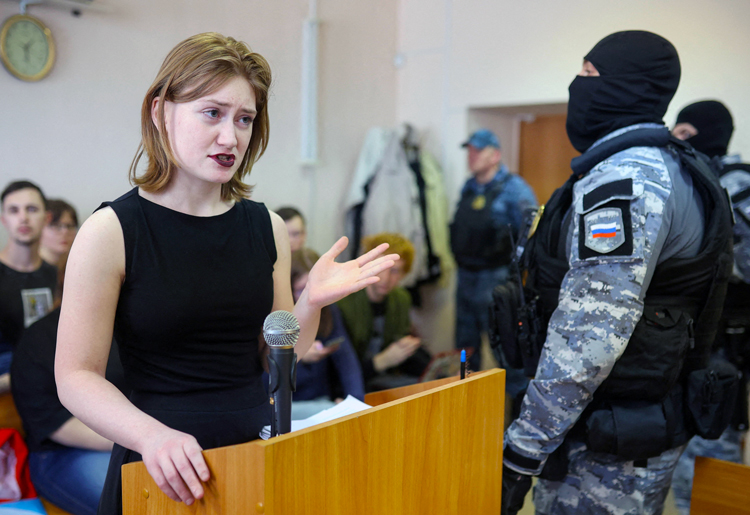
A July 3 open letter by 11 political prisoners in Russia made an international appeal on behalf of “at least 10,000 of us — Russian political prisoners and Ukrainian civilian hostages.” They have been “all punished for one thing — for taking a civic stance,” they said. Many of the prisoners openly oppose Putin’s regime and its wars.
“Repressive legislation aimed at eliminating any dissent has been consistently tightened since 2012,” the appeal notes. This has accelerated in recent years, especially since Moscow’s outright invasion of Ukraine. “Today, anyone who dares to think critically can end up behind bars.”
“The cruelty of punishment is growing,” with prison terms of 10, 15 and 20 years not uncommon. Russia’s “State Duma [parliament] regularly demands the return of the death penalty.”
“The health and lives of prisoners are at risk. Torture and pressure against them are most often not investigated or punished. Political prisoners are, more often than others, held in harsher conditions and deprived of the opportunity for parole and legal relaxation of the detention regime. The practice of initiating additional criminal cases based on denunciations by other convicts has become common.”
The letter calls “on both sides of the negotiations between Russia and Ukraine to immediately conduct an exchange of prisoners of war and civilians according to the formula ‘all for all,’ including Ukrainian civilian hostages” held in occupied eastern Ukraine. And “for the immediate and unconditional release of sick political prisoners who are dying in Russian prisons.”
The letter is signed by Alexei Gorinov, Anna Arkhipova, Vladimir Domnin, Boris Kagarlitsky, Darya Kozyreva, Dmitry Pchelintsev, Andrei Trofimov, Ilya Shakursky, Alexander Shestun, Artem Kamardin and Azat Miftakhov.