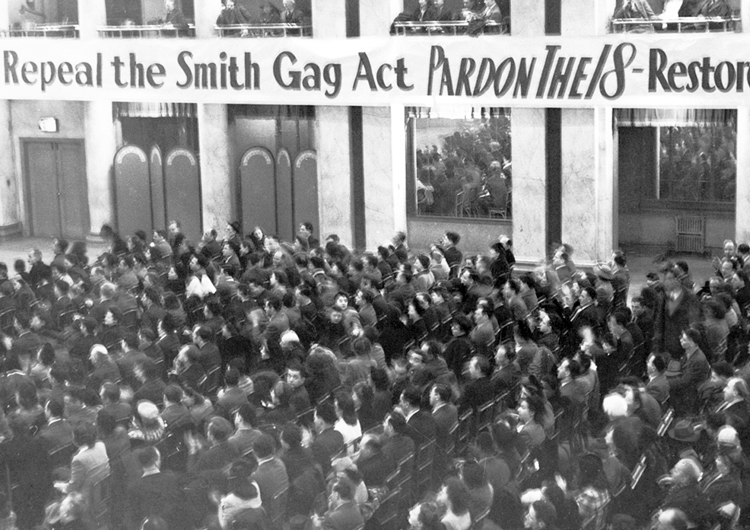
The Spanish edition of Socialism on Trial: Testimony at Minneapolis Sedition Trial, one of Pathfinder’s Books of the Month for July, is by James P. Cannon, national secretary of the Socialist Workers Party at the time of the trial. He and 17 other leaders of the party and Upper Midwest labor movement were framed up in 1941 and imprisoned two years later on charges of conspiring to advocate the overthrow of the U.S. government. Cannon testified, clearly and forcefully, presenting the communist program and course of the vanguard of the working class. The U.S. rulers’ aim was to prevent a mass working-class opposition to their entry into the second imperialist slaughter. Copyright © 2014 by Pathfinder Press. Reprinted by permission.
JAMES P. CANNON: Modern wars are caused by the conflict of imperialist nations for markets, colonies, sources of raw material, fields for investment, and spheres of influence.
SWP ATTORNEY ALBERT GOLDMAN: What do you mean by “imperialist,” Mr. Cannon?
A: Those capitalist nations which directly or indirectly exploit other countries.
Q: What is the party’s position on the inevitability of wars under the capitalist system?
A: As long as the capitalist system remains, and with it those conditions which I have mentioned, which flow automatically from the operation of the capitalist and imperialist system, wars, recurring wars, are inevitable. …
Our party has always stated that it is impossible to prevent wars without abolishing the capitalist system which breeds war. It may be possible to delay a war for a while, but eventually it is impossible to prevent wars while this system, and its conflicts of imperialist nations, remains. …
[F]undamentally wars are caused by the efforts of all the capitalist powers to expand into other fields. The only way they can get them is by taking them away from some other power, because the whole world has been divided up among a small group of imperialist powers. That is what leads to war, regardless of the will of the people. …
Our party is unalterably opposed to all imperialist wars. … By that we mean that we do not give any support to any imperialist war. We do not vote for it; we do not vote for any person that promotes it; we do not speak for it; we do not write for it. We are in opposition to it.
Q: How does the Socialist Workers Party oppose the idea of the United States entering into the war?
A: We do it as every other political party promotes its ideas on any foreign policy. We write against it in the paper; we speak against it; we try to create sentiment in any organization we can approach, to adopt resolutions against the war. If we had members in Congress, they would speak in Congress, in the Senate, against it. In general we carry on public political agitation against the entry of the United States into war, and against all measures taken either by the Executive or by Congress which in our opinion lead towards active participation in the war. …
“The Socialist Workers Party
is unalterably opposed to
all imperialist wars.”
Q: So, essentially, your opposition during a war would be of the same type as your opposition prior to the war?
A: A political opposition. That is what we speak of. …
[W]e do not put any confidence in the ruling capitalist group in this country. We do not give them any support because we do not think they can or will solve the fundamental social problems which must be solved in order to save civilization from shipwreck.
We believe that the necessary social transition from the present system of capitalism to the far more efficient order of socialism can only be brought about under a leadership of the workers. The workers must organize themselves independently of the capitalist political parties. They must organize a great party of their own, develop an independent working-class party of their own, and oppose the policy of the capitalist parties, regardless of whether they are called the Democratic or Republican, or anything else. …
America is today a capitalist nation. It is different from the others only in that it is stronger than the others and bigger. We do not believe in capitalist policy. We do not want to gain any colonies. We do not want bloodshed to make profits for American capital.
Q: What is the party’s position on the claim that the war against Hitler is a war of democracy against fascism?
A: We say that is a subterfuge, that the conflict between American imperialism and German imperialism is for the domination of the world. It is absolutely true that Hitler wants to dominate the world, but we think it is equally true that the ruling group of American capitalists has the same idea, and we are not in favor of either of them.
We do not think that the Sixty Families who own America want to wage this war for some sacred principle of democracy. We think they are the greatest enemies of democracy here at home. We think they would only use the opportunity of a war to eliminate all civil liberties at home, to get the best imitation of fascism they can possibly get. …
Wars frequently have been followed by revolution; wars themselves are the expression of a terrible social crisis, which they are unable to solve. Misery and suffering grow at such a tremendous pace in war, that it often leads to revolution.
The Russo-Japanese war of 1904 produced the Russian revolution of 1905. The World War of 1914 produced the Russian Revolution of 1917, the Hungarian revolution, near-revolution in Italy, and the revolution in Germany and Austria; and in general, a revolutionary situation developed over the whole continent of Europe, as the result of the First World War.
I think it is highly probable that if the war in Europe continues, then the mass of the people, especially in Europe, will undertake to put a stop to the slaughter by revolutionary means.