China’s state capitalist rulers are moving to extend their economic and military reach across the Pacific in a growing challenge to Washington’s decadeslong supremacy there. The U.S. rulers are determined to win out and protect their markets, resources and profits in the region, which they see as their prize from emerging as top dog out of the second imperialist world war. Washington threatens to intervene militarily, joined by its allies, if Beijing attempts to invade and seize Taiwan.
Beijing has heavily invested in expanding its armed forces, at the same time millions of China’s working people face a sharpening economic crisis. Labor actions and protests are suppressed by the authoritarian regime.
China’s rulers see Washington’s weakening domination amid a disintegrating world imperialist “order” as an opening to expand their own power in the Asia-Pacific region and beyond. They’ve conducted rehearsals for an invasion across the Taiwan Strait, jousted with forces of the Philippines over its nearby islands and stepped up production of armaments.
Beijing has created and fortified islets across the South China Sea, through which almost a third of global shipping passes. Recently, the Chinese rulers planted a permanent oil rig in a disputed part of the Yellow Sea between China and South Korea.
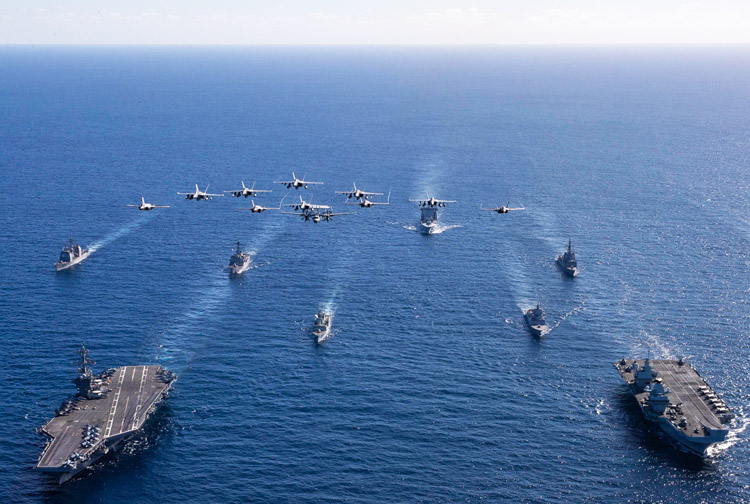
Two of China’s aircraft carriers held their first joint drills in the western Pacific near Japan in June. A third carrier — larger and more advanced but still not comparable to the nuclear-powered giants in the U.S. fleets — will enter service this year.
In February, Chinese navy warships carried out unannounced live-fire drills in the Tasman Sea between Australia and New Zealand that disrupted some 50 international airline flights. The aggressive display, including sailing around Australia, was a “wake-up call” for Canberra and Wellington, New Zealand’s defense minister said.
Washington is pressing the governments of its partners in the Pacific — Japan, Australia, South Korea, Taiwan and others — to bolster their own armaments and armies.
The largest-ever war games, co-organized by Washington and Canberra, began in northern Australia July 14. Over 2,000 U.S. Marines are based there for half of each year, and U.S. strategic bombers rotate in and out.
This year the biennial exercises, called Talisman Sabre, involved over 40,000 troops from 19 nations. The armed forces of imperialist powers from Japan and New Zealand as well as several European countries, along with those of South Korea, the Philippines, India and Fiji participated.
Air, land and sea drones, a growing part of today’s wars, featured in the fight over the sovereignty of Ukraine, are being pursued everywhere.
Trade conflicts with China
The deepening crisis of capitalism today is fueling trade disputes between rivals and allies alike worldwide. None is more fraught than those between the rulers in Washington and Beijing. This has sharpened conflicts among opposing powers over wealth extracted from the labor of workers and farmers, as well as access to markets and mineral riches.
Beijing’s vast manufacturing industries are keenly dependent on exports to markets in the U.S., European Union and elsewhere, since no comparable internal market has been developed inside China. This makes it vulnerable in trade disputes as it tries to export its way out of its crisis.
China’s working people face an uncertain future with the crisis provoking large-scale youth unemployment and disaffection, alongside growing inequality, layoffs and unpaid wages.
A huge bubble, inflated by years of government stimulus, in construction of huge apartment towers, which many workers could not afford, and other infrastructure development, burst in 2021. This was highlighted by the collapse of Evergrande, a giant real estate firm that fell amid a glut of unsellable housing and massive debt.
Millions lost savings in banking failures, and indebted local governments still face serious financial stress.
Attempting to escape the crisis by another giant central-government stimulus can only create a deeper disaster. Chinese President Xi Jinping recently admitted, “We should not only focus on how much GDP has grown and how many major projects have been built, but also on how much debt is owed.”
Competition among Chinese manufacturers for markets — both inside China and abroad — is headed toward a new crash. This is especially sharp in the electric vehicle industry, where cutthroat downward pricing is fueling a deflationary spiral.
Drawing a comparison to the housing collapse, Wei Jianjin, chair of Great Wall Motors, said, “The Evergrande in the automobile industry already exists, but it is just yet to explode.”
The only way auto bosses there have survived so far is by stopping payments to their suppliers, spreading the economic crisis.
The price cuts also feed tariff battles with foreign competitors. All this fuels the rush to increase military spending.
Working people around the world are being driven to resist attacks by the bosses and their governments on our livelihoods. At the same time, these same bosses tell us, “we” Americans have common interests in beating back foreign competition. This is a lie. U.S. workers have a strong class interest in international solidarity with our fellow workers against the bosses and their political parties everywhere, including in China.