At the center of a recent deadly fight in southern Syria is the Syrian government’s attempt to impose its rule in the predominantly Druze region. This is in contrast to what is often presented in the capitalist press as long-simmering disputes between Bedouin and Druze tribes.
Israeli Prime Minister Benjamin Netanyahu said it was “absolutely unacceptable” that the Syrian regime sent its troops into southern Syria, which Israel insists must be a demilitarized zone, and massacred hundreds of Druze. Maintaining a stable border is part of Israel’s battle to defend the country as a refuge for Jews and to prevent another Holocaust.
Resistance from the Druze and military strikes by Israel forced Damascus to back off.
Ninety-one percent of the population of Sweida governorate near Israel are Druze; the rest are Bedouins or Christians. There are some 700,000 Druze in Syria, 150,000 in Israel, 250,000 in Lebanon and 20,000 in Jordan who closely follow the unfolding battle for national rights in Syria.
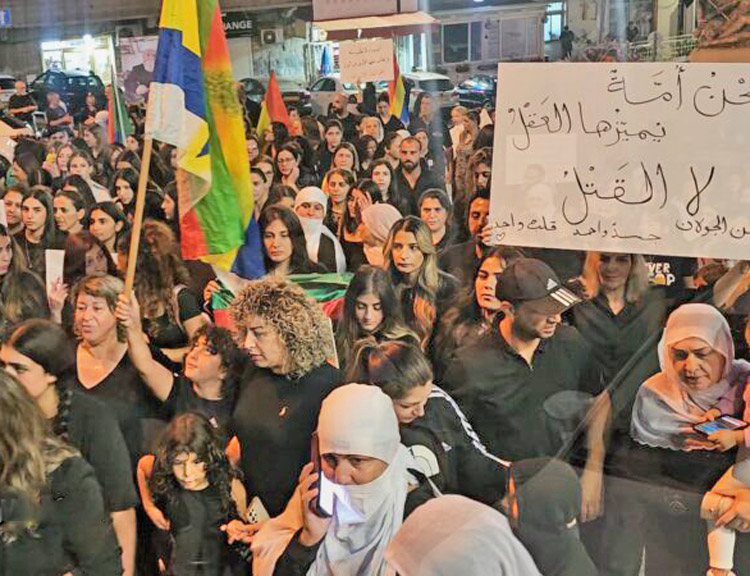
In Israel thousands of Druze took to the streets to demand that the government come to the aid of their Druze brethren in Syria. “This is our Oct. 7,” Sari Halabi, a Druze who lives in Majdal Shams in the Golan Heights 50 yards from the Syrian border, told the Jewish News Service.
Since the overthrow of the Bashar al-Assad dictatorship, Syrian President Ahmed al-Sharaa has sought to create a centralized capitalist state and army. But Kurds in the north and Druze in the south — given Sharaa’s origin in Islamic State and al-Qaeda — have good reason not to trust the new regime to respect their national rights.
During the Syrian civil war, the Druze worked to keep out reactionary Islamist forces fighting Assad. As Assad’s repression deepened, thousands of Druze in Sweida — along with local Bedouins — joined protests against his regime.
‘We were united, now it’s not so easy’
“It was a good time, we were united,” Omar al-Sabra, a Bedouin who was at those protests, told the New Arab news site. “Now it’s not so easy, tensions have emerged.”
Every modern capitalist regime has fostered divisions among Syria’s different nationalities and religions. The Bedouin are mostly Sunni Muslims and historically seminomadic, raising livestock. The Druze practice a religion that diverged centuries ago from Shia Islam and many are farmers.
Despite some conflicts over land and resources, the Druze and Bedouin in Sweida have mostly had fraternal relations, attending each others weddings, wakes and other social events.
The latest dispute began after a Bedouin militia allied with Sharaa kidnapped and robbed a Druze merchant at a checkpoint on the Damascus-Sweida road July 13. Druze groups retaliated, kidnapping several Bedouins.
This escalated into armed clashes as thousands of Bedouin fighters from hundreds of miles northeast and with little connection to Sweida poured into the south. Many large Bedouin tribes refused to join them.
Sharaa sent in troops of the Syrian Arab Army supposedly to quell the violence. Instead, they joined brutal attacks on the Druze.
Druze civilians, including women and children, were massacred. Videos showed Syrian troops and allied Bedouin militiamen forcibly shaving off the mustaches of Druze men, a symbol of their religion.
Some Druze and local Bedouin helped each other. When Fouad Hanna, a Druze, was shot by pro-regime thugs, his Bedouin neighbors rushed him to a hospital.
Israel insisted that the Syrian troops leave and backed up its demand by bombing Syrian tanks and positions in Sweida and the entrance to the defense ministry in Damascus. Sharaa ordered his troops to retreat, but his allied militias continued looting and attacking Druze. By July 20 a shaky ceasefire was in place.
According to the Syrian Observatory for Human Rights, 505 Druze fighters and 298 Druze civilians were killed, including 194 “summarily executed by members of the Defense and Interior Ministries,” along with 408 government troops and 35 Bedouins.
In the face of the Druze resistance and Israel’s warnings, Sharaa abandoned his call for Druze militias to dissolve and announced he was entrusting the Druze groups and their religious leaders to maintain the security of the province.
US gov’t: Israeli moves ‘at bad time’
President Donald Trump’s administration opposed Israel’s intervention. Trump announced in May he would lift all U.S. sanctions on Syria and removed the terrorist designation of Tahrir al-Sham, the group Sharaa led before toppling Assad.
His administration is trying to cobble together an alliance involving the Syrian regime, the governments of Saudi Arabia and Turkey and others, as well as reestablish relations with Tehran. The U.S. rulers want a new Pax Americana like it established as the victor after World War II — stability for capitalist profits under U.S. economic and political supremacy, backed up by Washington’s military might.
But stability is impossible given Israel’s fight against Hamas in Gaza is still unresolved and Tehran is looking to get back on course for developing nuclear weapons aimed at Israel’s major cities. Any ceasefire in Syria is unstable as the Sharaa regime is committed to extending its control over the Druze, Kurds and other oppressed nationalities.
Only by joining in common struggle can working people — Druze, Bedouin, Jews, Christians, Kurds, Afghanis and others — earn each others trust, defend their national aspirations and begin forging a working-class leadership and road forward.