The bourgeois clerical regime in Iran is stepping up its promotion of Iranian nationalism in a desperate attempt to counter the erosion of support at home. At the same time, it is moving against its critics, arresting hundreds of alleged “Zionist” agents and stepping up its already extensive use of the death penalty.
Tehran’s actions are a sign of its weakness in the wake of its losses in Israel’s recent 12-day defensive war to prevent another Holocaust. Israel’s goal is to prevent the Iranian regime from developing nuclear weapons and delivery systems to carry out its stated aim of destroying that country as a refuge from Jew-hatred the world over.
Neither Tehran’s patriotic appeals nor its terror have succeeded in stopping political protests and resistance by workers and oppressed nationalities, which have been on the rise, with ebbs and flows, since 2017.
Despite a lull during the recent fighting, protests have started back up. From July 26 to July 29 alone, there were more than 50 protests across the country by oil workers, bakers, farmers and retirees over wages, pensions, work conditions and other issues.
Retirees protested July 27 in Tehran, Rasht and Kermanshah. In Kermanshah a member of the Truckers and Drivers Association of Iran stopped by and later posted a video on the union website. “We don’t want war, we don’t want killing!” he reported the retirees chanted. “Solidarity, unity is the solution to oppression and injustice” and “Imprisoned teachers, imprisoned workers, must be freed.”
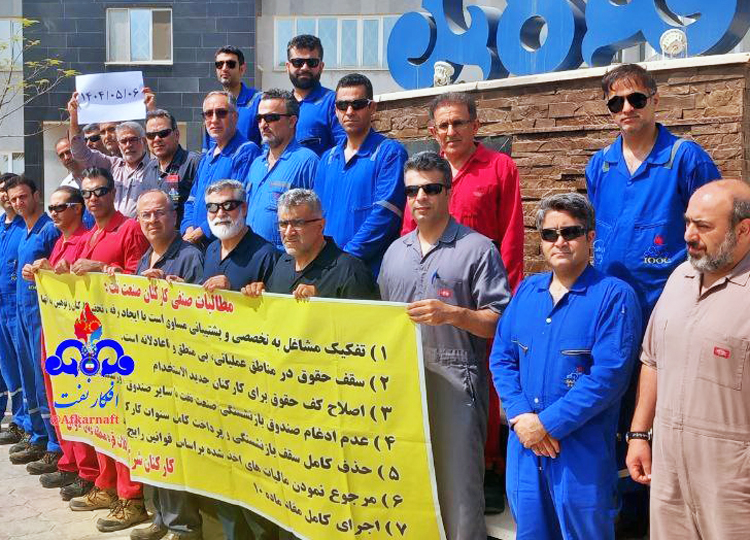
On July 28 permanent workers at 40 oil and gas platforms and at least six refineries and other sites protested against caps on their wages, announcing they will protest every week until they win their demands. Demands for job safety are a big part of the actions.
The Truckers and Drivers Association, which in late May and early June carried out the largest nationwide strike in decades, is continuing the struggle for its demands, including the release of all truckers imprisoned during that fight. The truckers also have expressed solidarity with the oil workers.
The association issued a statement in the wake of the death of several Kurdish environmental activists, who died fighting a fire near Sanandaj, where the government failed to respond. “With deep sorrow and heavy hearts, we received the tragic news of the passing of three selfless sons of Kurdistan,” the Truckers association said. “This heartbreaking event is not only an environmental disaster, but also a symbol of the oppression of a people.”
Protests against water crisis
Meanwhile, thousands of workers and farmers protested against the government for its inaction in the face of a severe water shortage, after five consecutive years of drought. Forty cities, including Tehran, are on rations. Water reserves in Tehran are only at 14% of their capacity and it’s even worse in other provinces.
Hundreds took to the streets of Khomam, a small town in Gilan province July 29. “Water and power are cut — this happens every day,” they chanted. They were attacked by the “security” forces.
“We can’t take it anymore,” one protester said. “The officials’ inaction has pushed the people to the breaking point.”
Anti-worker, Jew-hating regime
During the June airstrikes, Israeli forces destroyed some 80% of Tehran’s rocket launchers, roughly half its ballistic missiles, and severely damaged key nuclear installations.
The anti-working-class, Jew-hating regime had instigated and backed the Nazi-like Hamas death squads when they launched the Oct. 7, 2023, pogrom in Israel, killing 1,200 people, mostly civilians, wounding thousands, and raping and mutilating dozens of women. Since then, Israel has done serious damage to Tehran’s “axis of resistance” in Lebanon, Gaza and Syria.
Tehran now hopes its calls for Iranian patriotic unity will get a hearing from some workers. In doing so, it seeks to play on decadeslong popular opposition to the U.S. imperialist government, which on June 22, acting alone, dropped bunker buster bombs on three nuclear sites.
Many working people and youth in Iran oppose the U.S. rulers’ profit-driven plunder of the region. This includes helping to impose the brutal regime of Shah Mohammed Reza Pahlavi on the Iranian people through the CIA-organized 1953 coup. The shah was overthrown in the 1979 popular revolution.
The shift in the regime’s rhetoric, prominently mixing in patriotic Iranian nationalism with stock-in-trade religious appeals, marked the annual Shiite religious ceremony July 5 commemorating the seventh-century death of Imam Hussein, the grandson of the Prophet Muhammad.
In addition to the usual Shiite songs, this year Supreme Leader Ali Khamenei for the first time asked that a nationalist anthem be sung, with some religious stanzas added. The government’s Press TV reported that the song resonates “with listeners through its patriotic themes, evoking deep feeling of pride and love for the homeland.” Or so the regime hopes.
Two newly installed billboards in Tehran praise an ancient mythical Persian icon, Arash the Archer, whose image is surrounded by a volley of missiles.
Tehran steps up repression
Since the start of the war, Tehran has arrested at least 2,000 people, especially members of the oppressed Kurdish and Baluchi nationalities, and members of the Baha’i religious minority. It has also carried out massive deportations of Afghan immigrants.
At least 35 Jews have been arrested, including two U.S. citizens visiting Iran when the war broke out. Some of them had been stopped at checkpoints. When the regime’s agents found phone numbers of relatives in Israel, they were accused of spying for the Mossad. According to the Times of Israel, all but five have been released.
The regime has also stepped up use of the death penalty for political and criminal charges. According to Amnesty International, nearly 700 people have already been executed in 2025 compared to 900 in all of last year. Even before the step-up, Iran executed more prisoners than any other government in the world, except for Beijing.
Inmates at 48 prisons joined the 79th weekly Tuesday hunger strike against the death penalty July 29. According to the “No to Execution Tuesday” campaign, a few days earlier some 100 armed prison guards and other cops raided the political prisoners ward at Ghezel Hesar Prison in Karaj, near Tehran.
“All political prisoners in the unit were shackled hand and foot, blindfolded with bags over their heads and transferred to solitary confinement,” the campaign reported.