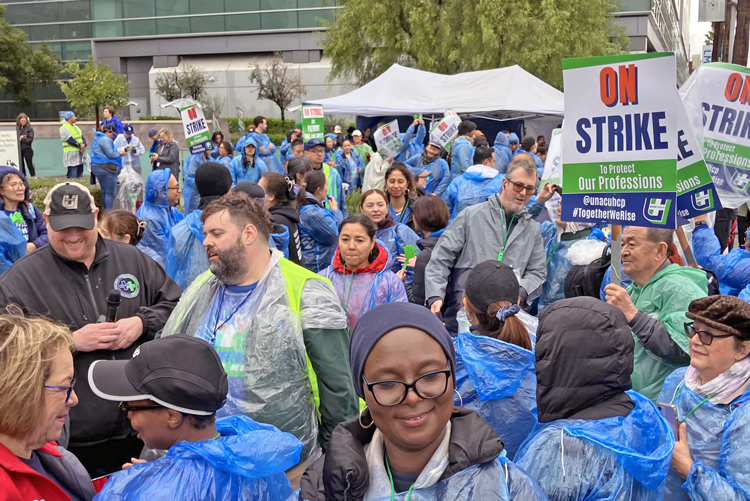
LOS ANGELES — Over 40,000 nurses and other health care workers at Kaiser Permanente hospitals went on strike for five days starting Oct. 14. “Kaiser pushed us to the end,” Tina Chin, a physician assistant in neurosurgery, told the Militant at a large picket line outside the Kaiser hospital on Sunset Boulevard here. “I’ve never done this before. They have to start respecting us so we can do our job correctly.”
The strike by the United Nurses Associations of California/Union of Health Care Professionals and other unions spread through 500 Kaiser hospitals and clinics on the West Coast and in Hawaii. Strikers include nurses, physician assistants, anesthetists, pharmacists and other medical personnel.
“Year after year, Kaiser has made billions. Year after year, they have raised prices on membership,” said Hectos Raygoza, a member of the local bargaining team and a physician assistant. “While inflation shot up, Kaiser refused to increase wages beyond the 2% yearly increase” negotiated in the last contract. The union is asking for a 25% raise over the next four years to catch up with inflation.
“But it’s not just about wages,” Raygoza said. “We’re overbooked and time spent with each patient has been reduced.”
Nicole Wooten, a registered nurse in Riverside, described what they face. “Nurses go home exhausted because we have too many patients to take care of. The shifts are long, the pace never slows, and there’s always one more call light, one more chart, one more medication to give. You move from room to room like you’re on a timer — because you are.
“And then, when you finally get to leave, you think about the faces you saw that day — the people you wanted to help more but couldn’t. The patient who was scared and needed someone to sit with them, but you had five other rooms to check. The one who wanted to tell you a story, but you were already halfway out the door to handle something urgent.
“That’s not how we want to practice nursing,” she said. “We want to give every patient time, attention and compassion, not just the bare minimum to survive the shift.
“This fight for a strong contract is personal for me. I grew up on the picket line. Back in the 1980s, my dad worked at Brown & Sharpe in Rhode Island, and he was part of what’s considered the longest industrial strike in U.S. history,” she explained. “I was just a kid, but I remember standing out there every day with him. He was a picket captain, and he never gave up.
“So when the chance came here to step up and be a union advocate, I knew it was my time. When I told my dad, he cried. He agreed, ‘Now it’s your turn.’
“And that’s why I’m here. Because the work we do matters.”