As the crisis of capitalism deepens and sharpening trade conflicts and disputes over markets and resources grow, ruling imperialist governments are looking to build their military forces, search for allies and prepare for wider wars.
What can working people do to prevent the horrors of the first two world wars from being repeated by nuclear-armed powers? Lessons from the conflicts and class battles that led up to the second imperialist world slaughter are invaluable for understanding what is needed to prevent fascists seizing power again. These lessons arm workers to understand why we must unite in our tens of millions to do the one thing that can prevent new world wars — taking political power from the capitalist war makers into our own hands.
In the aftermath of Hitler’s triumph in 1933, the Stalinist regime in Moscow instructed Communist Parties worldwide to make a sharp change from the ultraleft and sectarian policies that had led the large German CP to refuse common action with other forces to prevent the Nazis from coming to power.
They were now to seek lasting alliances with liberal capitalists, supposedly to prevent fascists coming to power elsewhere. Under this scheme — dubbed the Popular Front — the only choices for workers were between the “democratic” capitalist rulers or the fascists. The irrevocable class antagonisms that are fundamental to the workings of capitalism were concealed. The fight by the working class to establish its own rule was put on permanent hold.
That remains the course of Stalinist groups and the middle-class radicals that increasingly ape them today. In the U.S. they urge workers to get out the vote for the imperialist Democratic Party under the illusion that defeating the “fascist” Donald Trump is all that matters. They claim that Trump rules for some “oligarchs” among the capitalists, as if the Democrats weren’t run by big capital as well. Similar forces advance one or another version of this class-collaborationist approach everywhere.
Popular front policies were first imposed on Communist Parties at the 1935 congress of the Communist International. Comintern leader Georgi Dimitrov told delegates that in the U.S. the Republicans and other “reactionary” political forces that were attacking President Franklin D. Roosevelt and his New Deal were in fact “organizing a fascist movement.” Criticism of the New Deal is “tantamount to misleading the working class in the struggle against its worst enemy,” he claimed.
Roosevelt’s New Deal was actually aimed at convincing workers they’d be taken care of by liberal capitalist governments following the depths of the Great Depression in the early 1930s. It was aimed at taming a wave of deepening union struggles that led to the birth of the CIO, and keeping workers trapped within the bosses’ two-party setup.
Under popular front policies, the U.S. Communist Party proclaimed Roosevelt an “anti-fascist.” The party centered its politics on support for the Democratic administration, cutting down any movement by the unions toward creation of an independent labor party. And it pressed for a U.S. military alliance with the Soviet Union.
Popular Front paves way for fascism
The Stalinist parties’ use of “the conciliatory politics practiced by the People’s Front dooms the working class to impotence and clears the road for fascism,” exiled Russian revolutionary leader Leon Trotsky wrote in 1938. His remarks were built on the bloody defeat of the Popular Front governments that destroyed promising revolutionary upheavals that swept France and Spain.
In France the Popular Front government of Leon Blum was elected during an upsurge in strikes and factory occupations in 1936. Blum’s government was endorsed by the Communist Party’s parliamentary deputies. Instead of educating workers to rely on the strength of their own forces, Blum and the Stalinists pushed the illusion they could rely on a bloc with capitalist parties to protect them from fascism and war.
Blum’s government acted as a sharp brake on workers’ struggles and paved the way for demoralization and a crushing defeat. It was ousted just a year after its election. By 1938 Edouard Daladier, formerly a chief spokesman for the Popular Front, became prime minister. He unleashed a wave of repression that included banning and arresting his former allies in the Communist Party.
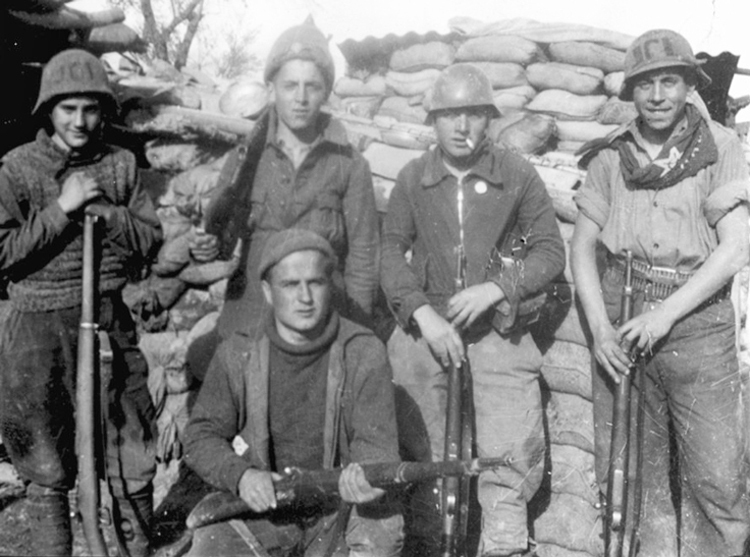
During the Spanish Revolution, a coalition of left-wing capitalist parties and the Socialist and Communist parties were elected to Spain’s parliament in 1936, supported by anarchists and centrists. Workers and peasants had begun seizing factories and taking control of the land in response to the growing capitalist crisis and assaults by Gen. Francisco Franco’s reactionary forces.
Even with the tremendous support among workers worldwide for the fighters in Spain, the Popular Front government was more afraid of the revolt of the toilers than it was of Franco’s fascists. It acted as a brake on a deep-going popular revolution, paving the way for its bloody defeat.
Popular front polices in Spain and elsewhere were accompanied by the Stalinists’ murder of revolutionary-minded opponents who stood up to their class-collaborationist course, first and foremost the followers of Trotsky.
The defeat of the Spanish Revolution made World War II inevitable. But the outcomes of the revolutionary struggles that preceded that slaughter were not preordained. The working class had its chance to take political power out of the hands of the capitalist class during revolutions in Germany prior to Hitler’s rise to power, and again in massive struggles in France and during the Spanish Revolution.
Whether or not a third world war takes place will be decided in the course of similar mighty class battles in years to come, by the development of a revolutionary leadership capable of organizing working people independently of the bosses and their political parties, the Democrats and Republicans. It will be decided by the building of a working-class party that is capable of leading the workers and their allies to conquer power.