“The current situation in our sister Caribbean nation of Cuba,” David Comissiong, ambassador from Barbados to the Caribbean Community (Caricom), said in a Feb. 17 public letter, “demands a significant and meaningful response from all people and governments of conscience.” Caricom is a cooperating organization of 15 Caribbean and Latin American governments, with another five associate members.
The Barbadian official described the impact of the U.S. rulers’ decadeslong economic war on the Cuban people, intensified by President Donald Trump’s Jan. 29 executive order threatening punitive tariffs on any country that dares to supply Cuba with oil. Commissiong called it “terrorism through hunger,” a deliberate U.S. policy to deprive Cuba of food and energy supplies.
He said a “special relationship” has existed between Cuba and four Caribbean nations since October 1972, when the governments of Trinidad and Tobago, Jamaica, Guyana and Barbados “took the courageous step of defying the mighty USA and the Organization of American States and broke the almost ironclad policy of isolation that these two entities had imposed on revolutionary Cuba.” The four English-speaking island countries had won their independence from British rule years earlier.
In January 1962, at the instigation of the Democratic John F. Kennedy administration, Cuba was expelled from the OAS as part of Washington’s pressure on all Latin American governments to break diplomatic relations with Havana.
To the newly independent Caribbean countries, Cuba’s socialist revolution set an example that true economic and political independence was necessary and possible to exist and develop as sovereign nations, not as semicolonial appendages of U.S. imperialism.
In an example of internationalist solidarity, the Cuban government has contributed to the economic, social and cultural development of Caribbean nations without any conditions. Thousands of their professionals have been trained in Cuba, as well as hundreds of athletes who have benefited from Cuba’s sports programs.
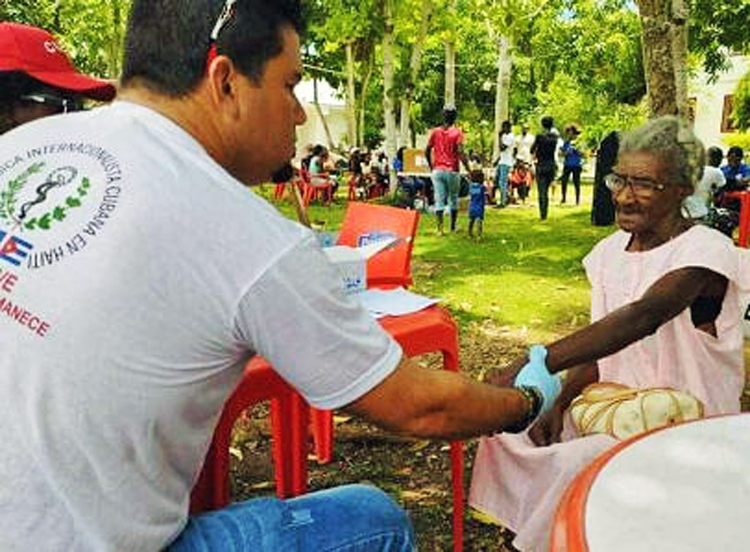
Millions of working people in Latin America and the Caribbean have been treated by Cuban medical doctors and nurses, both in their own countries and in Cuba, including hundreds of thousands who had their eyesight restored by Cuba’s Operación Milagro (Operation Miracle) program.
“The time has come for us — the people and government of Caricom — to do our duty and help our Cuban sisters and brothers,” said Comissiong.
“What about the rest of the international community?” Comissiong asked in his letter, noting that for over three decades the overwhelming majority of United Nations members —including members of its Security Council — have voted to adopt a yearly resolution calling on Washington to end its more than six-decade-long economic war against Cuba. “The time has therefore now come for these major countries to — as they say — ‘put their money where their mouths are’!”
U.S. violation of ‘international law’
Washington has carried out sanctions against Cuba and imposes countless obstacles on its trade with other countries. It has implemented an oil blockade, attacked alleged drug boats in the Pacific and Caribbean, and organized the murderous attack in Caracas that led to the seizure of Venezuelan President Nicolás Maduro and the murder of 100 Venezuelan and Cuban military and civilians. These are only a few recent examples of how so-called international law only applies when it serves the interests of the imperialist powers.
Bodies like the U.N., International Criminal Court, OAS and other imperialist-dominated organizations were created following Washington’s victory in the second imperialist world war to perpetuate the existing inequality among nations, rather than to establish any genuine equality among them. That isn’t possible under the imperialist system.
Washington’s war drive is also blowing out of the water — literally — the much-vaunted illusion that there exists a “multipolar” world today. Supposedly the BRICS (Brazil, Russia, India, China and South Africa) — or any other alliance of rivals of U.S. imperialism — would offer better conditions for the sovereignty of smaller underdeveloped nations and provide a counterbalance to Washington. But those governments — like all capitalist governments — first and foremost look after the interests of their national ruling classes.
Working-class solidarity
Millions of working people around the world are outraged by what the U.S. rulers are doing, with the complicity of other imperialist powers, against Cuba. Public demonstrations against Washington’s policy toward Cuba are beginning to take place. Many more, and more powerful, are needed.
In the U.S. and Canada, several demonstrations took place over the Feb. 21-22 weekend. (See lead article.)
Along with public protests, solidarity organizations in Mexico are organizing to collect material aid to send to Cuba. More than 200 tons of food and medicine had been collected by Feb. 23 at a tent set up for a couple of days in Mexico City’s historic Zocalo by the Association of Cubans Resident in Mexico and the Va por Cuba collective.
“There has always been a fraternal relationship” between the peoples of Cuba and Mexico, Alberto Romero told CNN as he dropped off a donation. “And I hope that we send them oil soon.”
Mexico and Venezuela supplied some 60% of the oil Cuba imported until the U.S. government kidnapped the latter’s president Jan. 3, and threatened Mexico with heavy tariffs if they didn’t cut off oil shipments to Havana. Washington’s stated aim is to crush Cuba’s socialist revolution.
The Mexican government suspended oil shipments to Cuba in early February, citing the need to avoid U.S. tariffs, and has sent “humanitarian aid” instead. The governments of Brazil and Colombia, two other oil producing countries in the region, have not signaled any intention to challenge the U.S. oil blockade.