Protesters mount pickets in New York, Canada, Oakland
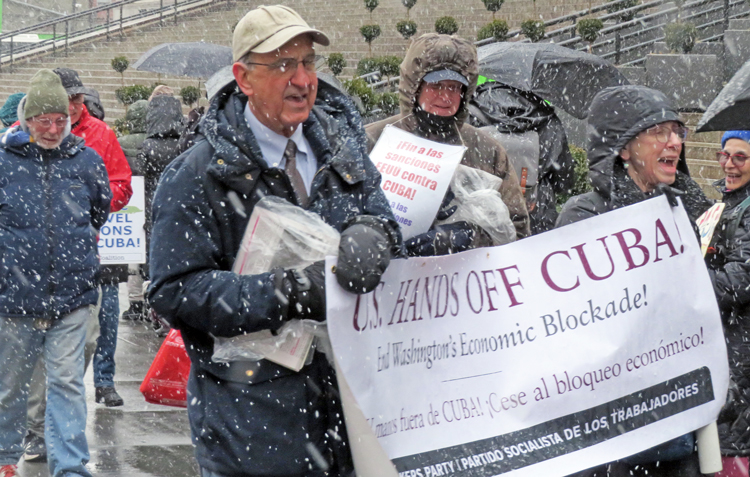
NEW YORK — Despite the beginning of a massive snowstorm here, opponents of Washington’s stepped-up attack on Cuba turned out for a spirited picket line in front of the main Post Office in Manhattan Feb. 22 to demand “U.S. hands off Cuba! End Washington’s economic blockade!”
The action was called by the New York-New Jersey Cuba Sí Coalition in response to the U.S. rulers’ threats that Cuba is “going to fall” and Washington’s blockade against all oil shipments to the island. Seventy-five people took part, with banners, signs and loud chants drawing the attention of the foot traffic and cars going by outside Penn Station and the Moynihan Train Hall. “Viva Cuba!” yelled a food delivery worker on a bicycle as he passed by with a clenched fist in the air.
“If it wasn’t for Cuba, there would be no independent Angola or Namibia,” a Yellow Cab driver originally from Mali said, as he was waiting for a fare across the street at Madison Square Garden and watching the picket line. Some 425,000 Cubans volunteered between 1975 and 1991 to go to help defend Angola against multiple invasions by South Africa’s apartheid regime, backed by Washington.
As the cab line moved, he bought a copy of Cuba and the Independence War in Guinea-Bissau and Cape Verde: The Fall of the Last Colonial Empire in Africa by Víctor Dreke. It tells the story of the decisive political and military aid Cuba’s revolutionary leadership provided to the liberation fighters in those two countries.
Representatives of several groups active in campaigns in solidarity with Cuba’s socialist revolution and against the U.S. economic war on Cuba spoke at an impromptu rally. Paul Mailhot, Socialist Workers Party candidate for governor of New York, noted the importance of public actions in opposition to Washington’s drive to destroy Cuba’s socialist revolution by suffocating its economy and people.
“The action here today is one of several taking place across the U.S., and won’t be the last,” said Ike Nahem, an organizer with the Cuba Sí Coalition. He urged participants to build and attend a March 14-15 Action Conference for US-Cuba Normalization in New York. It will feature representatives of the Federation of Cuban Women and other mass organizations.
“I was in Cuba before the COVID pandemic,” Michael Georgeson told the Militant as he was passing by the picket. “If the American people had the opportunity to see Cuba, it would change their mind about what they’ve heard about Cuba’s system. They’d see that there is a different way to organize things at a social level.” Georgeson said he had visited Cuba to attend an academic conference and it had a big impact on him.
‘Let Cuba Live’ protests held in several cities across Canada
MONTREAL — The Canadian Network on Cuba called an emergency National Day of Action for “Let Cuba Live” protests that were held in a number of cities across Canada Feb. 21-22. They demanded the immediate end of Washington’s oil blockade of Cuba, and for Ottawa to call for Washington to end its violation of Cuban sovereignty.
Over 200 rallied in Toronto; 120 in Montreal; 60 in Winnipeg, Manitoba; and 50 in Vancouver, British Columbia. A protest also took place in Edmonton, Alberta.
Stephen von Sychowski, president of the Vancouver and District Labour Council, was a featured speaker at the Vancouver rally. On Feb. 18 a membership meeting of Local 11, District 250 of the International Association of Machinists there adopted a resolution in solidarity with Cuba. It stated that Washington’s moves to cut off oil shipments to Cuba “sharply increase the risk of war in the world today.” The resolution demands that Ottawa call on the U.S. to end its almost 70-year embargo of Cuba.
“Cuba will resist with the solidarity of the world,” Julio Fonseca, co-chair of the Canadian Network on Cuba, told the Toronto rally in front of the U.S. Consulate there.
Union participation was an important part of these protests. The flags of the Ontario Public Service Employees Union and the Canadian Union of Postal Workers were part of a display in Toronto with placards condemning Washington’s attacks on Cuban sovereignty. A week before, CUPW issued a statement “condemning the U.S. government fuel blockade of Cuba,” as did the Canadian Union of Public Employees. The Canadian Labour Congress, representing more than 3 million workers, issued a similar statement Feb. 20.
In Montreal protesters gathered in front of the U.S. Consulate chanting “Cuba yes! Blockade, no!” Signs included, “End Ottawa’s complicity” and “Leave Cuba in peace.”
An official of the Montreal Central Council of the Confederation of National Trade Unions spoke along with representatives of Cuba solidarity groups.
Joe Young, the Communist League candidate in the Quebec provincial election, also spoke, telling the crowd that like Washington, Ottawa “is an enemy of the Cuban Revolution.” He said that based on false claims that there is no aviation fuel available in Cuba, all Canadian airlines have stopped flights to Cuba, “a big blow to the Cuban tourist industry.”
Even if Cuba ran low on fuel, airline officials acknowledge they could easily continue their flights, refueling at nearby airports.
Protesters marched to a downtown federal government building, demanding Ottawa take a stand against the U.S. oil blockade.
— John Steele
‘The attack on Cuba is also an attack on the U.S. working class’
OAKLAND, Calif. — Supporters of the Socialist Workers Party candidate for governor of California, Margaret Trowe, helped initiate an informational picket calling for “Hands Off Cuba!” outside a BART train station Feb. 18.
Seventeen people joined the protest, including long-time fighter for Puerto Rican independence Willye Rivera. They held signs and passed out flyers in Spanish and English explaining how the U.S. government has placed a blockade on oil getting to the Cuban people, an act of war. “The attack on Cuba is also an attack on the U.S. working class as many workers look to end today’s wars and prevent more deadly conflicts,” an SWP campaign flyer said.
Speaking over a sound system, Trowe and other speakers drew attention to the importance of organizing opposition to Washington’s military threats and economic blockade of Cuba. “Why does Washington hate Cuba so much?” Trowe said. “Why have all the administrations, Democrat and Republican alike, since the Cuban Revolution in 1959, tried to destroy the revolution? It’s because the workers and farmers of Cuba, 90 miles from the U.S. shores, threw off the U.S.-backed dictator, made a socialist revolution, and set an example for working people everywhere, especially in the U.S.!”
Supporters of Trowe sold four copies of Cuba and the Independence War in Guinea-Bissau and Cape Verde: The Fall of the Last Colonial Empire in Africa to people who wanted to learn more about Cuba’s socialist revolution.
At a rally organized by the Letter Carriers union and at a Teamsters picket line at California State University, East Bay, over the following days, SWP members raised the need for workers and the unions to join actions to defend Cuba.
— Betsey Stone