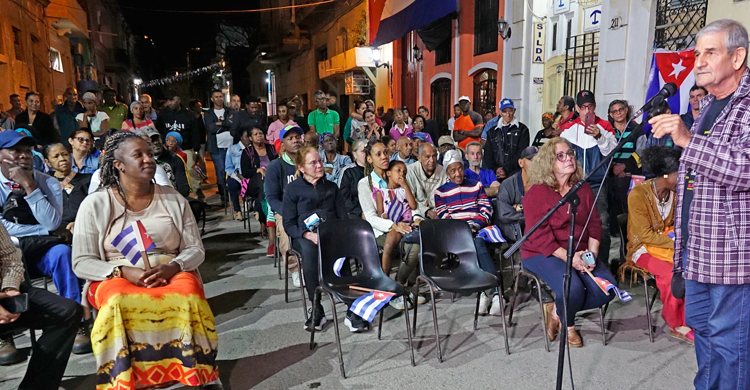
HAVANA — Some 120 residents of Colón, a working-class district in central Havana, gathered here Feb. 25 for an evening street meeting, organized by the neighborhood-based Committees for the Defense of the Revolution (CDRs). They discussed Washington’s latest attacks on Cuba’s socialist revolution. The meeting took place at a time when Cubans are confronting the brutal effects of a U.S. oil blockade. The island nation needs to import some 60% of its fuel.
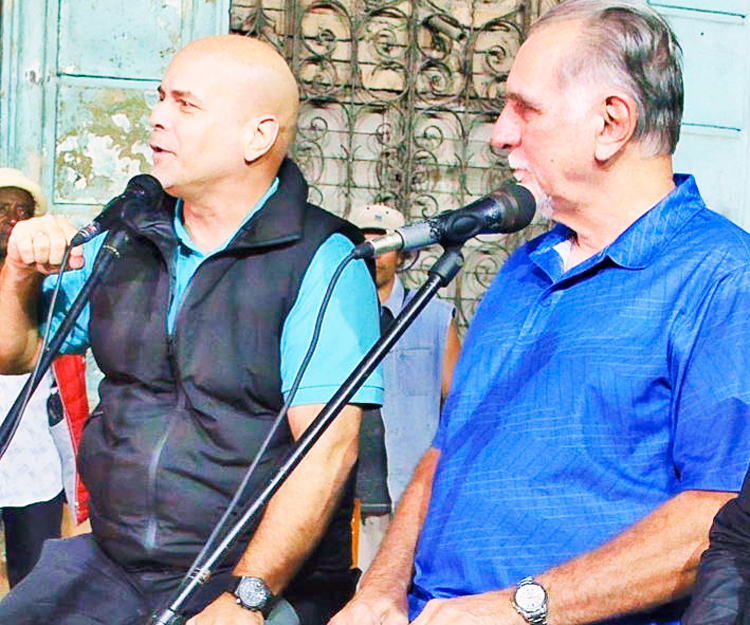
CDR national coordinator Gerardo Hernández pointed to the news just hours earlier that Cuban border guards had thwarted an armed incursion by Florida-based counterrevolutionaries on a speedboat seeking to land on Cuba’s northern coast (see article).
“We must be prepared,” he said, for the U.S. government to use such a provocation to ratchet up its propaganda campaign and efforts to overthrow the revolution.
Hernández addressed the meeting together with René González. They are two of five revolutionaries — known worldwide as the Cuban Five — who, between 1998 and 2014, were imprisoned in the U.S. for helping deter violent attacks on Cuba by similar U.S.-based counterrevolutionary outfits.
Both underscored Washington’s decadeslong efforts to crush the Cuban people for making a socialist revolution in what the U.S. capitalists consider to be “their” hemisphere. The audience viewed a film clip of a speech by revolutionary leader Fidel Castro, who said it was important to distinguish between the U.S. government and the people of the U.S.
“Fidel always taught us to make that distinction,” Hernández said. As an example, he welcomed the presence at the meeting of members of the Socialist Workers Party who, together with members of the Communist Leagues in Canada and the United Kingdom, were in Havana to report on the Cuban people’s response to Washington’s attacks. “While we were in prison, these compañeros supported the fight for our freedom and sent us the Militant and revolutionary books by Pathfinder,” Hernández said.
Hernández noted that the day before, members of the Cuban Five had spoken at events in different Havana neighborhoods to recall what had happened exactly 30 years earlier — Feb. 24, 1996 — when two planes flown by the Miami-based counterrevolutionary group Brothers to the Rescue, after repeated similar provocations, invaded the island’s airspace once again and were shot down by Cuban forces (see article). They especially sought to educate younger generations who didn’t live through that experience.
‘A hornet’s nest awaits them’
Several Colón residents took the floor. Luis Caballero, a retired restaurant worker, saluted the Cuban border guards who had stopped the most recent armed incursion. It’s a reminder to the U.S. government, he said, of “the hornet’s nest that awaits them if they launch a military attack on us.” He also paid tribute to the 32 Cuban internationalists killed in combat Jan. 3 when Washington assaulted Venezuela, kidnapped President Nicolás Maduro and his wife, Cilia Flores, and locked them up in a U.S. prison.
Caballero himself, like several others at the meeting, was among the more than 300,000 Cuban volunteer combatants who helped defend Angola’s sovereignty against invasions by the white-supremacist South African regime in the 1970s and ’80s.
Miguel Morales, a telephone lineman and president of the local telephone workers union, told the Militant this was one of the “barrio-debates” (neighborhood discussions) organized periodically by the CDRs. Residents discuss both defense of the revolution and how to confront challenges of daily life, in a country being strangled economically by U.S. government measures that deny working people access to the most basic necessities, from medicines to electricity and transportation.
Marisela Padrón said, “We face a lot of difficulties here as a result of the U.S. economic blockade. For example, high food prices because so many goods must be imported, and limited trash collection because the U.S. blockade leaves our trucks without fuel or spare parts.
“We discuss these problems in the CDRs. It’s not easy,” Padrón told us. “But one thing Mr. Trump should know — despite all this, we’re not going to give in to the demands of the imperialists that we change our system.” Others at the meeting said they knew what capitalism is like and did not want to ever go back to that exploitation.
Speaking with Militant reporters a few days before, Gustavo Chui Beltrán, a retired brigadier general in Cuba’s Revolutionary Armed Forces and also an Angola combatant, said it’s true the U.S. rulers know that, if they invaded Cuba, they would face a response far different from when they launched their assault on Venezuela.
Will they invade? “There’s one thing we’ve learned from our revolution, from Fidel and Che [Guevara],” Chui replied. “We can’t ever lower our guard.”