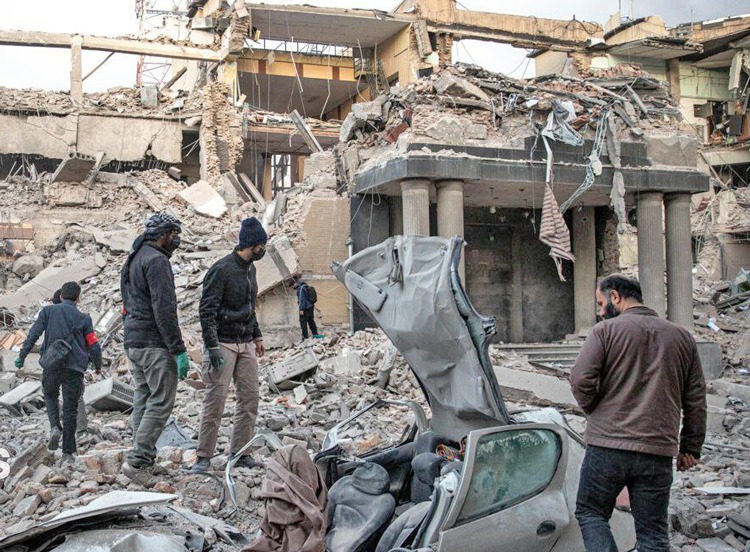
Washington’s massive military assault on Iran — a violation of the country’s national sovereignty — and Tehran’s drone and military counterattacks on U.S. bases, oil facilities in neighboring Arab countries and on Israel are having a devastating impact across the Middle East. Israel continues to defend itself from the Iranian rulers, who are committed to destroying it.
In his announcement of the Feb. 28 assault, President Donald Trump claimed it was intended to aid anti-regime protesters who had taken to the streets across Iran. But Trump’s claims to be promoting peace, prosperity, and freedom for those who live in Iran or elsewhere in the region are just a pretext for advancing the interests of the U.S. ruling class.
In the first hours of the attacks by U.S. forces and Israel dozens of the Iranian regime’s civilian and military officials have been killed, including Supreme Leader Ayatollah Ali Khamenei as well as the head of the hated Islamic Revolutionary Guard Corps. In the first 24 hours alone, more than 1,200 bombs were dropped on targets across the country, including the headquarters of the Revolutionary Guards, the paramilitary Basij and many police stations.
The U.S. assault prevented students, retirees and other workers from holding sit-ins and picket lines planned for Feb. 28. Their actions were gaining momentum, despite the regime’s brutal massacre of more than 7,000 protesters in January. Union activists and other opponents of the regime shifted to encouraging people to organize to look out for each other amid the bombings and the regime’s ongoing repression.
On Feb. 22, a week before the start of the new war, five Kurdish parties had announced the formation of a coalition to strengthen the fight for the “rights and freedoms of the people of Kurdistan,” for the rights of all the oppressed nationalities in Iran and for “democracy and the rejection of all forms of dictatorship.”
The bourgeois clerical regime in Iran and its predecessor, the U.S.-backed dictatorship of the shah of Iran, have repressed the country’s oppressed nationalities — including Kurds, Baluchis, Arabs and others — who make up some 40% of Iran’s population.
‘The people are cannon fodder’
“The government has provided no warning and no facilities to protect people’s lives. The people are cannon fodder in the power struggles of governments,” the Retirees Council of Iran said as the bombing began. “Whenever politicians compete, they take our lives; whenever they compromise, they steal our bread.”
The bourgeois clerical regime has been moving its forces near schools and other civilian buildings, copying the methods of Hamas in Gaza, where its cynical use of civilians as human shields for its military installations caused thousands of deaths.
U.S. forces destroyed oil facilities on Kharg and Kish islands, as well as port facilities that service oil tankers. This is a direct blow to oil workers who have held weekly protests for over a year, demanding higher wages, job safety and better work conditions. Many oil workers had begun joining the anti-regime protests that swept Iran in January. The number of workers killed or injured is not yet known.
A U.S. submarine sank an Iranian warship off the coast of Sri Lanka March 4. War Secretary Peter Hegseth, boasted it was “the first sinking of an enemy ship by a torpedo since World War II.”
The Iranian regime has fired hundreds of missiles at population centers in Israel, with most, but not all, intercepted. At least nine people were killed March 1 when a ballistic missile hit a bomb shelter, residences and a synagogue in Beit Shemesh.
Tehran’s drones and missiles also hit U.S. bases in Saudi Arabia, the United Arab Emirates, Bahrain, Qatar, Kuwait and Jordan. But instead of forcing those regimes to take their distance from the U.S. war, the attacks deepened Tehran’s isolation and opened the door to some Arab governments actively backing the U.S. operation.
The Saudi Ministry of Affairs said Feb. 28 that it “condemns and denounces in the strongest terms the treacherous Iranian aggression” and that it is “placing all its capabilities” to support the Arab nations that were attacked.
Debris from intercepted missiles damaged the airport, residential neighborhoods and a port in Dubai. Tehran bombed a power plant and energy facility in Qatar March 2, and its drones caused a fire at a major Saudi oil refinery.
U.S., Israel’s conflicting aims
The goals of the U.S. imperialist rulers and the capitalist government in Israel are not the same.
The U.S. rulers want a regime in Iran that will bow to U.S. efforts to dominate and plunder the oil, gas and other resources in the region and help Washington push back its rivals from Beijing to Moscow and beyond.
“Trump hit Iran — but he’s really got China in his crosshairs,” was the headline in a March 2 New York Post opinion column by Steven Mosher that captured part of this reality.
“Two years ago, China was riding high in the Arab world,” Mosher says. It had “brokered a normalization agreement between Shiite Iran and its longtime Sunni adversary Saudi Arabia.” And it was buying Iranian oil at below market prices in the face of U.S.-imposed sanctions.
But now, in the wake of Washington’s cutoff of Beijing’s access to cheap Venezuelan oil, “Beijing will be forced to pay full price for its oil to U.S.-owned refineries, in U.S. dollars,” Mosher said, if the U.S. rulers accomplish their current war aims.
As Washington looks for plunder and power, Israel’s goal is to defend its existence. Tehran put together the so-called axis of resistance, including Hamas in Gaza, Hezbollah in Lebanon, various militias in Iraq, the Houthis in Yemen, with the goal of destroying Israel and eliminating the Jews who live there.
Tehran financed and helped plan the Oct. 7, 2023, anti-Jewish pogrom that slaughtered 1,200 people in Israel. Acquiring one small nuclear bomb would give the Iranian rulers the capacity to wipe out Israel, killing Jews and Arabs alike.
Israeli Prime Minister Benjamin Netanyahu’s defensive battle to destroy Tehran’s nuclear program and missile capability during last year’s “12-day” war was blocked by Washington before Israel could finish the job, when Trump ordered him to end the war prematurely.
After Hezbollah fired missiles and drones at Israel to support Tehran in the current war, Israeli troops entered southern Lebanon and struck Hezbollah posts across the country.
A new regime in Iran?
The Trump administration has begun discussing publicly its plans for who will be in power in Iran when its war ends. Speaking at the White House March 3, Trump dismissed the idea of a government headed by exiled “crown prince” Reza Pahlavi, and told reporters that “someone from within, maybe, would be more appropriate,” someone “more moderate.”
Trump compared what the U.S. rulers want to gain in Iran, with their assault on Venezuela, where U.S. troops kidnapped President Nicolás Maduro, and installed Vice President Delcy Rodríguez in power, ready to collaborate.
“Venezuela was so incredible because we did the attack and we kept the government totally intact,” Trump said. “We have the whole chain of command.” But so far, there has been little indication of any section of the Iranian regime that is willing to concede to the U.S. rulers.
“Most of the people we had in mind are dead,” Trump said March 3.