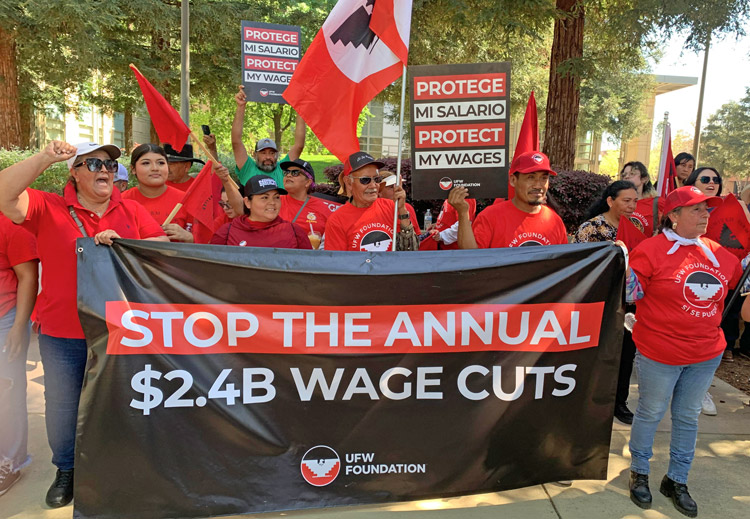
FRESNO, Calif. — Over 100 farmworkers, members of the United Farm Workers union, and supporters from throughout the Central Valley converged on the federal courthouse here March 18 to demand an end to stiff wage cuts imposed by the government for workers on H-2A visas.
They were joined by a few farmworkers from Georgia, Washington and Oregon. Workers carried signs and banners reading, “Protect my wages” and “Stop the annual $2.4 billion wage cuts.” Drivers passing the courthouse honked support for the protesters lined along the sidewalk waving signs and union flags.
Inside the courthouse, the first hearing took place on a lawsuit filed in November by the union and the UFW Foundation challenging new U.S. Labor Department regulations, asking that they be blocked, and a cap be placed on the number of H-2A visas issued, to protect jobs for area workers.
Of some 800,000 farmworkers in this state, 40,000-45,000 are workers from Mexico and other countries who have government permission to work in agriculture on a temporary basis. While the wages vary by state, the impact of the new rules and wage rates has meant an across-the-board wage cut. In a further boon to capitalist growers and packinghouse bosses, they can now deduct up to $3 an hour to cover a worker’s housing and transportation.
Before the new rules, workers in California with H-2A visas “were guaranteed a wage of $19.32 per hour with their housing and transportation paid for,” the UFW said on their website. “After the wage cuts, that wage was lowered to $17.13 per hour with housing and transportation deducted from that wage.”
UFW President Teresa Romero addressed the rally outside the courthouse. The cut in a H-2A visa-holder’s wages is an attack not just on farmworkers, or on immigrants, but on the entire working class, she said.
“According to the government’s own estimate, the wage cuts transfer at least $2.46 billion annually from workers to employers and would represent one of the largest wealth transfers from workers to employers in U.S. agricultural history,” the union website explains.
Isabel Panfilo works picking strawberries near Oxnard in Southern California and is one of 18 individual farmworker plaintiffs in the union’s lawsuit. “It’s important for all farmworkers to know that this wage cut doesn’t just impact workers on H-2A visas, it impacts all of us,” she said at the rally. Last year “I made over $19 an hour at the company. This year, I went back to the same job. I’m doing the same tasks picking strawberries I did last year. But this year, they are paying us $16.90 per hour, the state minimum wage.” Panfilo, a U.S. citizen, added, “This makes it very difficult for me to make ends meet.”
Marta Montiel from McFarland works picking mandarin oranges and other products. She told the Militant, “We used to get paid $50 a bin for mandarin oranges and now we are getting $35,” blaming competition with workers the bosses are bringing in at lower wages. She said the agencies that hire workers for the large Halo mandarin packing plant “stopped hiring anyone 55 or older.” She worked there for over five years, but they won’t take her back now.
“We’re fighting for those with papers and those without papers,” UFW Secretary Treasurer Armando Elenes said. “They want to divide us but we won’t fall into that trap.” He cited a company where workers make “over $21 an hour because they have a UFW contract.” This “is the result of a fight by those workers and that’s what others must do.”
Many workers said that their hours have been cut or they are unable to find work. Andres Godoy Tamayo took the mic from Elenes at the end of the rally. “In Mendota 50% of us are unemployed,” he said. “I’ve worked picking almonds, pistachios, melons, and tomatoes. I’ve been working 45 years in the area and it’s the worst situation ever.”
He explained the greater competition has allowed the bosses to push for speedup, saying at the last place he picked watermelons workers used to try to fill five pallets, now they were pushing to do 10. “They didn’t want to take breaks, get water, go to the bathroom,” he said, for fear that the foreman would not bring them back. He said the pace became too much for his wife, who had to stop working. Many workers described similar experiences.
Like others from Fresno and the surrounding area, Jose Luis Zorrilla, a supporter of the UFW’s fight to block the new H-2A regulations, joined the rally. He told the Militant he worked in fruit crops and almonds for two years and now tutors Chicano youth studying Spanish. “Until farmworkers are truly respected and able to work with dignity,” he said, “nothing will change.”
During the court hearing the union’s attorney, Kuntal Cholera, asked Judge Kirk E. Sherriff to issue an injunction to stop this “massive and unprecedented transfer of wealth” from farmworkers to their employers. A decision is pending.
Laura Garza, SWP candidate for mayor of Los Angeles, contributed to this article.