Despite devastating losses to its military, police and other parts of its repressive apparatus, as well as the destruction of many factories during the recent wars with Washington and Israel, Iranian Foreign Ministry spokesperson Esmaeil Baghaei claimed the ceasefire it signed with Washington shows Tehran is “truly a superpower.”
Meanwhile, the reactionary regime continues to arrest teachers union leaders, lawyers who defend political prisoners, supporters of Kurdish rights, artists who defy repressive laws, members of the Baha’i religious minority and others it views as threats to its brutal rule.
The government has stepped up use of the death penalty for some criminal offenses and for those it accuses of “corruption on earth” for participating in anti-regime protests. Torture to force confessions is common.
These are signs of weakness, not strength.
“A country in which workers, nurses and teachers are forced to choose between paying rent, getting medical treatment, and feeding their children is weak at its core, no matter how many tanks and missiles it possesses,” an article posted on the Iran Retirees Council internet site June 19 says.
Regime slogans discredited
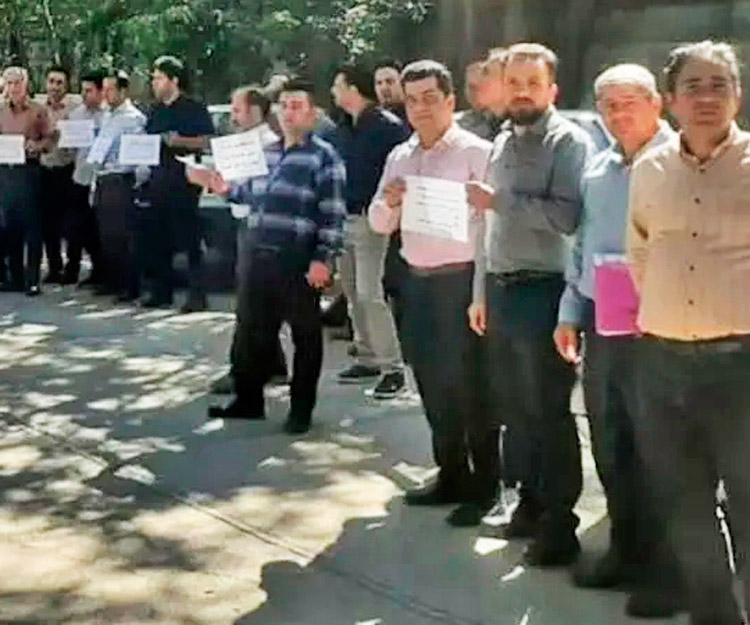
“When a retiree with 30 years of service stands in front of his office chanting, ‘Our table is empty,’ this is not merely a protest,” the article says, “it discredits all the slogans that have been promoted for years on billboards and television.”
Working people and oppressed nationalities in Iran have born the brunt of the capitalist economic crisis — made worse by harsh U.S.-imposed sanctions — for years. The war deepened this crisis. Job cuts, rising prices and shortages mean that many working people can’t afford basic necessities, including meat, chicken or even pistachio nuts. Protests are spreading again.
In the first few weeks of June, retirees demanding government-funded health insurance and higher pensions protested in Shush, Ahvaz, Kermanshah, Tehran, Qazvin and other cities. On June 7 many weekly retiree actions, which had been suspended amid the war, began again calling for freeing imprisoned unionists and political prisoners and abolishing the death penalty.
In early June thousands of high school students in at least 14 cities across the country took to the streets to oppose what they called top-down government decisions about their schooling made without the involvement of students and teachers.
The protests began when the government decided to hold in-person exams, despite the monthslong disruption of classes because of the war. “We’ve heard many promises, we’ve seen no justice,” the students chanted.
Workers’ protests are spreading as well. On June 16 truck drivers gathered outside the Sistan and Baluchistan province governor’s office in Rask to protest the suspension of fuel quotas for heavy vehicles and minibuses.
On June 17 farmers in Garmsar and Aradan counties, southeast of Tehran, blocked the train tracks to protest government responsibility for water shortages that have plagued the rural region for years. “The people want water, not promises!” they chanted.
That same day in the village of Pashmouki in Kerman province, soldiers severely beat with batons and kicked seven women from the oppressed Baluchi nationality after two days of protests against the effects of the chromite mine there. The protesters say that the mine hires few local residents and the profits are not used to help the community.
Workers at the Sepah Bank — which has ties to the Islamic Revolutionary Guard Corps — went on strike in several cities June 17, after they were only paid 50% of their monthly wage, rapidly forcing the bank to pay up.
Solidarity with Afghan women
Dozens of refugees protested outside the Afghanistan Embassy in Tehran June 12, in solidarity with protesters in Herat, Afghanistan, who were brutally beaten earlier in the week by Taliban forces. Echoing the 2022 protests in Iran, the Herat demonstrators chanted “women, work, freedom.”
Tehran authorities have backed off attempts to impose the hijab on women — who by law are supposed to cover their hair. In the wake of the war the regime has permitted public concerts, including looking the other way when women sing in public, which is officially banned.
In part this is an attempt by the regime — which is widely hated by working people and many in the middle classes — to garner support by projecting itself as standing up to “foreign” attempts by Washington and Israel to impose their will on Iran.
Despite this “relaxation,” the Qom provincial court sentenced singer Parastu Ahmadi and eight other musicians, who were participants in an online concert in December 2024, to 74 lashes, a two-year curfew, and a two-year ban on artistic activity for “producing and publishing vulgar and immoral content in cyberspace.” The indictment says their exposed head, neck, and hands were “obscene.”
‘Hear our approaching footsteps’
A June 9 statement by the Council for Organizing Protests of Oil Contract Workers in Iran reminded the regime thousands of oil workers had protested over their conditions before the start of the war.
Oil bosses forced workers to keep working despite dangerous conditions during the war, “recklessly endangering our lives,” the council said, including using “workers as human shields in oil production projects.”
It noted that their wages had been held up, thousands have lost their jobs and “even now, you are trying to finance the costs of war and repression from the tables of workers and ordinary people, while your plunder and corruption continue unabated.”
“You were eventually forced to partially reopen the internet, now open your ears,” the council wrote. “We seek justice. We press our demands. Hear our footsteps approaching.”