Pathfinder’s Books of the Month for June features Cointelpro: The FBI’s Secret War on Political Freedom by Nelson Blackstock. Much of what is known about this decadeslong political disruption program is the result of evidence forced into the light through a landmark lawsuit won in 1986 by the Socialist Workers Party and Young Socialist Alliance. This victory opened political space for all working people to speak, act and organize in our class interests. Excerpts below are taken from the introduction. Copyright © 1988 by Pathfinder Press. Reprinted by permission.
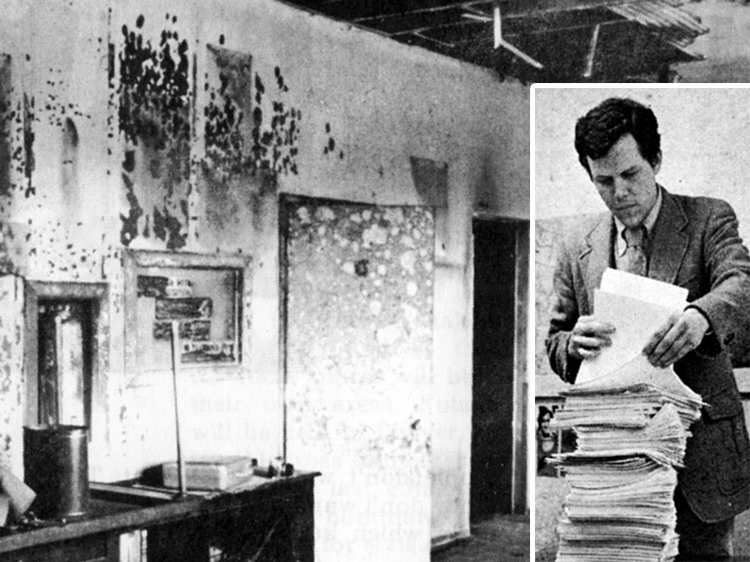
From December 1973, the government was compelled through several civil suits to release documentary evidence concerning its various campaigns to undermine and disrupt legal activities directed to social change or simply protest against state policy, through the decade of the 1960s. In comparison with these revelations, the whole Watergate affair was a tea party. The documents and depositions made public during this period, and revelations by disaffected government agents, lay bare a systematic and extensive program of terror, disruption, intimidation, and instigation of violence, initiated under the most liberal Democratic administrations and carried further under Nixon. …
The Cointelpro operations of the 1960s were modeled on the successful programs of earlier years undertaken to disrupt the American Communist party. …
From the evidence now available, it appears that the first FBI disruption program (apart from the CP) was launched in August 1960 against groups advocating independence for Puerto Rico. In October 1961, the “SWP Disruption Program” was put into operation against the Socialist Workers party. The grounds offered, in a secret FBI memorandum, were the following: the party had been “openly espousing its line on a local and national basis through running candidates for public office and strongly directing and/or supporting such causes as Castro’s Cuba and integration problems … in the South.” The SWP Disruption Program, put into operation during the Kennedy administration, reveals very clearly the FBI’s understanding of its function: to block legal political activity that departs from orthodoxy, to disrupt opposition to state policy, to undermine the civil rights movement. …
For example, the Phoenix office of the FBI noted in a memorandum of October 1, 1968, that Professor Morris Starsky of Arizona State University, “by his actions, has continued to spotlight himself as a target for counterintelligence action.” These “actions” consisted of the following crimes against the state: “He and his wife were both named as presidential electors by and for the Socialist Workers Party when the SWP in August, 1968, gained a place on the ballot in Arizona. In addition they have signed themselves as treasurer and secretary respectively of the Arizona SWP.” …
The commitment of the FBI to undermine the civil rights movement, despite an elaborate pretense to the contrary (and even some actions as government policy vacillated on the issue), will come as no surprise to people with first-hand experience in the South in the early 1960s. …
During these years, FBI provocateurs repeatedly urged and initiated violent acts, including forceful disruption of meetings and demonstrations on and off university campuses, attacks on police, bombings, and so on. … One FBI provocateur resigned when he was asked to arrange the bombing of a bridge in such a way that the person who placed the booby-trapped bomb would be killed. This was in Seattle, where it was revealed that FBI infiltrators had been engaged in a campaign of arson, terrorism, and bombings of university and civic buildings, and where the FBI arranged a robbery, entrapping a young Black man who was paid $75 for the job and killed in a police ambush. …
Perhaps the most shocking story concerns the assassination of Fred Hampton and Mark Clark by Chicago police directed by the state’s attorney’s office in December 1969, in a predawn raid on a Chicago apartment. Hampton, one of the most promising leaders of the Black Panther party — particularly dangerous because of his opposition to violent acts or rhetoric and his success in community organizing — was killed in bed, perhaps drugged. Depositions in a civil suit in Chicago reveal that the chief of Panther security and Hampton’s personal bodyguard, William O’Neal, was an FBI infiltrator. O’Neal gave his FBI “contacting agent,” Roy Mitchell, a detailed floor plan of the apartment, which Mitchell turned over to the state’s attorney’s office shortly before the attack, along with “information” — of dubious veracity — that there were two illegal shotguns in the apartment. For his services, O’Neal was paid over $10,000 from January 1969 through July 1970, according to Mitchell’s affidavit. …
The criminal programs of the FBI during the 1960s are simply an extension of past practices. According to William C. Sullivan, Hoover’s assistant for many years:
Such a very great man as Franklin D. Roosevelt saw nothing wrong in asking the FBI to investigate those opposing his lend-lease policy — a purely political request. He also had us look into the activities of others who opposed our entrance into World War II, just as later Administrations had the FBI look into those opposing the conflict in Vietnam. …
I have spoken of this system as a post-World War II phenomenon, but that is a mistake. Its roots go far deeper. Recall that J. Edgar Hoover rose to national prominence when he was appointed chief of the General Intelligence (antiradical) division of the Justice Department in August 1919, just before the “Palmer raids” of January 2, 1920, when more than 4,000 alleged “radicals” were rounded up in thirty-three cities in twenty-three states (over 200 aliens were subsequently deported), while the Washington Post editorialized that “there is no time to waste on hairsplitting over infringement of liberty” in the face of the Bolshevik menace.