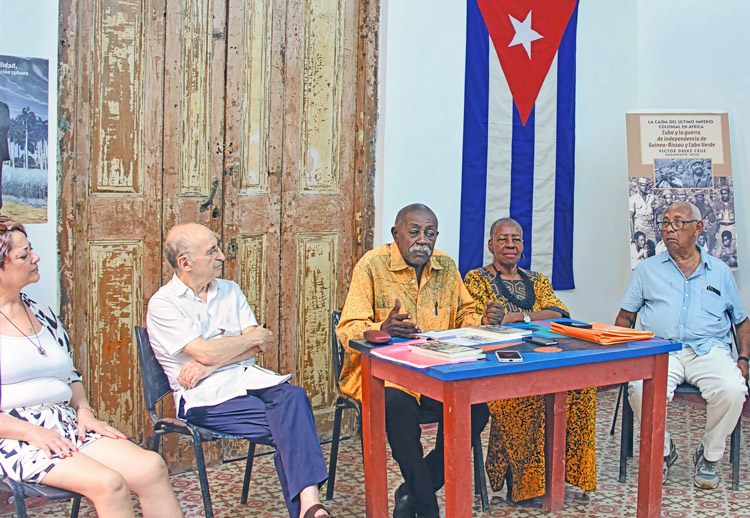
HAVANA — The contributions of Cuban internationalist volunteers to African liberation struggles, and the lessons of those experiences, were highlighted at an Aug. 14 presentation here of Cuba and the Independence War in Guinea-Bissau and Cape Verde: The Fall of the Last Colonial Empire in Africa. The book’s author, Víctor Dreke Cruz, headed Cuba’s military mission collaborating with the independence movement in Guinea-Bissau in 1967-68, crucial years in the battle against Portuguese colonial rule.
The meeting was held at the Artists and Creators House, a cultural center in Havana. Thirty people participated on just two days’ notice. This was an indication of the interest in the subject, given the scarcity of transportation and other challenges Washington’s crushing economic blockade imposes on Cuba. The book was originally launched in Havana in February.
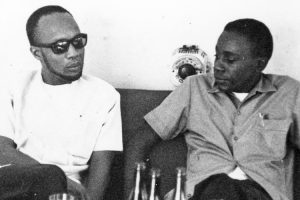
Dreke is well-known in Cuba for his lifelong record as a revolutionary leader and internationalist fighter. At age 15 he joined the revolutionary struggle, led by Fidel Castro, that overthrew Fulgencio Batista’s U.S.-backed military dictatorship in 1959 and opened the road to the first socialist revolution in the Americas. He then helped lead the battles that defeated U.S.-backed counterrevolutionary bandits who terrorized working people in the Escambray mountains. And over the decades he has shouldered many other leadership responsibilities both in Cuba and Africa.
Sara Sánchez, director of the center, welcomed those present and joined the speakers table. The panelists were Dreke, Oscar Oramas and Jonathan Silberman. Oramas was Cuba’s ambassador to Guinea-Conakry during much of the independence war and is interviewed in the book. Silberman is the director of Pathfinder Books in London and a leader of the Communist League in the United Kingdom.
The meeting was chaired by Ana Morales, program director at Havana’s Africa House. She was the founding director of the medical school in independent Guinea-Bissau in 1986.
Morales recognized the presence of Edna Barreto, Cape Verde’s ambassador to Cuba. Also in attendance were local leaders of the Association of Combatants of the Cuban Revolution, as well as Cubans who have shouldered prominent responsibilities in public health and a number of Cubans who heard about the meeting by word of mouth.
Lessons from Congo, Guinea-Bissau
Oramas said the story of Cuba’s participation in the anti-colonial war in Guinea-Bissau builds on “an earlier struggle that Dreke was part of in the Congo alongside Che.” In 1965 a unit of 130 Cuban volunteers led by Ernesto Che Guevara joined Congolese fighters battling the imperialist-backed regime there. Dreke was second-in-command of that mission under Guevara.
The Congo mission, Oramas said, was “a school where much was learned, where lessons were drawn that aided the struggle in Guinea-Bissau and Cape Verde.” The Congolese leaders were beset by internal rivalries, lack of discipline and marked by tribal loyalties and superstition.
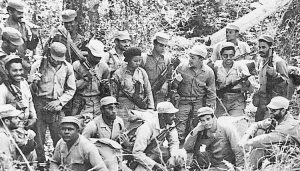
In contrast, the African Party for the Independence of Guinea and Cape Verde (PAIGC), led by Amílcar Cabral, was a politically steeled, disciplined organization that involved the population in a movement capable of defeating Portuguese colonialism.
The lessons of both the Congo and Guinea-Bissau, Oramas noted, made possible the success of subsequent Cuban military missions in Africa. These included helping lead the defense of Angola from invasions by South Africa’s white-supremacist regime and winning the independence of Namibia. That struggle led to the fall of the apartheid state in South Africa itself.
These are examples, he said, of what Fidel Castro meant when he explained, “We have created a revolution larger than ourselves.” That’s why today, Oramas said, “the imperialists want to suffocate the Cuban people.”
Cabral’s leadership
The speakers highlighted Amílcar Cabral’s leadership capacities. Cabral led the political fight in the independence movement to break down ethnic and tribal enmities that the colonial masters fostered as part of their divide-and-rule tactics. He championed the fight for women’s emancipation and their participation in the independence struggle. He explained that the fight was against Portuguese colonialism, not the Portuguese people, and that the Portuguese soldiers, most of them exploited peasants, could be won as allies in a struggle against their common enemy.
Cabral led the combatants to see themselves as part of a global struggle against imperialism, as “soldiers of humanity.” We are fighting, he said, not to replace European “white faces” with African “black faces” but “so that our peoples may never more be exploited.”
The PAIGC leader didn’t live to see the victory himself — he was assassinated in January 1973 in an operation organized by the Portuguese secret police. But the party he built was able to win independence for Guinea-Bissau in 1974 and Cape Verde the following year. Their victorious struggle triggered the collapse of the fascist dictatorship in Portugal itself and of the vast 500-year-old Portuguese empire in Africa.
Dreke, who today is president of the Cuba-Africa Friendship Association, spoke about the importance Fidel Castro gave to aiding the anti-colonial struggle in Guinea-Bissau and Cape Verde. In 1966 the Cuban leadership invited a PAIGC delegation headed by Cabral to attend an international gathering in Havana of anti-imperialist forces known as the Tricontinental Conference. Impressed by Cabral’s contribution to the discussion, Castro invited him to the Escambray mountains for three days to show him how the Cuban Revolution was transforming social conditions in that region for the benefit of rural toilers.
“On the front cover of the book you can see a photo of Fidel and Amílcar during their visit to the Escambray,” Dreke said.
Dreke noted the close collaboration between the Cubans and the PAIGC on the battlefield, including what they learned from Cabral’s leadership. He paid tribute to the contributions of other Cuban combatants who are interviewed in the final chapter of the book. These include Col. Alfonso Pérez Morales and Lt. Eduardo Torres Ferrer, better known as “Pina” and “Coqui,” who in 1966 were among the first Cuban combatants to arrive in Guinea-Bissau. And Col. René Hernández Gattorno who played an important role in the battle where the liberation fighters took the Portuguese garrison of Guiledje in 1973.
Castro sent Commander Raúl Díaz Argüelles to collaborate directly with PAIGC commander João Bernardo “Nino” Vieira in leading the offensive at Guiledje, which turned the tide of the war, leading to the defeat of the Portuguese colonial army.
A tool for today’s struggles
In his remarks, Silberman said Pathfinder had published the book for working people around the world “resisting the effects of today’s gigantic international capitalist crisis and its wars.” The story told in Cuba and the Independence War in Guinea-Bissau and Cape Verde shows that, with a leadership of the caliber of Amílcar Cabral, working people in a small African country could defeat an imperial power with many more military and economic resources.
“It also gives the answer when we are asked what’s behind Washington’s decades-long aggression against Cuba and its sharp escalation today. It’s not because Cuba is ‘a threat to U.S. national security,’ as imperialist spokespeople claim, but because of the threat of its example. The book explains what the Cuban Revolution is and how working people in Cuba changed themselves as they helped change the world. And how Fidel Castro led working people along that proletarian internationalist course.”
Dreke’s book, now available in English, Spanish, French and Arabic, has received a great response, Silberman said. Book presentations have already drawn audiences in the United States, Norway, Australia and France, anxious to learn about this little-known struggle.
During the lively discussion period, María del Carmen Betancourt, president of the Association of Combatants of the Cuban Revolution in Old Havana, said, “This book is a study tool for young people, for combatants like us to tell this history.”
Dr. Luis Estruch Rancaño, a founder of the Latin American School of Medicine (ELAM) in Havana, pointed out that, in addition to the Cuban internationalists who fought in Africa, the Cuban government has offered scholarships to thousands of youth from around the world to study medicine here. “Some of the first ELAM scholarships were for students from Guinea-Bissau, Cape Verde, and other African countries,” he said. “That, too, is part of the revolution.”
Following the program, audience members welcomed the opportunity to buy copies of Dreke’s book and other Pathfinder titles, both on the Cuban Revolution and on the class struggle worldwide.