SAN JUAN, Puerto Rico — During a visit in mid-October, Militant correspondents and members of the Socialist Workers Party found working people here face similar challenges as those in the United States: the high cost of living, low wages, deteriorating infrastructure, lack of affordable housing, inadequate medical care, deportations of immigrants and more.
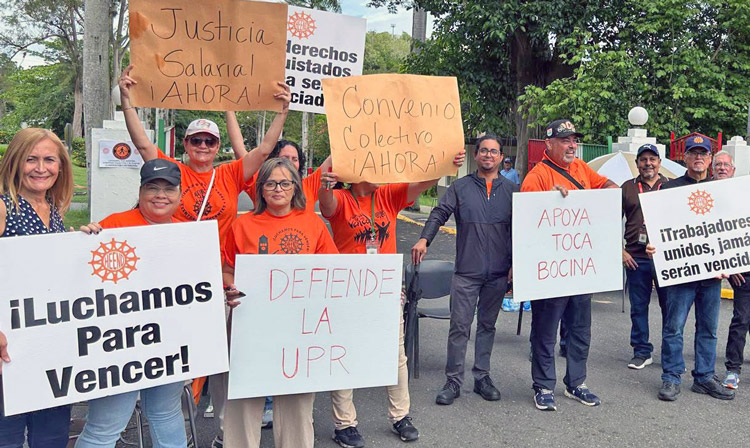
“Many people work two jobs, but it’s not enough to pay all the bills,” Hilda Torres Guzmán, president of the Brotherhood of Exempt Non-Teaching Employees (HEEND) at the University of Puerto Rico, told us Oct. 22. “Young people can’t afford to start a family.”
Hotel workers, construction workers and others we met said similar things. “I’m doing fine with just one job, but that’s because I earn tips,” a waitress at a restaurant that caters to tourists here told us. “I know how hard it is for those just depending on a wage.”
The crisis here is deeper because of Puerto Rico’s 128-year-long colonial subordination to Washington.
In 2016 the U.S. rulers moved to directly control key financial decisions when President Barack Obama — with the backing of Democrats and Republicans alike — imposed the Financial Oversight and Management Board for Puerto Rico. The purpose of the unelected Junta, as it is known here, was to ensure payment to wealthy bondholders of over $70 billion in debt taken out by the local government and to squeeze more out of the island’s working people.
Ten years later, the debt stands at $31 billion, while the Junta still exercises dictatorial control over key government financial decisions.
Electric rates, after an increase just two weeks before our arrival, are nearly double those in the U.S. The official unemployment rate here in September was 6.2%, well above the U.S. rate of 4.2%. And the percentage of workers earning minimum wage — nearly one-third of them at private companies — is double the figure in the U.S.
Meanwhile, U.S.-owned and other foreign corporations are making profits hand over fist from exploiting low-wage labor. Pharmaceutical companies alone take in more than $50 billion a year in exports from their plants in Puerto Rico. All of the island’s more than 13,000 pharmaceutical workers are nonunion.
Twice as many Puerto Ricans in U.S.
Under these conditions it’s no surprise that the population of Puerto Rico has decreased every year except one since 2004 and the death rate is higher than the birth rate. The low birth rate is largely due to the fact that raising a family is unaffordable and by the number of young people leaving the island. Only 16% of the population in Puerto Rico is under 18 years old, compared to 22% in the United States. Today there are some 3.2 million Puerto Ricans living on the island, but over 6 million in the U.S.
Government agencies and institutions use this large-scale migration to justify cuts, including closing more than 670 schools. Since 2016 the Junta slashed funds for the University of Puerto Rico by 50%, while forcing tuition hikes.
As a result, many students can’t afford to eat three meals a day and have trouble finding housing, Torres said. Rents have gone up, she said, because many homes are being bought up by foreign investors.
“Four years ago dining rooms for university students were started up,” she said, at the initiative of some churches, student groups, and the union, getting some aid from the university administration, because “their scholarships didn’t cover all their costs.”
The university recently announced it was hiring a physician, offering a salary of just $25,000 a year. While doctors earn more than that in the private sector, it’s still much less than in the United States. “Thousands of doctors and nurses have left the island, causing a shortage,” Torres said. “But with an aging population, those doctors and nurses are needed more than ever.”
85% of food imported
“They even cut back programs at the University of Puerto Rico’s Utuado campus, which specializes in agriculture,” said HEEND Vice President Jorge Rodríguez Echegaray. “They claim that young people don’t want to work. But in reality they are turning them away.”
Decades ago, Puerto Rico produced most of the food its people needed. Today because giant U.S. corporations can produce at lower costs, they have driven production out of the country. Some 85% of food is imported.
No wage increase in 12 years
“We haven’t had a general wage increase in more than 12 years,” Torres said. The Junta demanded that the university draw up a new wage scale and classification system, before it would consider approving a wage increase. “We negotiated a new scale and system with the UPR administration in 2024,” Torres said, “but the Junta still has not approved it.”
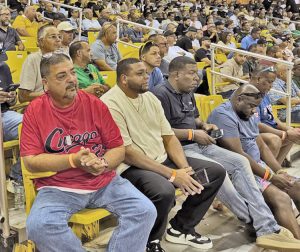
Most workers at the government-run AAA water and sewage authority have also gone 12 years without a wage increase, except for those who earn the minimum wage.
After 13 years at only $7.25 an hour, in 2023 the Junta allowed the government to raise the minimum wage to $8.50. It now stands at $10.50. That still doesn’t keep up with inflation.
The Independent Authentic Union at the AAA water and sewage authority held a one-day strike Aug. 18 to back its demand for higher wages.
Water and power outages are common throughout Puerto Rico. Amid a severe summer drought that lowered levels in many reservoirs — despite the abundance of water sources on the island — many towns and farm areas went without running water for weeks at a time. In early August the government began rotating water shutoffs in San Juan for 48 hour stretches.
More than 30% of the water in the system leaks out of some 20,000 miles of ancient pipes, and another 30% is not paid for because of broken water meters or water “theft.”
“Wages are so low, they can’t fill all the open positions and keep up with repairs,” José Cajigas, president of the Independent Authentic Union, told the Militant. There are more than 1,000 unfilled positions. The water authority has been hiring private contractors who they pay “more than they pay our members,” he said. “If they have resources to pay private contractors, then they should also have the will to agree to equal pay” for our members.
Despite all this, the water authority administration is cutting back funds for repairs to just 4% of its budget, down from 7% the year before. Like other government agencies, the priority is paying the bondholders.
Some 646 workers who belong to the Independent Brotherhood of Telephone Employees (HIETEL) at ClaroPR, a cellphone company owned by Mexican capitalist Carlos Slim, are also fighting for a new contract after 12 years with no wage increase. Claro had revenues of $1.1 billion in Puerto Rico in 2025.
The company had refused to meet in person with the union committee, instead conducting the wage negotiations via Zoom, HIETEL President Wilda Frechel told the Militant during a break in their negotiations Oct. 20.
As a private company, “the Junta’s rules don’t affect us directly,” said Frechel, “but it has a lot of influence because of the general situation it has created.”
Need for united union struggles
All three union halls we visited proudly display photos from a massive strike that took place July 7 and 8, 1998. There have not been any union struggles on that scale here since then.
That two-day strike was called by a coalition of some 50 trade unions, involving hundreds of thousands of workers to support striking telephone workers in their fight to oppose the sale of the state-owned Puerto Rico Telephone Co.
The strikers were also protesting government plans to sell other state-owned enterprises to capitalist enterprises. The striking unionists paralyzed the docks, city buses, banks, shopping centers, university campuses, government offices and a few factories.
It was the first strike of this magnitude since the 1930s.
The strikers ultimately did not win their demands. The telephone company was sold. In the last 10 years the electrical system has in essence been privatized. But they demonstrated the potential power of working people across the island. That memory still lives.
Rachele Fruit contributed to this article.