BOSTON — Dayanis García Farinas, coordinator for international relations at the Martin Luther King Jr. Memorial Center in Havana, spoke at the First Baptist Church of Jamaica Plain here Oct. 26, part of her four-city U.S. tour. She gave an eyewitness account of the devastating effects of the tightening U.S. blockade against the Cuban people.
The meeting was part of a week of activities across the country and abroad against Washington’s oil blockade and threats of war against Cuba.
It was organized by the July 26 Coalition of Boston, which for the past 37 years has fought for the normalization of U.S.-Cuba relations, along with Witness for Peace and the church. Some 125 people attended the event, with others following online.
García Farinas described what an average day is like for working people in a country subjected to Washington’s brutal oil blockade, which causes daily blackouts lasting 20 hours or more. To get up having had no electricity for hours, which means no running water, no working stove to cook a meal, no refrigerator to prevent food going bad. Then, with public transportation paralyzed, being forced to walk or bicycle back and forth to work.
“These conditions affect everyone,” she said. Infant mortality has doubled; 80% of the medicines needed are no longer available. Overall cancer survival rates have plunged.
“We have made errors, but those are for us to address,” she said. The main cause of this crisis is the U.S.-imposed blockade “preventing us from trade and relations with other countries.”
“How do we resist? Thanks to our creativity and capacity to adapt,” she said. Hospitals have found ways to restore a semblance of normal basic functioning by getting solar panels and more bicycles, to help healthcare workers to get to work.
“We need material solidarity, yes. But also, the political solidarity of your denouncing, at every step, the actions and effects of this blockade. We resist because we are not going to give in!”
Participants in the meeting contributed to the “Healthcare on Wheels” initiative, which sends donated bicycles to Cuba for use by medical personnel.
***
EMERYVILLE, Calif. — Over 40 people attended a meeting here Oct. 25 at the J-SEI Japanese community center to hear a report by a delegation that recently visited Cuba to investigate the challenges Cuban healthcare workers face from Washington’s intensifying economic war on the Cuban people. The delegation was organized by MEDICC — Medical Education in Cooperation with Cuba.
A good number of those at the meeting came from the Japanese community, most of whom were new to learning about the Cuban Revolution and the U.S. rulers’ attacks against it.
Speakers described the toll the U.S. attacks are taking, including causing rising rates of infant mortality and deaths from cancer. They also pointed to the dignity, determination and ingenuity of the Cuban people in facing this.
The program was chaired by Josie Camacho, first vice president of the Asian Pacific American Labor Alliance. Camacho, a longtime labor organizer and former secretary-treasurer of the Alameda Labor Council, urged those present to organize other reportbacks and to donate to Global Health Partners’ Neonatal and Maternal Healthcare Initiative, a project that is bringing supplies needed to support mothers and babies in Cuba.
David Paul, a retired nurse practitioner who was part of the delegation, showed film clips of the visit. One was of a surgery taking place after a shutoff of electricity, with light from cellphones being the only illumination.
Other speakers included Leni Villagomez Reeves, chair of the Women’s International League for Peace and Freedom, and Cindy Domingo, chair of US Women and Cuba Collaboration.
The program was part of a week of activity in the San Francisco Bay Area in solidarity with Cuba’s fight against theU.S. government’s drive to strangle the Cuban Revolution. Over 100 rallied in downtown San Francisco Oct. 28.
To donate to the Neonatal and Maternal Healthcare Initiative, go to ghpartners.org.
— Betsey Stone
***
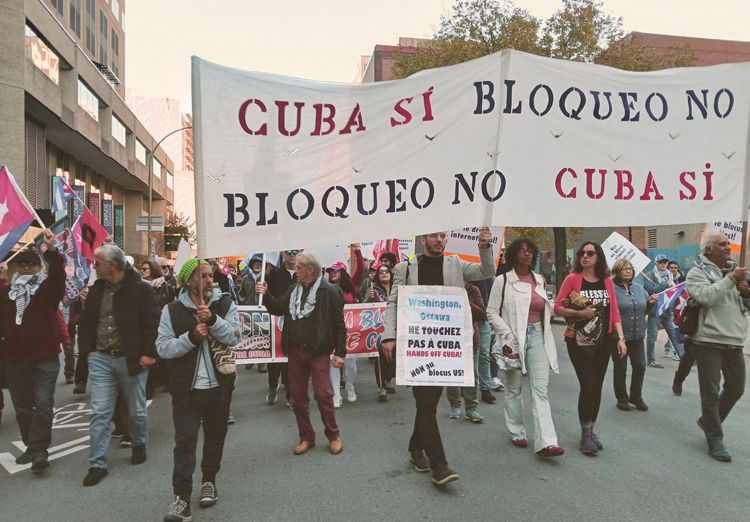
MONTREAL — Some 100 people marched and rallied here Oct. 24, part of a worldwide week of action to support Cuba. The central demands at the rally, organized by the Quebec-Cuba Solidarity Roundtable, were an immediate end to the U.S. blockade of Cuba and for the Canadian government to vote in favor of the resolution at the United Nations Oct. 27-28 calling for an end to the blockade.
Speakers included Betrand Guibord, president of the Greater Montreal Labour Council of the Confederation of National Trade Unions (CSN). Guibord condemned the “attacks that the U.S. has been making against Cuba for more than 60 years.”
“All countries in the world, including Canada, should denounce the blockade,” he said.
— Beatrice Bowen
***
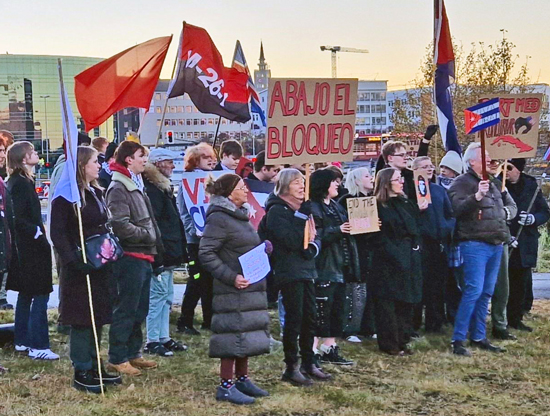
REYKJAVIK, Iceland — Some 50 people gathered in front of the U.S. Embassy here Oct. 28 to protest against Washington’s economic blockade on Cuba, organized by the Iceland-Cuba Friendship Society. A group of young people and some Cubans living in Iceland made up a good part of the action.
In an effort to stigmatize the protest, the U.S. Embassy issued a “security alert” closing the embassy early and urging American citizens to “avoid areas where protests are taking place” and “exercise caution at all times in the vicinity of protests.”
When he was interviewed by the media a week before the action, Raúl Delgado Concepción, Cuba’s ambassador to Iceland, described the difficulties the U.S. sanctions are imposing on the Cuban people. “The country is fully functional,” he said, “but does face a difficult struggle.”
— Sigurlaug Gunnlaugsdottir
***
AUCKLAND, New Zealand — Some 35 people came together for a meeting here Oct. 31 to call for the U.S. blockade against Cuba to be dismantled.
Ambassador Luis Ernesto Morejón Rodríguez spoke to the meeting, which marked the end of his term as Cuba’s chief representative in New Zealand. “Families, workers, patients, students, farmers and small businesses all experience the consequences of the U.S. policy of economic strangulation,” he said. In response, the Cuban government is organizing wide-ranging measures to organize working people to address the blockade’s impact.
Morejón also denounced U.S. threats of “possible military aggression.”
Bob Schwartz, executive director of Global Health Partners, spoke to the meeting via video link. “The U.S. embargo impacts every aspect of daily life in Cuba today,” he said, “but I believe it exacts the cruelest toll of all on Cuba’s public health system.
“Hospitals can’t afford equipment or spare parts,” Schwartz said, as punitive U.S. sanctions “have frightened off banks, shippers and suppliers.”
Schwartz said that when he had “started working with Cuba more than three decades ago,” he had witnessed the country’s drive to bring down infant mortality.
By 2012, it stood at 4.8 per thousand live births. “This was one of the major achievements of the Cuban Revolution,” he said, “an achievement built neighborhood by neighborhood, based on preventative health, the family doctors and a strong primary care system.
“Today that number is 14, and it continues to rise,” said Schwartz, as Cuba faces many challenges, from shortages across healthcare to a “nutritional deficit” suffered by mothers and newborns.
Schwartz urged those present to contribute to a Global Health Partners Neonatal and Maternal Healthcare Initiative, “aiming to supply Cuban hospitals with lifesaving equipment” and to back up their efforts “to ensure healthy mothers and babies.”
A selection of videos, including from Belly of the Beast, a news agency based in Cuba, were shown at the meeting. The event was jointly sponsored by the Auckland Cuba Friendship Society and the New Zealand Fabian Society, which live-streamed it and then put the video on its YouTube channel.
— Patrick Brown