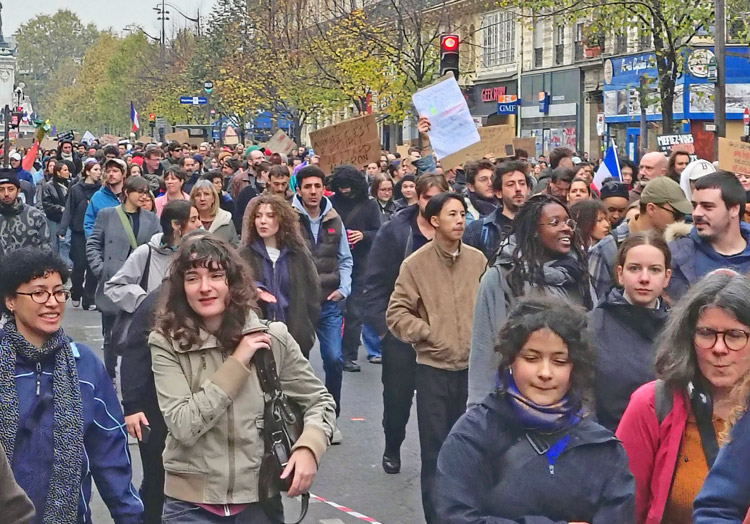
PARIS — Hundreds of thousands of working people joined marches here and across France during a one-day strike called by the country’s five main union federations Nov. 5.
The actions were part of a wave of street protests over the past month by workers, farmers and youth against high prices, the dilapidated state of many schools, government cuts to services and the bosses’ broader drive to put the capitalist crisis on workers’ backs. The demonstrations have inspired similar protests elsewhere in Europe.
Labor rallies were held in 260 cities and towns across France Nov. 5. The unions are demanding a raise in the minimum wage and increases to pay, pensions and benefits. Two days later tens of thousands joined additional union-backed marches here and elsewhere protesting the policies of the government of President Emmanuel Macron Nov. 7.
“I have a friend who is retired with a 1,180 euros [$1,320] monthly pension,” Said Boukhamsa, a chef in a small bakery, told the Militant. “After paying his bills — rent, car insurance, gas and electricity — he’s left with 100 euros for the month! And since his wife earns 400 euros, that puts them over the limit to get any government subsidies.”
“It’s time this government falls,” said Stephanie Matenot, a union shop steward at an online pharmacy. “The bosses just get richer while we’re getting poorer. My husband is a self-employed plumber. The taxes he has to pay are so high. He wants to hire an apprentice, but simply can’t afford to.”
Many people expressed anger at the state of the healthcare system and the lack of jobs. Koudieye Sacko, a hospital lab technician, said her workplace is “chronically understaffed.”
“I am here for many reasons,” Baptiste Ropert, a trainee paramedic, told the Militant at the Nov. 5 march. The government is “destroying public services. My 93-year-old grandfather suffered injury from a fall this summer. It took over four hours in the hospital before he was seen by medical staff.”
“Many people in this country think twice when they have a health issue about whether to see a doctor,” said Colombe Schwebel, a bank worker. “It is the accumulation of all these types of costs, without our wages going up, that gets people irritated.”
The actions take place as a flurry of street protests against the rising cost of living have spread from France to Italy, Greece, Portugal, Spain and elsewhere.
“All over Europe people are suffering,” Damien Laguiche, a freelance videographer, said. “Many industries have gone and now office workers are being replaced by artificial intelligence.”
Union-led disciplined protests
The protests on Nov. 5 and 7 were largely disciplined and peaceful, but anarchist-type thugs and other middle-class radicals did orchestrate some violent confrontations with cops. Similar dangerous clashes on a larger scale, alongside rioting and looting, took place at marches on Oct. 17, providing the government with a pretext to impose restrictions on the right to assembly.
The thuggery on Nov. 5 included an effort by supporters of Jean-Luc Melenchon’s France Unbowed party to physically block one of Melenchon’s rivals in France’s presidential race, Raphael Glucksmann of the Socialist Party, from joining the march, Le Monde reports. After an hour’s standoff, Glucksmann gave up trying to join the action.
Both Glucksmann and Melenchon are on the left of capitalist politics. They’re attempting to tap workers’ outrage at the growing assaults on living standards to garner support for their own election campaigns. Both claim they’re the best candidate to stop Marine Le Pen, the candidate of National Rally, a party on the right of capitalist politics, from winning the presidential elections next year.
Macron’s government has tried to quell the mobilizations by promising 4 billion euros — in loans — to renovate schools and the hiring of more teachers. He says the government will increase the minimum wage by 1.6%.
The CGT union federation says this isn’t enough and has called a further one-day strike and demonstrations for Nov. 17.
Many workers and youth that this worker-correspondent spoke with at the Nov. 5 and 7 marches expressed an interest in the need to build an independent working-class party. That interest was reflected in the 62 Pathfinder books by Socialist Workers Party and other revolutionary working-class leaders that were sold at both demonstrations.