

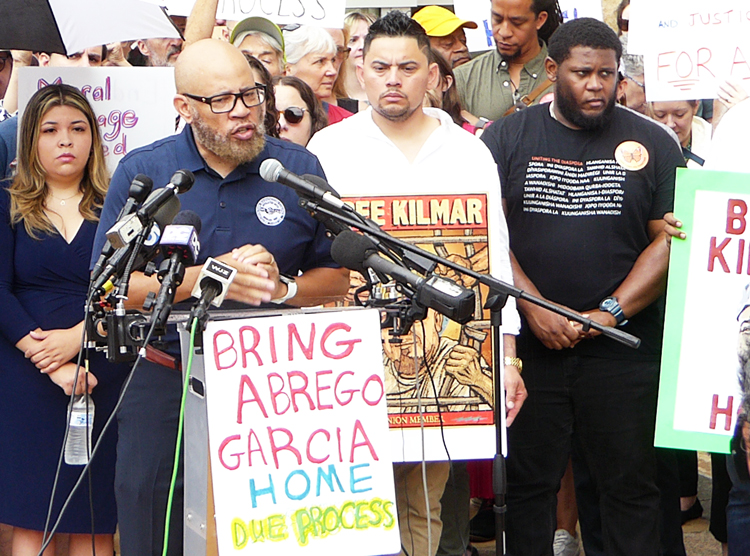
GREENBELT, Md. — “We stand here as union brothers and sisters saying an injury to one is an injury to all. Whether you’re a teacher here in Prince Georges County, an iron worker or a hotel worker, we are all Kilmar. We want him home, because he is one of us,” Samuel Epps, president of the Metropolitan Washington Council AFL-CIO, told some 200 supporters of the fight to win Kilmar Abrego García’s freedom, outside the federal courthouse here July 7.
Many of the participants at the rally have been protesting for over three months since March 15 when Abrego García, a sheet metal apprentice and member of the SMART union, had his constitutional right to due process to defend himself tossed aside and was flown to El Salvador by Immigration and Customs Enforcement. He was incarcerated there in the notorious CECOT megaprison — the Terrorism Confinement Center
His deportation directly violated a 2019 court order barring his removal to El Salvador. The administration later admitted in court the deportation was “an administrative error.”
“Kilmar is back on U.S. soil because of us,” Ama Frimpong, from CASA de Maryland, said to cheers and chants. “No government smear of Abrego García’s character will stand in the way of the fight for him and all those facing deportation and detention.”
“We stand with Kilmar,” Greg Akerman, president of the Baltimore-D.C. Metro Building Trades Council, told the rally. “And we have one simple message — bring Kilmar home.”
Ronald Claude of the Black Alliance for Just Immigration pointed to the barbarity of what Abrego García faced caged in CECOT with no perspective of ever getting out. “Detention like that is torture,” he said.
Jennifer Vasquez Sura, Abrego García’s wife, joined in the July 7 rally and hearing, as she has at all of his hearings and most of the protests on his behalf. His brother was there too.
Abrego García could not attend. He is being held in a prison in Tennessee at the request of his own attorneys, to protect him from being seized by ICE and immediately deported. He has pled not guilty to the government’s trumped-up felony charges, which even Magistrate Judge Barbara Holmes there said are “far-fetched.”
He faces over 100 counts of interstate human smuggling for financial gain between 2016 and 2025, though the only evidence is a statement by a government witness who has been promised all charges against him will be dropped and he will be given legal status in the U.S. in exchange for his frame-up story.
The case is built around a single 2022 traffic stop in which he was driving a car with a handful of fellow construction workers. After questioning him, the cops issued him a citation for driving without a valid license. No other charges were filed.
Two courts, two cases
So Abrego García’s future is now tied up in two different courts. One is an immigration case in Maryland, where his lawyers are fighting for a court order barring his deportation. The government’s newly filed criminal case is in court in Tennessee.
In Maryland, his lawyers are also seeking to have him transferred here to be closer to his family and his legal team. This will make it more difficult for ICE to swoop down and deport him while his legal cases are still being fought out.
U.S. District Judge Paula Xinis told the July 7 hearing that getting straight answers from the Department of Justice was like “nailing Jello to a wall.” She tried repeatedly to get the government lawyers to say whether they planned to pursue the criminal case filed against García, or, if he is released, to turn him over for deportation.
Another hearing is set for July 10, where Judge Xinis has ordered the government to produce a witness who can give a forthright explanation to their intentions.
New motion describes torture
Abrego García amended his suit against the Trump administration over his deportation to include the beatings and torture he faced at CECOT. In these new court documents, he describes how the detainees he was with at CECOT “were confined to metal bunks with no mattresses in an overcrowded cell with no windows, bright lights that remained on 24 hours a day, and minimal access to sanitation.”
When he was taken there from the plane he was deported in, he was given prison clothing and kicked in the legs and hit in the head and arms to spur him to change faster. Then he and his fellow prisoners were forced to kneel on the ground with their hands chained for the entire night, “with guards striking anyone who fell from exhaustion,” the court filing said. All night they were “denied bathroom access” and he “soiled himself.”
Two weeks later, he said, he had lost nearly 31 pounds.
The one thing positive from his experience is the Salvadoran prison authorities recognized almost immediately that he “was not affiliated with any gang.” They acknowledged his tattoos “were not gang-related.” He was placed in a special cell where only nongang inmates were housed to help protect them from attack.
Still, guards periodically threatened to throw him into a cell full of gang members who would “tear” him apart. He saw inmates in nearby cells violently harm each other.
To fight this onslaught against Abrego García, to defend thousands of other workers facing prison, attacks and deportation, and to defend constitutionally protected freedoms, the labor movement must mobilize. Enough is enough.