One of Pathfinder’s Books of the Month for August is the French edition of The Low Point of Labor Resistance Is Behind Us: The Socialist Workers Party Looks Forward by party leaders Jack Barnes, Mary-Alice Waters and Steve Clark. It features the political resolution adopted by the December 2022 Socialist Workers Party national convention, part of which is excerpted below. It’s from the section titled, “The Cuban socialist revolution and our communist continuity.” Copyright © 2023 by Pathfinder Press. Reprinted by permission.
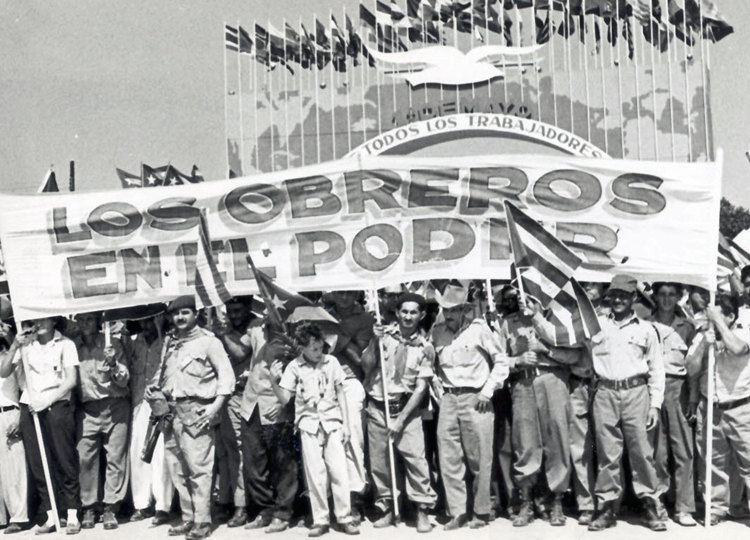
The Cuban socialist revolution — under the leadership of Fidel Castro, seasoned Rebel Army combatants, and other Cuban fighters won to its proletarian internationalist course — did not simply transform the lives, conditions, and political consciousness of workers and farmers in Cuba. That revolution, like the Bolshevik Revolution before it, opened a renewal of communist leadership in the Americas, in the United States and beyond.
From the Castro-led assault on the Moncada barracks in Santiago de Cuba and Bayamo garrison on July 26, 1953 — and publication the next year of History Will Absolve Me, Fidel’s courtroom defense of the aims of the revolution — the revitalization of communism began, both in program and in action.
Cadres of the Socialist Workers Party, from our origins within the American section of the Communist International in 1919, have understood that proletarian internationalism and class solidarity are carried out, first and foremost, as we build a revolutionary working-class party to advance the socialist revolution in the countries where we live, work, and fight.
Building such a party, and leading along that course toward a victorious struggle for workers power in the US, is the permanent centerpiece of what working people in this country contribute to ending Washington’s economic, trade, financial, and political war against the toilers of Cuba — a policy carried out by every Democratic and Republican administration since 1959.
The imperialist rulers’ aim is to crush the spirit of Cuba’s working people, their socialist revolution, and the example of working-class leadership and revolutionary intransigence they set for toilers in the United States, across the Americas, and worldwide. The message the US propertied rulers are signaling to working people here and everywhere is unvarnished: “This is what will be done to you if you work and fight to emulate Cuba’s socialist revolution.”
Since 1959 Cuba’s workers and farmers, their revolutionary government, and their political leadership have held US imperialism at bay. They continue to do so, despite the brutal intensification of the US rulers’ unrelenting efforts to destroy the revolution. The cumulative toll exacted over more than six decades by this all-encompassing imperialist assault weighs heavily on Cuban working people. The commodification of production and exchange, as well as the sway of the law of value — and its reflection in the attitudes of human beings — continues to expand.
The greatest burden borne by the Cuban toilers and their government is the absence of any new victorious socialist revolution for more than sixty years. In the 1970s and 1980s working people in Cuba gained new strength from the internationalist mission in Angola, which dealt a death blow to apartheid and white minority rule across Southern Africa.
The Cuban Revolution was politically revitalized by the revolutionary workers and farmers governments in Grenada, led by Maurice Bishop, and in Nicaragua, under the leadership of the Sandinista National Liberation Front — what Fidel Castro in the early 1980s pointed to as “three giants rising up to defend their right to independence, sovereignty, and justice, on the very threshold of imperialism.” The popular revolution in Burkina Faso in the mid-1980s, led by Thomas Sankara, brought reinforcement from West Africa.
None of these struggles culminated in a lasting extension of the world socialist revolution, for reasons the SWP has explained. While their political conquests and lessons remain indispensable, today there is not a single revolutionary working-class government anywhere in the world aside from Cuba.
These international factors and their social consequences in Cuba inevitably widen class divisions and social inequalities, raising the stakes in promoting and maintaining proletarian political consciousness and solidarity. Though weakened, the foundations of a living and fighting socialist revolution still stand.
In 2022, however, there can be no simple replay many decades later of the course led by Fidel Castro during the Rectification process that opened in 1986. Interlinked with the victorious culmination of the internationalist mission in Angola, the “Rectification of Errors and Negative Tendencies” brought renewed confidence to the Cuban working class. That class strength was decisive in the ability of Cuban working people to surmount the deep economic crisis of the 1990s — what Cubans call “the Special Period” — following the abrupt collapse of trade and financial relations with Stalinist regimes in the Soviet Union and Eastern and Central Europe.
Washington’s determined drive to crush Cuba’s example has been exacerbated by economic pressures of the global capitalist crisis that weigh heavily on all oppressed nations — rising prices, higher interest rates, the growing tendency toward capitalist stagflation on a world scale. Despite Cuba’s exemplary response to COVID, the economic and social costs of the international pandemic have been heavy. …
The greater hardships of everyday life have been registered in the migration of more than 200,000 Cubans to the United States in 2022, nearly double the last big wave of 125,000 in 1980, often identified as the Mariel boatlift.
A new revolutionary triumph or rise of substantial class battles in other parts of the world can impel a new direction in Cuba, as it would with revolutionary-minded working people in the United States and elsewhere in the Americas, Europe, Africa, the Middle East, and the Pacific and Asia.