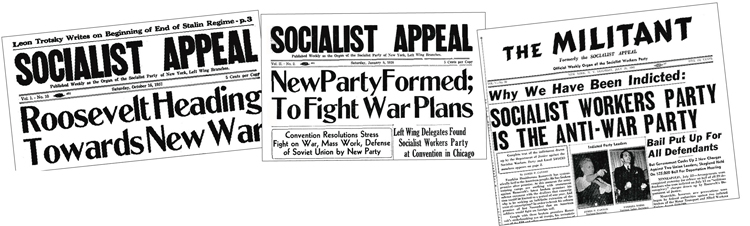
Teamster Bureaucracy by Farrell Dobbs is one of the Books of the Month for October. This is the last of his four volumes on the Teamsters. It covers the union’s campaign to lead working-class resistance to the bosses’ attacks and the U.S. rulers’ drive to enter the unfolding world war to compete for profits and power. Unleashing the FBI, the Franklin Roosevelt administration tried to smash union power and silence anti-war militants. It framed up and imprisoned 18 leaders of the Socialist Workers Party and Minneapolis Teamsters for campaigning against the war. Dobbs, a central leader of the Teamsters battles and one of those imprisoned, later became SWP national secretary. The excerpt is from the first chapter, “Let the people vote on war.” Copyright © 2018 by Pathfinder Press. Reprinted by permission.
To get out of this bind, the boss class acquiesced in a promise by the incoming president to give the “ill-fed, ill-clothed, ill-housed” of the nation a “New Deal.” …
Just enough social concessions were added to revive faith among workers and farmers that their problems could be taken care of through repair of the capitalist system. In that connection, especially, the aims of the New Deal were supported by the trade union bureaucracy, the social democrats and — beginning in 1935 — the Communist Party.
As a consequence of those combined factors, the labor upsurge was confined to struggles at the trade union level; the workers were blocked from taking the road of independent political action and forming their own party; and the capitalist ruling class kept a firm hold on the reins of government. …
Imperialist rivals were encroaching upon territories abroad which this country’s ruling class, with its global interests, had staked out for exploitation. Among those competing governmental gangs, two loomed as the most formidable opponents of their Wall Street counterparts. One operated from within Hitlerite Germany; the other had its base in Japan, where a militarist regime held power. Both had their eyes on the superprofits United States banking combines and monopoly corporations were raking in from foreign holdings; Germany and Japan were out to grab a larger piece of the action.
It was in this rivalry between imperialist cutthroats that Roosevelt was dedicating himself to the protection of “American interests.” But that wasn’t what he talked about during the 1936 elections. Instead, he campaigned on the basis of his phony image, built up during his first term, as a champion of the exploited masses. …
At that point General Drivers Local 544, in Minneapolis, Minnesota, set out to organize trade union opposition to Roosevelt’s preparations for use of the workers as imperialist cannon fodder. Local 544, an affiliate of the International Brotherhood of Teamsters, AFL, was led by Trotskyist militants. They were revolutionary socialists, whose training and experience enabled them to grasp the real meaning of the scheme being cooked up in Washington.
The leaders of Local 544 were also seasoned campaigners, well versed in the organization of mass actions. Thus it was apparent to them that the first task was to alert the union ranks to the dangers arising from the new course taken by the White House and to explain why the workers’ vital interests were threatened. Only in that way could the necessary forces be drawn together to launch a broad protest movement.
Fortunately, there was an excellent vehicle at hand to undertake that beginning. The Minneapolis Teamsters had a weekly paper, the Northwest Organizer, published initially by the General Drivers Union. In 1936 it had been made the official organ of the Teamsters Joint Council, a body composed of representatives from all IBT locals in the city. … All in all, the Teamster organ had a prime body of readers, among whom the initial protest forces could be mobilized.
The educational phase of the campaign was opened through an editorial in the April 22, 1937, issue of the paper. It was pegged to the upcoming celebration of May Day, the international working-class holiday. …
“May Day will continue to express the interlocking nature of economics and politics,” the editorial said in part. “But although puny politicians may try to turn the occasion into a common election rally, the workers will be turning their attention to much broader and sounder implications, namely independent working-class action. Proper economic subjects such as hours, wages, jobs, relief and organization, will be amplified by consideration of political relations such as civil liberties, war and the other struggles ahead. …
“Wars and rumors of war are … necessary implements of great capitalist competitors. Not one of them can remain peaceable but each must strive until his power is broken, to gain world-wide supremacy by ruthless terror and destruction. Here, too, petty politics are of no avail. Why? Because government, ‘the executive committee of the ruling class,’ must not only conduct war for its master, but must prepare the way by subduing all opposition and assuring ‘unity at all costs’ at home. May Day therefore calls for renewed defense of workers’ rights.” …
[T]he Teamster paper set out to counter the jingoistic line, opening with an editorial which asserted:
“The reason the United States has its garrisons in China and its warships in the Far Pacific is to protect American capitalism in the Orient. The American worker has nothing whatever at stake, the American bosses have millions of dollars of investments that must be protected. The American worker has nothing to gain and everything to lose by a war fought to protect American capitalism. … In the present crisis in the Far East, the interests of the American workers lie with the interests of the downtrodden people of China.”