The lack of aid from Washington to the trail of devastation left in Jamaica and a number of other Caribbean nations by Hurricane Melissa shines a spotlight on the deadly consequences for working people of the economic and social priorities of the ruling capitalist families in the U.S.
In sharp contrast, the response by the government of Cuba highlights what working people can accomplish with the backing of a government that mobilizes resources and working-class solidarity to ensure that no one is left to fend for themselves.
The hurricane battered Jamaica Oct. 28 as a Category 5 storm, one of the strongest ever in the Caribbean. The next day it hit Cuba as a Category 3, weakening as it churned across the island, then heading toward Haiti, the Bahamas, Bermuda and into the Atlantic.
In Jamaica, 32 people died. No inch of the town of Black River was spared by the storm. The next day, residents there had to walk for miles to get food, water and other basic necessities, because no help had arrived and no one knew when it would come. Other hard-hit communities remained isolated because of a lack of equipment to clear damaged roads. Small farmers and fishermen face long-lasting effects on their livelihoods due to the loss of crops, and equipment.
Haiti, where working people already face a social disaster from murderous gang rule and the effects of earlier natural calamities, was spared a direct hit. But at least 43 people were killed in floods after a river burst its banks. As the painful task of picking up the pieces begins, the human toll is likely to rise.
‘No one left alone in Cuba’
In contrast, in Cuba over 700,000 people were evacuated out of harm’s way before the storm struck, resulting in zero fatalities.
Social and economic disasters seen after hurricanes like Melissa and other natural phenomena are not inevitable. They can be minimized by a government that mobilizes resources in advance and organizes to protect working people, especially the most vulnerable. This, of course, runs counter to the priorities of the for-profit capitalist system.
While working people in capitalist countries are left on their own, the opposite is true in Cuba, where workers and farmers made a socialist revolution and hold political power.
In the days leading up to Melissa’s arrival, Cuba’s Civil Defense Committees went into action, reaching out across the entire country by radio and television, telling people to prepare for evacuation. They even dispatched scooters and other vehicles fitted with loudspeakers to spread the word.
Before the storm, the trade unions, other mass organizations and the government joined residents to clear accumulated trash and cut down trees. Priority was given to ensuring safe conditions in hospitals, homes for the elderly, schools and other centers used to house evacuees.
Hundreds of thousands were evacuated to safety, the majority to homes of relatives and friends, and food supplies were distributed prior to the storm. Rescue units of the Revolutionary Armed Forces and the Ministry of the Interior were positioned near high-risk areas to respond quickly.
In Holguín, one of the Cuban provinces hit by Melissa, some 106 community brigades were prepared to work with 1,600 workers from electrical and other technical brigades to restore power as soon as possible.
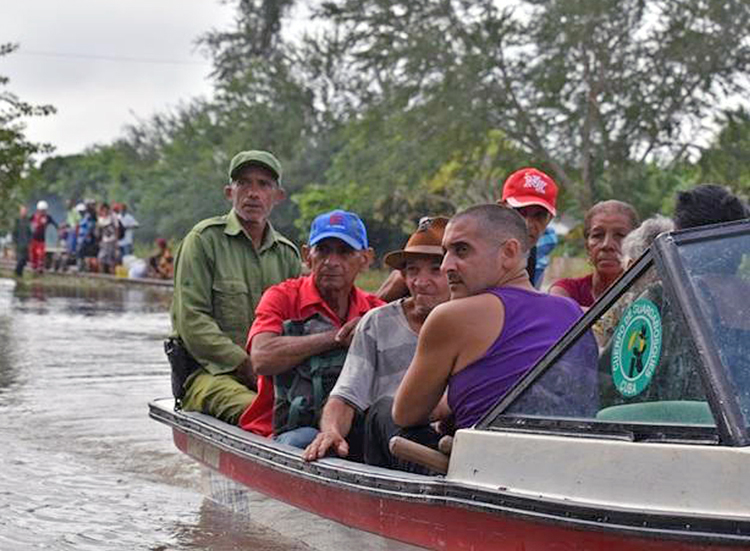
In Guamo, Granma province, rescue operations were still ongoing days after the storm passed, as hundreds of people were trapped by river floods. As some 2,000 residents were being evacuated by a passenger train, it ran into flooding that covered the tracks. After inspecting the area, the crew proceeded to move forward as slowly as possible, the Cuban daily Juventud Rebelde reported. A drop in the track under water, however, caused the cars in the rear to uncouple.
In a very difficult operation, “only possible because of the solidarity and everyone’s determination,” some passengers were transferred to the other cars, while others were taken back to Guamo, where they were sheltered in the train station and a local health clinic. No one was hurt.
“The crews, including conductors, engineers, drivers and assistants, did a yeoman’s service. To all of them, our gratitude,” Cuban Minister of Transportation Eduardo Rodríguez wrote on his Facebook page.
“We were able to preserve all human lives, even with the complex situation we’re confronting,” Yudelkis Ortiz Barceló, head of Granma’s civil defense committee, said.
As working people set out to rebuild housing, restore electricity and reorganize agricultural production damaged by the storm, the U.S. government hasn’t backed off one inch from its economic and political war against the Cuban people.
Washington’s economic war on Cuba
For more than six decades Washington has levied punishing economic, financial, and trade sanctions on Cuba — the main cause of the shortages of oil, medicines, fertilizers and other basic imports for production on the island. The U.S. rulers’ stated goal is “to weaken the economic life of Cuba” in order “to bring about hunger, desperation and overthrow of government,” says a State Department memorandum from April 1960.
As Hurricane Melissa was heading toward Cuba, the U.N. General Assembly adopted a resolution Oct. 29 by an overwhelming majority calling on Washington to end its economic war against the Cuban people.
“I am speaking on behalf of a people that right now faces, with scarce resources, virtually only with determination, unity and solidarity, a monstrous hurricane,” Cuba’s Foreign Minister Bruno Rodríguez told the meeting.
As Cuban revolutionary leader Raúl Castro said in a message to the Cuban people the night before the storm hit, Rodríguez said, “in the face of this new challenge, we will also come out victorious.”