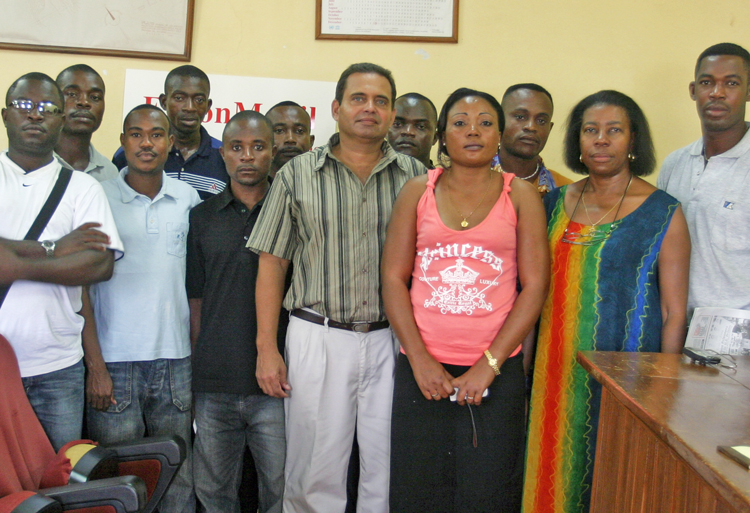
The Spanish edition of Capitalism and the Transformation of Africa: Reports from Equatorial Guinea by Mary-Alice Waters and Martín Koppel is one of Pathfinder’s Books of the Month for November. The two authors joined a Militant reporting team there in 2005 and 2008, seeing changes in social relations as capitalist development gives birth to a working class, as well as the impact of Cuba’s internationalist volunteers, who bring the life-changing effects of Cuba’s socialist revolution led by Fidel Castro. The excerpt is from the introduction by Waters, a leader of the Socialist Workers Party and president of Pathfinder Press. Copyright © 2009 by Pathfinder Press. Reprinted by permission.
Capitalism and the Transformation of Africa: Reports from Equatorial Guinea is not an account of how centuries of colonial domination, the slave trade, and imperialist pillage have ravaged the peoples of Africa and plundered the natural resources of the continent. That history, in all its brutality and with all its consequences, has been lived by countless millions and documented thousands of times over. …
Our focus is quite different. We spotlight the transformation of the instruments of production and the new class relations emerging today in Equatorial Guinea. We look at the working class, drawn from the four corners of the earth, that is beginning to develop — in the same measure as a bourgeoisie is being formed, together with expanding layers of traders, middlemen, and professionals.
This is a book about the future being forged in the present. It is about the fight to make it a future that advances the interests of toiling humanity, different in all ways from the only past we have known. It is about the heightened expectations and the growing confidence, pride, consciousness, and combativity of the women and men who are themselves both agents and products of this ongoing transformation. …
[Our] visits enabled us to see and record the living example of Cuba’s socialist revolution, without which the road forward for working people in Africa, as elsewhere in the world, would be far more difficult to discern. The hand of proletarian solidarity extended by the more than 230 Cuban internationalists working in Equatorial Guinea as doctors, nurses, medical technicians, teachers, electricians, and others registers the kind of social relations — and human beings — that only a socialist revolution can produce. …
Class society “has never been anything but the development of the small minority at the expense of the exploited and oppressed great majority; and it is so today more than ever before,” Engels explained in The Origin of the Family, Private Property, and the State. That has been true since the days, shrouded in the unrecorded mists of prehistory, when cattle and women first became the private property of a few men. Today, when it is factories employing thousands, vast tracts of farmland in the tens or hundreds of thousands of acres, and mines producing millions of tons of coal, metals, and other raw materials indispensable to modern industry that are the private property of capitalist families the world over, Engels’s observation seems even more obvious.
The revolutionary conquest of political power by the workers and farmers of Cuba on January 1, 1959, marked one of the greatest leaps in history toward putting an end to those millennia of successive class societies. Over the next two years Cuba’s working people and their government expropriated the vast majority of the plantations, factories, mines, public transport, banks, and utilities held as private property by the capitalist families of the United States and Cuba. They successfully defended their course against the military assaults and economic warfare organized by the most brutal imperial power on earth.
It was these decisive actions first by hundreds, then thousands and millions, that made possible the steps they have taken over the last five decades to begin constructing a society built on a different class foundation. A society driven not by the dog-eat-dog, blind laws of capital, but one based on the conscious social solidarity of the toilers.
That class solidarity — to cite but one example especially pertinent to the account in this book — is what defines the character of the primary care and medical education that some 38,000 doctors, nurses, dentists, and lab technicians trained by the Cuban Revolution are bringing to the most remote and inaccessible regions of some seventy-three countries around the world, Equatorial Guinea among them.
How has Cuba — with its limited economic resources, and in face of unceasing aggression by Washington — been able to create a medical system acknowledged around the world for its excellence? How has it been able to train doctors and nurses who are not only willing but eager to travel to the most isolated regions of the world to provide medical services? Why is no other country on the face of the earth capable of anything similar?
The answer was explained with unmatched clarity by Ernesto Che Guevara, the great Argentine-Cuban revolutionary leader who fought at the side of Fidel and Raúl Castro in the revolutionary war and early years of the new government. “To be a revolutionary doctor, … there must first be a revolution,” Che told an audience largely composed of Cuban medical students and health workers in 1960.
And make a revolution is exactly what Cuban working people did. Their economic, social, and political accomplishments since then — from health care and education, to aid given freedom fighters the world over — have been possible only because they took the power to rule out of the hands of the landlords and capitalists.
One of the great ironies of history may well be a coincidence no one could have predicted. The most far-reaching revolutionary victory in the Americas — alive and advancing despite all odds — celebrates its fiftieth anniversary just as the leaders of the Yankee empire that set out to destroy it are plunged into the worst economic and social crisis they have faced since the one that culminated in World War II.