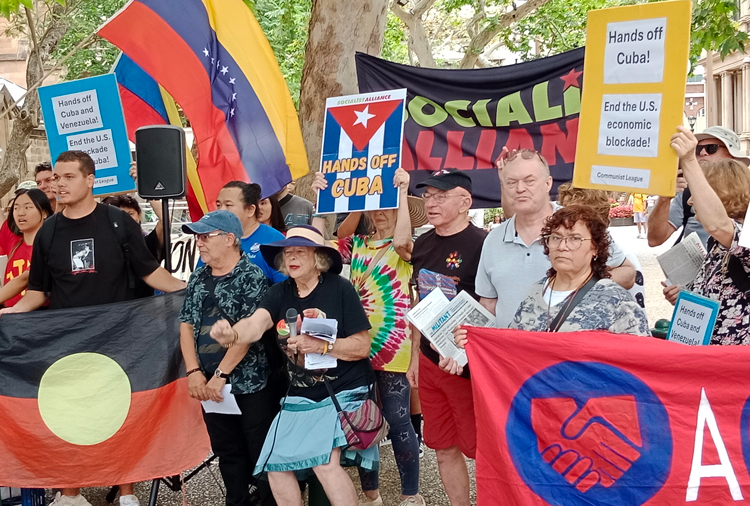
SYDNEY — Up to 70 people rallied at the Town Hall here Feb. 28 to demand “End the U.S. blockade of Cuba and Venezuela!” The protest was called jointly by the Australia-Cuba Friendship Society and the Venezuela Solidarity Network.
The National Network on Cuba in the U.S. has called for a week of actions in defense of Cuba March 8-15, culminating in a weekend conference in New York City to plan future activity.
At the Sydney event, Marx del Rosario, who participated in a recent solidarity brigade to Cuba, read a message from a member of the Cuban Institute for Friendship with the Peoples. “The signing of the executive order by [U.S. President Donald] Trump, which cut off or prohibited the entry of fuel from Venezuela to Cuba, and the application of tariffs on countries that sell fuel to the island, has greatly worsened our current situation.”
This has led to “massive daily blackouts” and means the “public transportation system is unable to meet the demand,” adding, “hospitals have been deprived not only of basic supplies to ensure care of the population, but also of medication to treat our illnesses.”
Washington’s attacks on Cuba come at “one of the most critical points in her entire history,” the message said, targeting “a people whose only crime was achieving, through their own strength, freedom for the first time in their history.” The fact that Cuba’s people continue to resist, “in the eyes of our neighbor 90 miles away, is the greatest of affronts.”
Supporters of the Communist League built the protest, pointing to the need for action by working people to oppose the U.S. rulers’ blockade and escalating military threats against Cuba.
The Maritime Union of Australia, which organizes seafarers and longshoremen, sent a message to the Cuban Embassy in Canberra Feb. 17 condemning Washington’s oil blockade. “Threats of naval and economic measures against countries that lawfully trade with and supply vital goods, including oil, to Cuba,” the union said, “constitute an intolerable extension of the blockade and an affront to the sovereignty of all affected nations.
“As maritime workers, we are particularly conscious of the gravity of attempts to enforce coercive measures on international shipping and energy supplies, including threats of secondary sanctions against third countries and companies.”
* * *
MIAMI — Nearly 50 people rallied in a pouring rain in the Flag Plaza at the Miami International Airport here March 1 to protest the government’s escalating attacks on Cuba. The Miami Coalition to End the Blockade of Cuba and the José Martí Cultural Association organized the action, with the Democratic Socialists of America, Socialist Workers Party and a number of other groups participating.
A constant flow of cars and people passed by, and many drivers slowed down to read the handmade signs we carried. They included, “The oil blockade is a crime, US hands off Cuba! End the criminal economic blockade!” and “No power = no incubators, no water in homes, no trucks, no buses: Let Cubans live. No más guerra contra Cuba. [No more war against Cuba.]”
CBS and Univision TV both filmed the demonstration, and CBS ran a story on the protest on the evening news.
Robert Rosa, a member of the American Indian Movement, drove four hours from Deltona to join the protest. He held a giant Cuban flag and chanted with the crowd, “¡Familia sí, bloqueo no!” (Family yes, blockade no!) This was one of the most popular chants at the event.
— Laura Anderson
* * *
LOS ANGELES — Some 100 people joined an emergency speak-out held in person and online against the U.S. oil blockade against Cuba Feb. 28. The program, hosted by the Los Angeles U.S. Hands Off Cuba Committee, featured David Ramírez from the Cuban Embassy in Washington, D.C., and other speakers.
“The blockade against Cuba is still in place and still affecting the people of Cuba,” Ramírez said. “It’s still affecting the children in our schools, still affecting our patients in our hospitals.”
“Yes, the blockade is stronger than ever. Yes, the United States is enforcing it. Yes, there was an incursion of terrorists that tried to enter the country illegally,” he said. “We are creative in essence and we will always seek for a way out of our problems. If you block access to fuel, we will put in solar panels in order to power our hospitals and our schools. If you block our access to food, we will start growing food in the cities if we have to. We are not going to give up.
“When the people of Cuba feel threatened, we unite, because for us what’s most important is to preserve our nation, to preserve our independence, to preserve our sovereignty,” he said. “And we are willing to do everything to defend our nation because we have shed a lot of blood for many centuries in order to be independent and not be a colony of any other country.”
Ramírez talked about U.S. efforts to prevent other governments from requesting Cuban doctors to serve in their countries. The governments of Honduras and Guatemala have recently been told they must leave. “There is a direct pressure campaign from the U.S. government against these countries to stop their medical cooperation with us. We always try to pursue humanitarian solidarity with the people all around the world. We don’t do it because it’s a business. We do it because it’s in our core to be humanitarians. And we are going to continue to do this.”
Kevin Kucera, district president of the International Association of Machinists here, said, “We must and will continue to defend the sovereignty of Cuba and Cuba’s right to self-determination. We must continue to protest.
“The attack on Cuba and Cuba’s rights is an attack on workers’ rights around the world,” he said. “Our union and the AFL-CIO stand with the Cuban people in solidarity.”
The meeting heard about how supporters of Cuba will be going to Phoenix to attend and distribute literature when the Cuban national baseball team plays two U.S. Major League teams there March 3-4, part of preparations for the World Baseball Classic in Puerto Rico.
The meeting ended with a decision to organize a picket line March 8 calling for “US hands off Cuba — End Washington’s economic blockade!” from 1-3 p.m. at the corner of Hollywood Blvd. and Highland Ave.
— Bernie Senter