
“We are getting very close to meeting our objectives” and ending the fighting, President Donald Trump claimed March 20, but then ordered another 2,500 Marines to the Middle East. This is on top of the 2,500 Marines sent the week before. On March 24 the Pentagon ordered some 3,000 soldiers from the 82nd Airborne Division to the Middle East.
All three groups are trained for landing parties to take coastal areas.
Trump’s objectives have nothing to do with defending Israel as a refuge from Jew-hating violence or with supporting the courageous struggles of the peoples of Iran.
Trump announced March 24 that his envoys had convinced key Iranian officials to agree to joint control of the Strait of Hormuz and to surrender Tehran’s stock of enriched uranium. He also said Tehran had renounced building nuclear weapons.
But the Iranian regime has always told lies about its nuclear program, claiming it’s only for peaceful purposes.
Tehran says it has rejected Trump’s proposal but are open to more discussion.
Washington has allowed Tehran to sell more oil, stating it was necessary to bring down the cost of crude oil, which has skyrocketed since the start of the war.
Despite attacks by U.S. and Israeli forces that have severely degraded the reactionary regime’s military capacity, Tehran is still launching large numbers of missiles and drones at Israel and nearby Arab nations, and threatening shipping through the Strait of Hormuz.
Some 20% of the world’s gas and oil pass through the strait. Tehran’s attacks are affecting not just fuel, but urea and ammonia, crucial for fertilizers, with a disastrous impact on working farmers who depend on its timely delivery. Some 2,000 ships with 20,000 seafaring workers on board, are stuck in the area, with nowhere to go.
Tehran’s missiles struck Shell oil’s liquefied gas facility in Qatar March 2 — the largest in the world — knocking out 17% of its capacity. It could take years to repair. In mid-March Tehran struck oil and gas facilities in Saudi Arabia, Kuwait, Qatar, the United Arab Emirates and Bahrain.
Since the war began, the Saudi government has reversed course, ending its refusal to let U.S. forces use an air base in the country. The New York Times reported March 25 that the rulers there are urging Washington to continue attacking Iran, calling this “a historic opportunity” to remake the region.
Israel has been focusing on military targets and the Iranian rulers’ repressive apparatus. In contrast, many of Tehran’s missiles — armed with cluster munitions that spread shrapnel over a wide area — are aimed at indiscriminately killing Jews and others in Israel. One missile landed on a salon in the Palestinian West Bank March 18, killing four women and wounding nine other Palestinians, including a 4-year-old girl.
If, instead of a cluster bomb, the missiles carried a nuclear weapon? That would be a new Holocaust.
Divisions among imperialist powers
While the war has pushed the capitalist monarchies of the Gulf states into a more open alliance with Washington, it has widened divisions between U.S. imperialism and its “allies” elsewhere. Trump has complained repeatedly that governments that are part of the U.S.-led NATO bloc are “COWARDS” for refusing to protect shipping in the Strait of Hormuz from Iranian attacks.
The U.S. rulers’ goal is strengthening Washington’s own economic, political and military domination of the region. They want to expand their profits by plundering the gas, oil and labor of the Middle East.
“This is not our war, we did not start it,” German Defense Minister Boris Pistorius said March 16. The French foreign ministry said that its navy was staying where it was in the eastern Mediterranean. And British Prime Minister Keir Starmer said that the United Kingdom “will not be drawn into the wider war.”
However, fearful of being cut off from getting a share of the oil and other resources in the region, London and Paris are now saying they plan to send minesweepers to the Strait of Hormuz, but only after the war ends.
The cost of ‘riding with’ Trump
Trump’s announcement that he was in “productive” talks with the regime in Tehran, was not welcomed in Israel. “As Trump steers away from war with Iran, Israel rediscovers cost of riding with him” was the headline on a March 23 article in the Times of Israel.
Israel’s war with Iran is not the same as Washington’s. For Israel it’s a life-or-death question. The bourgeois clerical regime in Iran openly states it intends to destroy Israel — and expel or eliminate the Jews there.
Over the last year Tehran has helped Hezbollah in Lebanon rebuild its forces to attack Israel. By March 19 Hezbollah had fired more than 2,000 missiles at Israel.
The current war demonstrates why Israel has no choice but to destroy Tehran’s ballistic missile and nuclear capability and to try to defeat its proxy forces like Hezbollah.
The Times of Israel article notes that this is not the first time that the U.S. rulers have “undermined” Israel’s interests.
In May 2025, the Trump administration reached a deal with Houthis in Yemen that ended “attacks on US vessels, but allowed the Houthis to keep shooting at Israel.”
As Israel was preparing new strikes after Tehran broke a ceasefire ending the 12-day war last year, “Trump’s response was to berate Israel and publicly force it to turn its planes around.”
While Israel Prime Minister Benjamin Netanyahu relies on Washington’s aid — sowing deadly illusions about the character of U.S. imperialism’s intervention — he has also repeatedly shown that Israel will do what is necessary on its own to defend its existence as a refuge for Jews.
New protests in Iran
Amid the war, Iran’s capitalist rulers have stepped up their brutal attempts to intimidate working people, oppressed nationalities and others, hoping to prevent a repeat of the massive anti-government protests that swept the country in January. The Islamic Revolutionary Guard Corps, paramilitary Basij thugs and cops slaughtered over 7,000 protesters, ending the demonstrations.
The regime has set up checkpoints manned by the Basij, sent convoys of armed thugs chanting pro-regime slogans through cities and towns, and arrested hundreds of people it accuses of being Israeli agents.
On March 19, the eve of Nowruz, the Iranian New Year, Tehran executed Saleh Mohammadi, Medhi Ghasemi and Saeed Davoudi in Qom, after accusing them of killing two police officers during the January protests.
Their families reject the accusations, saying the three were forced to confess “under pressure and torture,” the Coordinating Council of Iranian Teachers’ Unions reports.
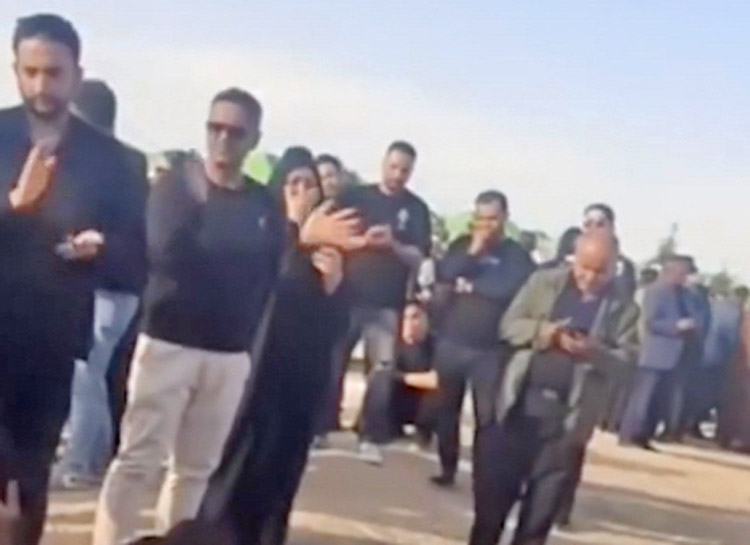
Defying the regime and the additional challenges caused by Washington’s war, over 100 people joined the family of 19-year-old Mohammadi, a wrestling champion, at a funeral procession and ceremony at his graveside.
That same week, there were graveside commemorations for two young men who were killed during the January actions — 21-year-old Kurdish lawyer Mahan Rostami in Kermanshah and 16-year-old Alireza Seidi from Abdanan, who was killed in Tehran.