There are countless examples of how workers and farmers in Cuba are coming together to organize to meet the brutal effects of Washington’s stepped-up economic war and defend the gains of their socialist revolution. They are doing it with the ingenuity, creativity and solidarity spawned by that revolution.
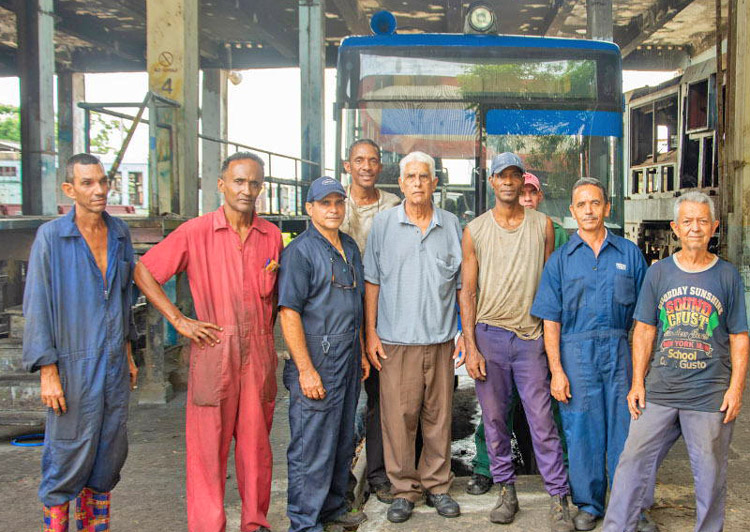
Rail workers building and maintaining a system of railbuses to serve rural neighborhoods, many of which have no other reliable mode of transportation, is one example.
With public transportation virtually at a standstill due to the lack of fuel and spare parts for buses, Cubans across the island are turning to bicycles, electric scooters, even horse carriages, to get around and keep production and essential services going. The transportation crisis was accelerated by the Donald Trump administration’s Jan. 29 executive order threatening tariffs on any country that sells or gives oil to Cuba.
Defending gains in rural areas
The steps by rail workers today are built on the gains made after the Jan. 1, 1959, overthrow of the U.S.-backed dictatorship of Fulgencio Batista. Carahatas — buses that have been adapted to run on rail tracks — played an important role then in closing the gap in conditions of life between workers in cities and countryside, a goal of their socialist revolution.
The railway network whose primary purpose had been to connect the sugar mills with cane fields and workers’ settlements — to feed the mills with sugarcane at harvest time, and the coffers of its owners in the process — now had a social purpose, to provide transportation to these historically abandoned sectors of the population, alongside other advances like access to electricity, health and education. For the first time, workers and peasants had the chance to participate in social and political activity in a meaningful way.
Over decades, this essential service has dwindled drastically, as Cuba’s ability to purchase new equipment, spare parts and other materials to maintain the tracks and equipment was increasingly blocked by Washington’s economic, trade and financial sanctions imposed as part of its drive to overturn the socialist revolution.
Starting in 2010, Cuba’s Transportation Ministry launched a major project to rebuild the rail industry. It included the Birán Project, named after the small rural town in the hills of Holguín province where Fidel and Raúl Castro’s family was from. It was set to repair the tracks leading to these rural towns and replace the old carahatas with a fleet of modern Russian-made railbuses.
The U.S. embargo and other obstacles, however, made purchasing the Russian railbuses impossible. Nonetheless, workers at Cuba’s national railway company were determined to press ahead.
With workers’ ingenuity
Workers’ “intelligence is stronger than technological obsolescence and the lack of resources,” said a May 2021 TV Camagüey news report on their work taking old buses that had been taken out of service for lack of parts and transforming them into a new version of carahatas. One of the buses, a Chinese-made Yutong, was named “El Mayor” — the biggest — by the workers, both because of its size and the degree of commitment involved in making it run.
The project — being carried out simultaneously in several of the country’s provinces — often involves retired rail workers with their technical skills working alongside younger workers with less experience. Many of them are part of the National Association of Innovators, a movement initiated in the 1960s by Cuban leader Ernesto Che Guevara. This group grew out of Guevara’s efforts to lead the Ministry of Industry in drawing on workers and farmers to resolve crippling shortages of parts and raw materials after the John F. Kennedy administration began the U.S. economic embargo on Cuba in 1962.
“The people in the town itself take part in the restoration of the tracks,” Camilo Chávez Molina, an engineer in one of the ministry’s workshops in Holguín province, told Cuban TV. “When the equipment arrives and enters service, it’s practically a fiesta,” he said.
“I’m very proud of having worked hard on this railbus,” Carlos Hernández, a train engineer in Holguín, told Canal Caribe TV in February 2025 as he drove out of the shop in a completed railcar. “We do it for the children, the university students, for those going to medical appointments in the province capital.”
Solidarity overcomes adversity
The carahatas “have gone beyond their initial purpose,” wrote Germán Veloz, Holguín correspondent for the Cuban daily Granma Feb. 23. They are used as ambulances for the ill, or women in labor, for instance. Since Washington’s move to cut off oil supplies to Cuba, agricultural cooperatives and other institutions are increasingly relying on the railbuses to move everything, from medications to basic food supplies in remote areas.
Because it is considered an essential service, the government provides the railbuses with a certain amount of diesel regularly. But when that proves impossible, “solidarity becomes the battering ram that demolishes adversities,” says Veloz. Agricultural cooperatives and other local institutions come to the rescue, offering some of the sparse fuel they have “because the benefit will spread to many people.”
The stops along one of the routes in Holguín were made famous around the world by the song “Chan Chan,” performed by the Buena Vista Social Club band. They sing, “De Alto Cedro voy para Marcané; llego a Cueto voy para Mayarí” — “From Alto Cedro I head for Marcané; I reach Cueto, then head for Mayarí.” It is easily accessible online for your enjoyment.