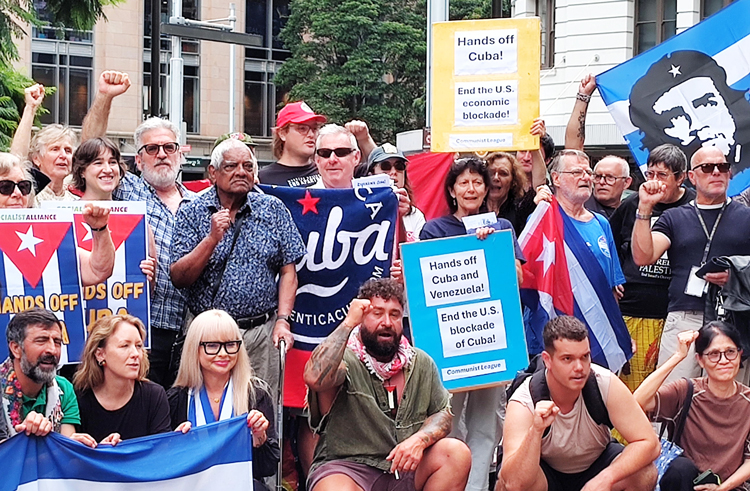
SYDNEY — “What do we want? End the blockade! When do we want it? Now!” chanted participants at a March 21 protest here to oppose Washington’s escalating threats and economic stranglehold on Cuba. Up to 70 people rallied outside the Town Hall in the action organized by the Australia-Cuba Friendship Society.
No oil has reached Cuba for three months because of the blockade imposed by the U.S. government, and Cubans are facing greater difficulties in accessing necessities of life. The rally was timed to coincide with the arrival of humanitarian aid to Cuba from the Nuestra América convoy. Protests were also held in Brisbane and Canberra.
Speaking at the rally, Abigail Boyd, a Greens member of the New South Wales state Parliament, condemned what Washington imposes against Cuba “as not just an economic policy but an act of sustained aggression against the self-determination of a people.”
Paul Keating, Sydney branch secretary of the Maritime Union of Australia, called out the federal and state governments for not standing up against Washington. “The politicians,” he said, “send working-class people into war. Our children are killed. Our union stands for humanity. We stand with the Cuban Revolution.”
The economic damage from Washington’s six-decades-long economic war against Cuba “is estimated to be $130 billion,” said Larissa Payne, speaking for Progressive International, one of the organizers of the Nuestra América convoy. She explained the embargo is part of Washington’s ongoing efforts since the 1959 revolution to overthrow the Cuban government.
Supporters of the Communist League built the protest and carried placards demanding “Hands off Cuba! End the U.S. economic blockade!”
Bob Treasure, president of the Sydney Australia-Cuba Friendship Society, said it is a lie “that Cuba is an imminent threat to the United States.” He pointed to the collaboration between the U.S. and Cuban coast guards to prevent drug trafficking. Treasure ended the rally by stressing the importance of international solidarity with Cuba.
* * *
More than 600 representatives from some 33 countries, across Europe, the U.S. and Latin America, traveled to Cuba as part of the Our America to Cuba convoy, bringing sorely needed material aid to the Cuban people. They were received outside the headquarters of the Cuban Institute for Friendship with the Peoples (ICAP). A number of central leaders of the Cuban Communist Party and government attended, including President Miguel Díaz-Canel.
The centerpiece of the convoy was a 75-foot fishing trawler from Mexico that arrived in Havana. It carried aid from Brazil, Colombia, the U.S., Uruguay and Mexico, including medical supplies, food, school kits and other essential items.
Hundreds of volunteers from political, labor and solidarity organizations around the world assembled and transported more than 20 tons of supplies. About half a million dollars were raised in the U.S. to buy solar panels and related equipment for Cuban hospitals. Others flew in with suitcases stuffed with medicine or on charter flights loaded with food.
Fernando González Llort, now president of ICAP and formerly one of five Cuban revolutionaries unjustly imprisoned by Washington for up to 16 years for gathering information on planned attacks on the revolution, spoke to the gathering.
“Under no circumstances will we renounce the defense of the just causes of the people nor our aspirations to continue fostering solidarity, internationalism and collaboration, which have been pillars of our foreign policy,” he said.
“You represent the certainty that no imperial siege can ever imprison the dignity of our peoples,” he told the members of the Our America convoy. This is “because the homeland we defend, the homeland of Martí, Fidel, of those who have fallen and of those who resist, is not a strip of land under siege, it is a piece of humanity that refuses to surrender.”
Building the convoy was part of winning broader solidarity with Cuba in the face of Washington’s assaults. This is as important as the material contribution from the convoy. Since January the U.S. government has imposed an energy blockade, escalating its drive to economically strangle the Cuban people and overturn their socialist revolution.