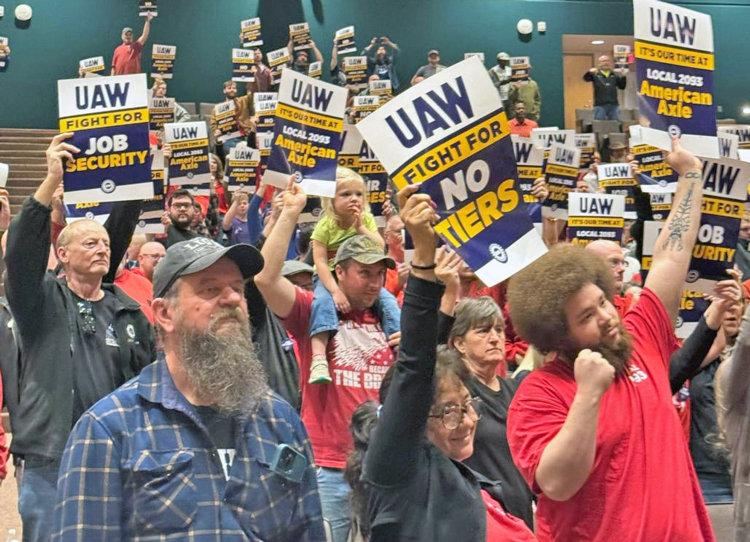
THREE RIVERS, Mich. — Nearly 1,000 striking members of United Auto Workers Local 2093 returned to work June 15 after winning substantial gains. They had walked off the job at the large American Axle plant here, now called Dauch, two weeks earlier demanding higher wages and improved working conditions.
The factory was originally owned by General Motors. Like many other drivetrain and auto parts plants, it was sold in 1994 to an investment group led by former auto boss Richard E. Dauch. Like the rest of the auto industry, the company was battered by the 2008 capitalist financial crisis. The bosses took advantage of this to impose massive pay cuts and other concessions on the workers.
“We were on strike for 87 days in 2008, in the freezing cold,” Shawn Schnepp, a forklift driver who has worked at the plant for 32 years, told the Militant when this correspondent visited the union hall and picket line June 10. That strike involved over 3,000 workers at the five plants in Michigan and New York that Dauch had purchased. It ended with wages slashed from $29 an hour to $14.50. In the 18 years since, workers’ raises have been minimal. As of June 1, starting pay was still just $18, with line workers topping out at $22 after five years on the job.
In the meantime, Dauch and the bosses reaped big profits. After a $1.44 billion takeover of another auto supply company earlier this year, the company changed its name to Dauch Corporation, which is now run by David C. Dauch, the son of the former owner. It is currently valued at $12 billion.
Among its investors are Blackrock, Vanguard Capital Management, Goldman Sachs and the Bank of America.
“In 2008 management said they would make it right once the company got back on its feet,” Schnepp said. “But they never did.” In this strike the union demanded $30 an hour by 2030.
On June 14, the strikers voted 80% in favor of a new four-year contract. “We got what we were asking for, and didn’t make any concessions,” UAW Local 2093 bargaining chair Josh Jager told the Militant. UAW members who started before 2008 get an immediate $8 an hour raise, “and everyone hits $30 by 2029. Starting pay goes up to $22, and new hires will reach $30 in four years.”
Schnepp and every other striker I spoke to complained about massive forced overtime. “I used to be involved in my church, now I can’t do it,” because of seven-day workweeks, he said. “Pastors have complained to the company, but they don’t care.”
“Everyone was on board for the strike,” said Chuck Taylor, a young worker with four years in the plant, while picketing at one of the main gates. “Management has disrespected us for a long time. They can make plans. But they can tell us Thursday we have to work the weekend.”
For line worker Greg Thompson, “the central question is respect — for them to treat us like human beings, not robots. People have families and lives outside of here. There are single mothers working here. We have to work 19 days in a row to get a weekend off. I’ve been here over 10 years and it hasn’t gotten better yet.”
The new contract includes three more paid holidays, nine more vacation days and a guaranteed profit share payout of at least $1,000, Jager said. There will still be mandatory overtime, “but we got slightly better provisions that should make it more manageable.”
The strike was popular among other workers in the region and beyond. Strikers said they’d gotten a lot of solidarity from other unions, including visits from local Steelworkers and UAW members at the GM truck plants in Fort Wayne, Indiana, and Flint, Michigan.
“The support we got from the community and across the state was overwhelming,” Jager said. “Even the California Coalition of Nurses called to ask how they could help.”