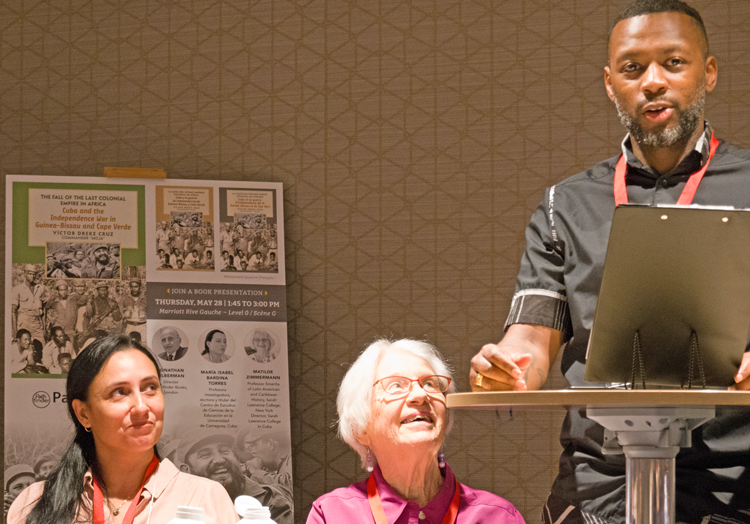
PARIS — “The fight for freedom is not local, it’s worldwide,” María Isabel Bardina of Cuba’s Camagüey University told 30 people at a meeting here to present Cuba and the Independence War in Guinea-Bissau and Cape Verde: The Fall of the Last Colonial Empire in Africa by Cuban combatant Víctor Dreke. The May 28 event was part of the 2026 Congress of the Latin American Studies Association, the second congress of the U.S.-based LASA to be held in Europe.
Bardina paid tribute to Dreke, the Cuban leader who headed that country’s internationalist mission in the independence struggle in Guinea-Bissau. Over seven decades Dreke, 89, has shouldered many leadership responsibilities in the Cuban government, armed forces and Communist Party, with the rank of “comandante.” Today, he is president of the Cuba-Africa Friendship Association.
He joined the revolutionary struggle at 15 and served in combat missions in the Congo as well as in Guinea-Bissau and Cape Verde. The people of these two West African countries put an end to 500 years of Portuguese colonial exploitation, Bardina said, triggering the collapse of Portugal’s empire in Africa and the downfall of the decayed fascist dictatorship in Portugal itself.
“Cuba’s participation changed everything,” added Wilson da Graça Robalo, president of the Federation of Cape Verdean Associations of France. Da Graça reported that as a student he had learned about the Cubans’ collaboration with Amílcar Cabral, who led the African Party for the Independence of Guinea and Cape Verde (PAIGC). His association had written and performed a play about the independence struggle there to help others in France, especially those in the African diaspora, learn about it. He toured Cuba, speaking with students from Africa and others. There are dozens of Cape Verde associations around France. “We have to get this book circulated broadly,” he said.
Marie-Christine Delacroix, a leader of Cuba Coopération, a Paris-based solidarity organization, and former president of France-Cuba, paid tribute to Cuba’s solidarity, “which began immediately after the Cuban Revolution’s triumph in 1959.” Delacroix said the book, now available in French, as well as English and Spanish, would be featured in Cuba Coopération’s online newsletter.
‘A book for working people’
“This book is published for working people resisting the rulers’ drive to make us pay for the crisis of their system, which is marching us to another world war,” said Jonathan Silberman, director of Pathfinder Books in London and a leader of the Communist League in the U.K.
“The victories in Cape Verde and Guinea-Bissau and Cuba’s collaboration show working people can win against powerful enemies, shake off the self-image the rulers teach us, and take power and reorganize society,” Silberman said. “And the book highlights the character of leadership that’s necessary.”
Silberman pointed to Cabral’s political course and capacities, which are described in Dreke’s book. How he led in overcoming national and tribal enmities, drawing women into the struggle, and participating in combat as well as the political leadership. “Cabral explained that working people in Portugal were the allies, not the enemy, of the African toilers, Silberman said.
“A person’s name or the color of their skin isn’t what matters. What matters is what that person has in his head and in his heart,” Silberman quoted Cabral. “Between one man carrying a gun and another carrying a tool, the more important of the two is the man with the tool.” We are fighting, Cabral said, “so that our peoples may never more be exploited.”
Cabral and Fidel Castro were drawn together by their common revolutionary class-struggle outlook, Silberman said. This included the principle that the methods employed in the struggle for a new society must be consistent with the character of the new society we’re struggling for. “Those not willing to fight for the freedom of others will never be able to fight for their own,” Castro said.
In making a socialist revolution and defending it for nearly seven decades, Cuba’s working people have not only changed the world, Silberman said, “they have transformed themselves.” This is captured in Dreke’s book by Alfonso Pérez, a Cuban combatant best known as “Pina,” his nom de guerre. “It was a matter of pride to be asked to go on an international mission,” he said.
“It’s because of their socialist revolution that Cuba’s working people have taken to the streets in their millions to face intensified imperialist aggression and military threats against the country’s sovereignty,” said chairperson Matilde Zimmermann, formerly a professor at Sarah Lawrence College in New York. She introduced Nathalie Gomis, of the Guinea-Bissau community and president of the Miranari Association.
She also introduced Leyanis Perojo, cultural attache at the Cuban Embassy in Paris. “This is why we need a massive movement of solidarity,” Perojo said, adding that events such as this and the publication of Dreke’s book are a real contribution to helping build such solidarity. The meeting ended on this note.
The Pathfinder booth was a hub of discussion at the conference, which attracted thousands of participants around the theme of the colonial revolution. Forty-two copies of Dreke’s book were bought in English, French and Spanish. Overall 164 books, including 16 on the Cuban Revolution and 24 collections of speeches by Thomas Sankara, leader of the popular 1983-87 revolution in Burkina Faso, were sold. This included 11 of Women’s Liberation and the African Freedom Struggle.
Participants also bought 24 copies of The Fight Against Jew-Hatred and Pogroms in the Imperialist Epoch: Stakes for the International Working Class; Fascism: What It Is and How to Fight It by Leon Trotsky; and The Jewish Question by Abram Leon; as well as five subscriptions to the Militant.