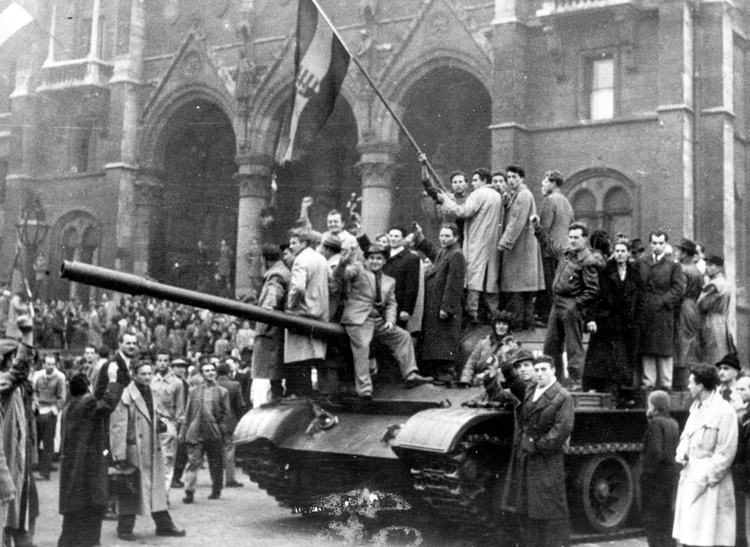
On the 70th anniversary of the Hungarian Revolution, which broke out Oct. 23, 1956, there are valuable lessons from that struggle for working-class fighters. That powerful outpouring was a popular uprising led by workers who organized a fight to rid themselves of Moscow’s domination and national oppression.
Their determination to replace Stalinist brutality with a socialist system based on the program advanced by V.I. Lenin in the early days of the Soviet workers state, gained the attention and solidarity of working people worldwide.
Its example shone strong for a few weeks before it was crushed in a bloodbath by invading Soviet troops and tanks. Thousands were killed or wounded and nearly a quarter of a million Hungarians fled the country.
“The political revolution of the East European working class against Kremlin-sponsored bureaucratic rule scored a major advance,” said the front-page article in the Oct. 29, 1956, Militant, when it “broke out in full force in Hungary this week.”
The next issue carried a lead article: “Workers Lead Uprising in Hungary; Set Up Local Revolutionary Councils.” It said, “Hungary’s workers, soldiers and students are in armed revolt against the Kremlin’s brutal rule and for their national independence.” The article noted that “a large section of Hungary is controlled by local revolutionary workers, soldiers and students councils.”
“The Khrushchev regime in the Soviet Union slanderously attacked the uprising as ‘counterrevolutionary’ and ‘fascist,’” it continued. Likewise, the imperialist news media, awash with Cold War propaganda, “tried to give the impression that the uprising is pro-capitalist.”
The Militant reported, “There is no hint of pro-capitalist sentiment in any of the revolutionary leaflets or statements.” The workers’ uprising, which rapidly became a general strike, was a fight for national independence and reestablishment of workers power over society, expressed by their call for “democratic socialism.”
Another Militant article opposing Washington’s treacherous role was headlined, “Bring U.S. Troops Home from Europe Says Farrell Dobbs,” the Socialist Workers Party candidate for president.
“The Soviet troops who were thrown into battle against ‘counter-revolution’ fought in fact not fascists or reactionaries but the common people of Hungary: workers, peasants, students and soldiers,” Peter Fryer, a former correspondent for the Daily Worker, newspaper of the Stalinist British Communist Party, reported from the scene. Fryer broke with the party’s counterrevolutionary slander and put his articles together in a book worth reading, Hungarian Tragedy.
Following the death of Soviet dictator Joseph Stalin in 1953, unrest spread among working people against decades of brutal repression across the bureaucratically deformed workers states in the Eastern European countries under Moscow’s thumb. The uprising in Hungary showed workers there still looked to build a working-class-run state they could wield in their own class interests.
A spark becomes a revolution
It began with thousands of students marching to Radio Budapest, calling for independence and the withdrawal of Soviet troops, Fryer said. The Stalinist State Security Police (AVH) opened fire and several protesters were killed. This was, he said, “the spark that turned peaceful demonstrations into a revolution.”
Two days later pro-Moscow forces moved to prevent developing fraternization between Hungarian workers and Soviet soldiers, by ordering the troops to open fire on unarmed demonstrators outside parliament, killing hundreds.
“News of the shooting swept through the city like wildfire,” Fryer said. “Soon the people were armed and engaged in running street battles against the AVH.” They demanded “abolition of the AVH and the withdrawal of Soviet troops.”
Workers hated the security police, Fryer said, which was “moulded and trained on the approved Stalinist pattern, completely lacking in either political understanding or common humanity, guilty of the most unspeakable crimes.”
But Hungarian troops in Budapest, as later in the provinces, Fryer continued, either turned over their weapons to the people or “brought their arms with them when they joined the revolution.”
Fryer described how workers set up a network of committees bearing a “striking resemblance at so many points to the soviets or councils of workers,’ peasants’ and soldiers’ deputies, which sprang up in Russia in the 1905 revolution and again in February 1917.”
He explained that “they were at once organs of insurrection — the coming together of delegates elected by factories and universities, mine and army units — and organs of popular self-government, which the armed people trusted.”
“They enjoyed tremendous authority, and it is no exaggeration to say that until the Soviet attack of November 4 the real power in the country lay in their hands.”
But the anti-working-class regime in Moscow sent in 60,000 Soviet troops and 1,000 tanks that day to put the working-class uprising down in blood. After four days of continuous bombardment, “vast areas of the city — the working-class areas above all — are virtually in ruins.”
Pockets of defiant resistance continued for weeks, including a general strike Dec. 11-12 and workers’ councils still organizing factories and mines.
The Hungarian Revolution showed how working people, even facing the most repressive conditions, can rise up, organize to govern themselves, assume political control and learn to defend workers power arms in hand. Stalinist regimes and the imperialist rulers alike hated and feared this historic example.