The following is an expanded version of the opening remarks by Mary-Alice Waters at the Oct. 21 public meeting in San Juan, Puerto Rico, co-sponsored by the Hostosiano National Independence Movement and the Socialist Workers Party.
Waters is a member of the National Committee of the SWP and president of Pathfinder Press.
Thank you Sonia for your generous introduction.
And a sincere thank-you to the leadership of the Hostosiano National Independence Movement (MINH) for hosting this presentation of Cuba and the Independence War in Guinea-Bissau and Cape Verde: The Fall of the Last Colonial Empire in Africa by Víctor Dreke Cruz.
Before anything further, I have a very welcome obligation: to bring you greetings from the author of the book we are discussing this evening.
As we all know, deep historic ties have united the people of Cuba and Puerto Rico throughout centuries of struggles against Spanish and then U.S. domination. For that reason especially, Víctor Dreke very much wanted to send a written message to address this gathering himself. He has just been released from an extended hospital stay, however, and is recuperating at home under strict orders from his doctors to rest. He is very happy to know we are here together tonight and extends his warmest regards and best wishes for a successful meeting.
***
On behalf of the leadership of the Socialist Workers Party, I want to say that it is genuinely an honor to be here with you. For many decades the fight for the independence of Puerto Rico has been our fight as well. We face the same enemy, the imperialist ruling class of the United States. We have found ourselves shoulder to shoulder on the same battle lines many times.
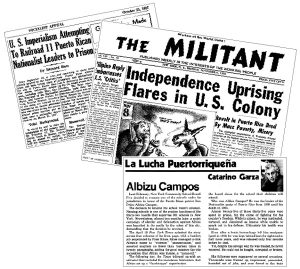
More than 85 years ago, as Washington prepared to enter the second great imperialist slaughter, both the leadership of the Socialist Workers Party and the leadership of the Nationalist Party were framed up and convicted of “conspiracy to overthrow the U.S. government.” The SWP and the Militant campaigned throughout the war for the freedom of the Nationalist patriots incarcerated in federal prisons — including the great Puerto Rican patriot Pedro Albizu Campos — as well as for our own leadership.
A June 1945 issue of the Militant interviewed Nationalist Party leader Julio Pinto Gandía, one of those facing prosecution. Puerto Ricans refuse “to fight as a slave of the imperialist power,” he explained.
From the late 1930s through the early 1950s, the SWP had a sizable maritime trade union fraction. Numerous comrades worked the trade routes between the U.S. and Puerto Rico, as well as elsewhere through out the Caribbean. When I joined the party in the early 1960s, I got my first education on the importance of the Puerto Rican independence struggle from some of those sailors, leaders of the party, who had themselves been educated by the Puerto Rican sailors they worked side by side with.
One of those sailors was Ed Shaw, later the national organization secretary of the SWP. A 1995 Militant article describes a 1943 wartime run to Puerto Rico by Shaw with a crew organized by the Seafarers International Union. He was elected union delegate by the crew of mostly Puerto Rican workers. When the ship unloaded in San Juan, the captain refused to pay them for their overtime labor. Ed helped lead a successful sit-in strike by the crew that won them the wages they were due.
In the 1960s and ’70s — inspired by the hard-fought victories being won in the battle to bring down Jim Crow segregation throughout the South — Black and Puerto Rican communities in New York City waged a powerful struggle against discrimination. They fought for community control over their schools, especially the right to decide how their children were educated. SWP members were part of that movement from the beginning. Catarino Garza, one of the sailors referred to already, was deeply involved in that fight. He used his multiple SWP election campaigns — for mayor of New York City, for governor of the state, for U.S. Senate — to champion this and other struggles, from access to housing to protesting police brutality.
Every four years the SWP presidential campaigns organize for comrades on our slate to come to Puerto Rico, so they can speak more effectively, from firsthand knowledge, about the colonial conditions you are combating. We take every opportunity to sharpen our demand on the U.S. imperialist government to free the largest remaining colony on earth.
In 1979 our forces came together again in the broad international movement that, with the help of Cuban President Fidel Castro, finally won the freedom of all five Puerto Rican Nationalists who had served a quarter century in U.S. federal prisons for their armed protests in Washington in 1950 and 1954 challenging colonial domination.
Rafael Cancel Miranda, one of those Puerto Rican heroes, toured the U.S. many times during the following years, speaking on numerous college campuses. I’ve never forgotten a conversation I had with him when we were on the platform together for a 1998 meeting at the City College of New York celebrating “100 Years of Struggle Against U.S. Imperialism.”
He made a point of telling me and telling the audience that while in prison, he decided to learn English because he needed it to communicate with his fellow inmates, especially those with whom he was engaging in political activity behind bars. He proudly told us all that reading the Militant newspaper, which we sent him every week, helped him learn English. He even wrote a couple of articles for the Militant from prison.
Campaigns to free other Puerto Rican pro-independence prisoners — from the Hartford 15 in the 1980s and early 1990s, to Oscar López, who was released in 2017 — have always been championed by the party and in the pages of the Militant.
And of course we joined forces together in the nearly 17-year battle to win freedom for the Five Cuban Heroes, a battle that finally came to fruition in 2014.
We have for many years participated together with you in the annual hearings on the status of Puerto Rico organized by the United Nations Special Committee on Decolonization. And we often find ourselves together in Cuba and elsewhere around the world at events of every kind.
I remember first meeting comrades who are today leaders of the MINH in the course of our parallel international activities. I met Olga Sanabria in Havana in the mid-1980s when she was in charge of the Puerto Rican Mission to Cuba. And I first encountered Rafael Anglada, one of my fellow panelists tonight, in Guyana in 1987 at a ministerial meeting of the Movement of Nonaligned Countries we both attended.
Even with all this shared history to build on, our meeting here tonight still has a unique importance.
This is the first time the Socialist Workers Party has had the honor of taking part in — and co-sponsoring — a political meeting such as this in Puerto Rico. And for that we thank the Hostosiano National Independence Movement.
With that in mind, and to introduce ourselves to those of you who might not know of this history — and that includes new members of the Socialist Workers Party — I hope you’ll allow me to end my introductory remarks by reading a few sentences from one of the earliest documents of the SWP, our “Declaration of Principles,” adopted in 1938 by delegates to the party’s founding convention.
That Declaration of Principles has guided the work of the Socialist Workers Party for almost 90 years. (See accompanying text.)
A book needed now
There could have been no more important moment than today for the publication of this account by Víctor Dreke of Cuba’s internationalist mission to aid the national liberation struggle in Guinea-Bissau and Cape Verde.
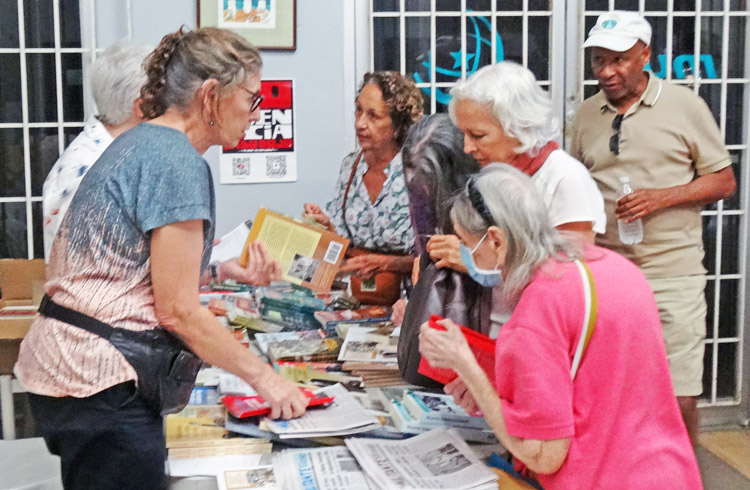
There is no better moment than now to learn about — and study — the example of Amílcar Cabral and the humble men and women he led to victory over the Portuguese colonial empire.
At no time has it been more necessary to spread the truth about Cuba’s socialist revolution and its example of proletarian internationalism in action, led by Fidel Castro and Che Guevara.
The reason is simple. It’s because the conflicts between the world’s most powerful nation states are sharpening at an increasing pace, as are the consequences for the oppressed and doubly exploited peoples everywhere. To take our own hemisphere as an example, we can see clearly that what we are living through is not a series of isolated events.
- The shock-and-awe commando raid to seize Venezuela’s president and his wife and confiscate the country’s vast oil reserves.
- The brutal energy blockade of more than 10 million human beings in Cuba, with all its devastation.
- Washington’s threat to “take back” the Panama Canal.
- The rulers’ success in “buying” Greenland in order to turn it into an imperialist military outpost in the Arctic.
- Their push to annex an oil-rich Canadian province as the 51st state of the U.S.
- And not least of all, the colonial sacking of Puerto Rico to pay off a debt to North American billionaires that they — not the people of Puerto Rico — created. As well as the remilitarization of Puerto Rican territory for use as a launching pad in current and coming wars throughout the Caribbean and Latin America.
None of this is due to the actions of a crude, egotistical president of the United States, drunk on his own enormous power and envisioning himself emperor of the world. It’s the deliberate course of an imperialist government advancing the bipartisan state policy of the ruling capitalist families.
The U.S. rulers are simply — openly — using the weapons available to them to maximize the natural resources, markets and profits under their control and to secure the militarily strategic territories their world domination requires — from Puerto Rico to the space frontier.
What we’re witnessing is the laws of capital at work — the only “international law” that is not just hypocritical bluster.
What we’re living through is something similar to the period leading up to World Wars I and II — spreading “regional” wars, trade wars, the battle to control vital resources and shifting alliances as all the “great” powers prepare for what is coming.
Now as then, there is only one power that can ultimately prevent the nuclear World War III that is already visible on a distant horizon — the action of united, class-conscious workers leading the toilers of the world. The only future for humanity is to make, defend, explain and extend the proletarian revolution that was opened in 1917 by the workers and peasants of the old czarist empire, and exemplified in our own time by the workers and farmers of Cuba and the opening of the socialist revolution in our hemisphere.
To bring together the forces necessary to achieve that, however, demands revolutionary leadership of the highest caliber on the national and international level. Leadership like that of Lenin and Trotsky, Fidel Castro, Che Guevara, Amílcar Cabral, Malcolm X. Leadership that can only — and will — emerge from the working-class resistance and struggles that are coming.
Today most working people can’t imagine we are capable of anything like that. That’s what capitalist social relations have conditioned us to believe.
How could the toilers of one of the smallest and least developed African countries — Guinea-Bissau — kept 99% illiterate by their colonial masters, bring down the oldest imperialist empire on the continent? How could they bring down the decayed fascist dictatorship of their oppressors in Portugal and change the history of Europe?
Most would say “Impossible!”
But it’s not impossible! That’s what they did.
And that’s why this book is important. Why it’s needed today.
Fidel explained it perfectly in his magnificent tribute to Che Guevara in 1987:
“Che believed in man. And if we don’t believe in man, if we think that man is an incorrigible little animal, capable of advancing only if you feed him grass or tempt him with a carrot, or whip him with a stick — anyone who believes this … will never be a revolutionary … will never be a socialist … will never be a communist. Our revolution is an example of what faith in man means. … [Our] revolution triumphed because we believed in man.”