The battle over tariffs unfolding between Washington and Beijing, and worldwide, is driven by the determination of the capitalist rulers in every country to defend their own national interests against all others, as the crisis of their dog-eat-dog system deepens. At the same time, they all move to intensify their exploitation of working people at home to boost their competitive position.
Washington has now “paused” reciprocal tariffs on many countries after 75 rival governments asked for talks, which points to the likelihood of concessions by the U.S. rulers’ competitors.
But the U.S. government has levied a massive 145% tariff on goods from China, and Beijing responded by placing tariffs of 125% on U.S.-made commodities in return.
Washington emerged as the world’s dominant imperialist power following its blood-soaked victory in World War II. Today, it seeks to shore up its weakening place at the head of the capitalist world “order” and push back the economic and military rise of Beijing.
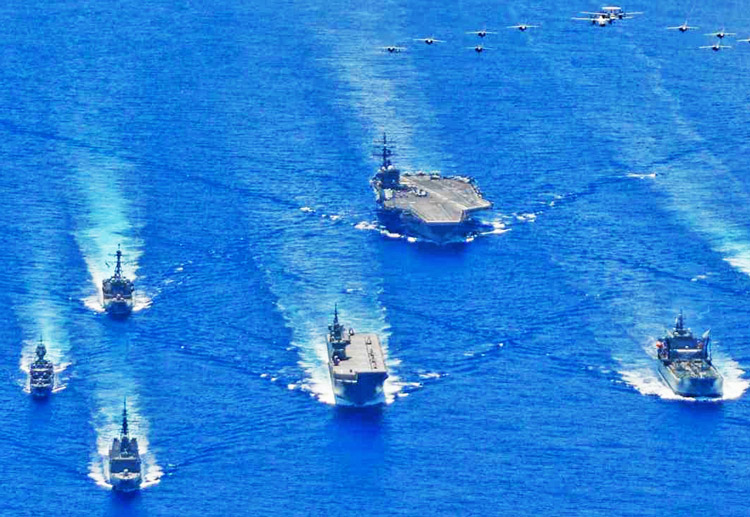
The Chinese rulers have extended their economic reach across Asia, Africa and Latin America and are deploying greater military clout, especially in the Pacific, as well as threatening to seize control over Taiwan. In response, the U.S. rulers are reinforcing their military alliances with the rulers of Japan, Australia and others in the region.
Long before the current trade clashes, political and military tensions were rising between the U.S. rulers and Beijing. In 2019 Washington banned Chinese-owned Huawei, the world’s largest cellphone and telecommunications company, claiming this company threatened U.S. “national security.” For its part, Beijing has banned U.S. arms manufacturers from the Chinese market.
What’s at stake for Washington in these clashes is both its military supremacy as well as its dominant place in investment and finance. Both are decisive in meeting the challenges the U.S. rulers face in today’s increasingly unstable world, as rival powers rearm and prepare for more wars. Military competition has deepened worldwide since Moscow’s invasion of Ukraine and the Oct. 7, 2023, deadly pogrom against Jews in Israel by Hamas.
When Trump launched his “Liberation Day” levy of tariffs against some 90 countries April 2, it triggered a sell-off on the stock market and a sharp fall in the price of U.S. Treasury bonds, long considered a “safe” asset by wealthy capitalist investors and foreign governments everywhere.
“People were getting a little queasy,” Trump said. These “people” — including the ruling capitalist class in the U.S. — consider as untouchable the interest payments they get from providing the government with credit. As the value of their bonds slumped, they found ways to let Trump know to back off. And he did so.
Trump announced April 11 additional exemptions from tariffs for companies that make smartphones, laptops, semiconductor chips and other electronic goods, saying he was giving bosses at these companies time to relocate their production from China to the U.S.
Each step by Washington and Beijing to target the other scuttles the illusion that we live in a rules-based world order where mounting clashes between nuclear-armed rival capitalists can be controlled.
What underlies capitalist trade conflicts is laid bare in a series of indispensable articles in the New International, published by leaders of the Socialist Workers Party.
“Every time we hear about one of these so-called trade deals on TV … what we’re watching unfold is the growing use of political and military clout to achieve economic ends,” writes Socialist Workers Party National Secretary Jack Barnes in “Imperialism’s march toward fascism and war” in New International no. 10.
“None of this has anything to do with advancing free trade, remedying unfair competition, or any of the other high-flown rationalizations emanating from the White House and bipartisan Congress. It’s the use of power to drain surplus value from wherever it’s produced by workers and toiling farmers into the pockets of capitalists in the United States.”
Crisis of capitalist overproduction
Some bosses welcomed Trump’s tariffs, saying they’re a necessary response to Beijing’s dumping of cut-price commodities on U.S. markets. The American Iron and Steel Institute said, “Government action to address this unloading of steel overproduction on world markets is overdue.”
Whenever bosses talk about overproduction, what they mean is there are more goods on the world market than they can sell for high enough profit. In response, they slash production, throw workers out of jobs and often dump goods on markets at rock bottom prices. The purpose of capitalist production is to maximize profit amid cutthroat competition for resources and markets. It has nothing to do with satisfying the unmet needs of billions for food, housing and other necessities.
Last year Beijing was targeted by the U.S.-led World Trade Organization a record number of times over allegations it dumped goods on world markets to boost Chinese exports. The rulers in Beijing are especially vulnerable to tariffs, as they depend heavily on exports of manufactured goods.
Trump claims tariffs are needed so that “jobs and factories will come roaring back into our country.”
But the failure of capitalists to increase investment in manufacturing in the U.S. over many years wasn’t a “mistake.” As profit rates fell at home, the ruling capitalist families turned to investing wherever they could get the highest return. Over decades they exported more and more capital to semicolonial countries, where they could pay workers less and exploit them more. Moreover, Trump’s call on working people to get behind Washington’s protectionist measures, seeks to boost “American” nationalism and turn workers in the U.S. against workers in China and elsewhere, dividing us from our real allies, billions of fellow working people who face the same class enemy and many of the same challenges we confront at home.
Imperialist investors and Chinese capitalists have long valued the no-strike pledges and low wages enforced by the regime in Beijing. But like elsewhere in the world, workers in China are seeking ways to resist the conditions foisted on them. In December, workers at Emei KVE Sporting Goods Co. in Sichuan province went on strike after bosses failed to make social security payments required for workers’ pensions.
Their action, one of many reported in the China Labour Bulletin, is a small glimpse of the class struggle unfolding there today, as conditions for Chinese workers worsen.
The unfolding trade battle and armaments escalation between Washington and Beijing points to one central lesson. Workers in both countries need to develop the political leadership necessary to advance the fight to establish our own governments, and work together for a world where humanity can move forward.
This is what the Socialist Workers Party is out to do.