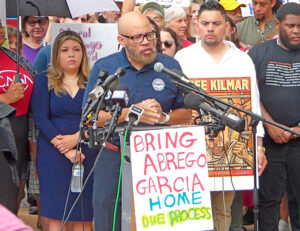
Several unions in the U.S. have recently stood up in defense of members threatened with deportation or losing their protected immigration status. This underlines the fact that the struggle for amnesty, for the legalization of all undocumented workers in the U.S., is completely intertwined with the strength of the labor movement.
Whether the labor movement will be able to fight effectively for better wages and working conditions is tied to its ability to convince workers — native- and foreign-born — that they need to band together.
If, on the other hand, the ruling class succeeds in convincing a significant section of the working class that immigrants should be treated as pariahs with lesser constitutional protections and legal rights, the struggles of all workers will be weakened.
In mid-July the New York Times ran an article about a film made 21 years ago, “A Day Without a Mexican.” The 2004 film depicts people in California waking up one day to find all Mexicans were gone, disappeared from agricultural fields, construction sites, meatpacking plants, Home Depot parking lots where they had been looking for work, and everywhere else. The Times said the film felt all too real today, as church attendance and store and street traffic plummeted in Los Angeles after Immigration and Customs Enforcement agents descended on the city and workers stayed home, afraid of being picked up.
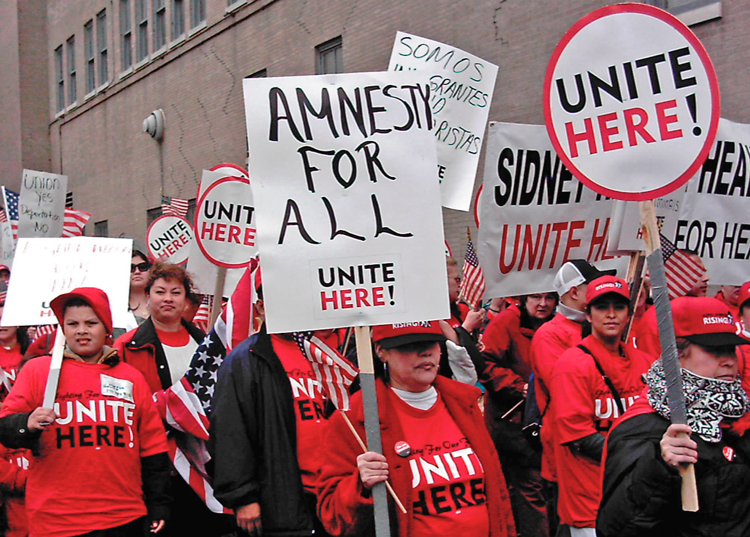
What was striking about the article, however, is that it made no mention of the historic mass mobilizations that took place May 1, 2006, under the slogan, “A Day Without an Immigrant.” Workplaces and stores were shut down. Two million people, in more than 140 cities in 40 states, took to the streets. Not out of fear, but to stand tall to oppose the Sensenbrenner bill, which would have made it a felony to live in the U.S. without papers.
Hundreds of thousands of workers nationwide were absent from their jobs, in many cases encouraged by their unions, and joined the demonstrations.
Discussions about the bill and the place of immigrant workers were abuzz everywhere. They drew in U.S.-born workers, who were impressed by the example of unity and determination displayed in the protests.
The conservative magazine National Review noted with alarm the rallies were “ominous … because of their hint of a large, unassimilated population existing outside of America’s laws and exhibiting absolutely no sheepishness about it.”
That is precisely what the bosses try to instill — “sheepishness,” by keeping a large pool of immigrants with fewer rights than the rest of the working class in fear of being deported. And immigrant workers were saying we’re not going to live in fear. “We are not criminals. We are workers!” was the battle cry of the demonstrators.
These powerful actions put the question of an amnesty on the national political agenda. The AFL-CIO joined with immigrant rights groups, like the Immigrant Workers Freedom Ride, to call for amnesty. Buses crossed the country rallying support for legalization. Many African Americans extended support, reminded of the original Freedom Rides, which helped build the movement that brought down Jim Crow segregation in the 1960s.
These demonstrations gave a boost to workers’ struggles and built on the success of strikes and other struggles over the previous decade.
Two landmark struggles showed how the incorporation of immigrants into the working class had strengthened the labor movement. One was the 1992 organizing drive that brought 4,000 drywallers, largely new immigrant workers, into the Carpenters union in Southern California. The other was the Justice for Janitors Campaign, which brought thousands of building janitorial workers into the Service Employees International Union in the 1990s.
Immigrants strengthen unions
Hanging drywall had traditionally been a well-paid union job for U.S.-born workers. But the bosses drove the unions out of the residential housing industry by replacing their members with undocumented immigrants, largely from Mexico. Similar offensives were launched by the bosses against the unions in other industries.
Before the strike, the Carpenters union didn’t attempt to unionize immigrant workers. Union officials would treat them as “scabs” for taking the jobs of union drywall workers. But this changed dramatically after these same immigrant workers approached the union for support as they led a six-month-long strike against the building contractors. It is well worth watching a video, “The 30th Anniversary of the 1992 Southern California Drywall Strike,” available on YouTube.
Today, in New York City alone, it is estimated that 40% of construction workers are undocumented. Among them are the “men and women out of nowhere” who will join and lead the union struggles to come.
Union leaders must reject the demagogy of capitalist politicians claiming to protect “American jobs” and fight to defend the basic right of all workers in the U.S. to a job.
The simple fact is the bosses are dependent on immigrant labor. This is shown by their objections to the government’s stepped-up attack on workers without papers in the agricultural, construction, hotel and restaurant industries. They’re concerned that the raids, deportations and revocation of Temporary Protective Status and other humanitarian parole programs are cutting too deeply into the pool of exploitable labor they need.
The goal of the ruling capitalist families is not to expel all undocumented immigrants, but rather to make their lives as precarious as possible so they keep their heads down and accept the second-class status the bosses seek to impose.
A call for mass actions against deportations and for amnesty would mobilize broad support right now, including among many who voted for Donald Trump, who reject the arrests and deportations of their neighbors, friends, and co-workers.
The attempts by the capitalist rulers to turn immigrant workers into scapegoats will not cease. As today’s crisis of capitalism deepens, the wealthy ruling families have no alternative but to deepen their brutal drive to lower the wages and living standards of working people as a whole. To do so, they need to foster divisions among the working class and weaken its capacity to fight back.
This is what is at stake in advancing the fight for amnesty, to unify the working class. This is the perspective the Socialist Workers Party promotes. We invite you to join us.